
Iranian Crypto Sanctions Evasion and Market Implications: Emerging Risks and Opportunities in Global Compliance
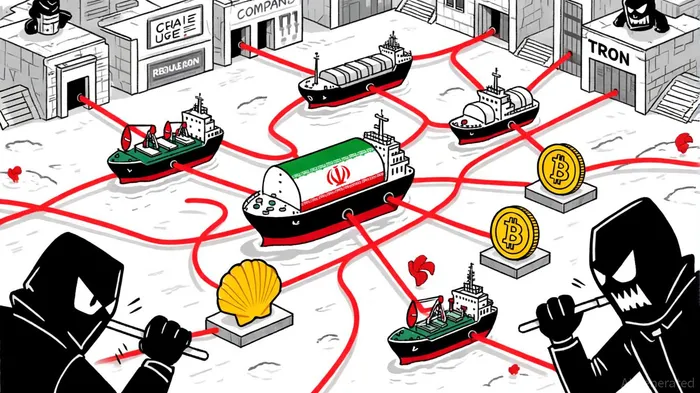
The Iranian regime's sophisticated use of cryptocurrency to circumvent U.S. and international sanctions in 2025 has created a volatile intersection of geopolitical risk and innovation in the global crypto compliance sector. As Iran's shadow banking networks and digital asset infrastructure evolve, they expose critical vulnerabilities in existing regulatory frameworks while simultaneously fueling demand for advanced compliance tools. For investors, this dynamic presents both existential threats and untapped opportunities in a sector poised for rapid transformation.
The Anatomy of Iran's Crypto Evasion Machine
Iran's sanctions-evasion strategy in 2025 hinges on a hybrid model of cryptocurrency, shadow banking, and maritime subterfuge. According to a report by Chainalysis, a shadow banking network coordinated by figures like Alireza Derakhshan and Arash Estaki Alivand moved $600 million in crypto inflows through jurisdictions such as Hong Kong and the UAE, directly funding the Islamic Revolutionary Guard Corps (IRGC) and its procurement of drone components and AI hardware [2]. This network operates via a web of shellSHEL-- companies, leveraging platforms like Nobitex—Iran's largest crypto exchange—which processed $3.7 billion in total volume between January and July 2025, with 87% of transactions routed through TRON's TRC-20 USDT and TRXTRX-- networks [1].
The regime's reliance on TRON-based stablecoins is no accident. These assets offer low transaction fees, fast processing, and a degree of anonymity that aligns with Iran's need to bypass traditional banking restrictions. However, this system is not without cracks. A June 2025 hack of Nobitex by a pro-Israel group siphoned $90 million in liquidity, exposing systemic cybersecurity weaknesses and the dual-use nature of Iran's crypto infrastructure—where economic survival and illicit operations coexist [1].
Risks for the Global Compliance Sector
Iran's crypto activities highlight three critical risks for the compliance industry:
Regulatory Arbitrage and Enforcement Gaps
While the Central Bank of Iran (CBI) has imposed stricter oversight—mandating direct supervision of crypto exchanges and introducing capital gains taxes [3]—these measures primarily serve to consolidate state control rather than eliminate illicit flows. The regime's ability to formalize crypto under its own rules creates a precedent for other sanctioned regimes to exploit regulatory loopholes, forcing compliance providers to adapt to a patchwork of conflicting legal standards.Cybersecurity Vulnerabilities
The Nobitex breach underscores the fragility of Iran's crypto infrastructure. For global compliance firms, this signals a growing need for real-time threat detection and incident-response tools tailored to high-risk jurisdictions. As noted by TRMMPTI-- Labs, even “illicit activity” in Iranian exchanges remains relatively low (0.9% of total volume), but the potential for large-scale breaches or ransomware attacks remains a wildcard [1].Shadow Banking's Resilience
Iran's shadow banking networks, which combine crypto with traditional financial instruments like UAE-based exchange houses, demonstrate the limitations of current AML/KYC protocols. These hybrid systems thrive in jurisdictions with weak enforcement, such as Hong Kong and the UAE, where shell companies act as intermediaries for oil sales and military procurement [3]. For compliance providers, this demands advanced analytics capable of mapping cross-border transaction patterns and identifying “dark fleet” operations linked to crypto inflows.
Opportunities in Compliance Innovation
The same challenges that define Iran's evasion strategies also point to lucrative opportunities for firms specializing in crypto compliance:
Blockchain Forensics and AI Monitoring
The surge in TRON-based transactions has created a niche for firms offering TRC-20-specific tracking tools. Companies like TRM Labs and Chainalysis are already developing AI-driven platforms to trace stablecoin flows and detect AIS manipulation in maritime trade [1][3]. Investors in these firms stand to benefit from increased demand for granular, jurisdiction-specific compliance solutions.Regulatory Tech (RegTech) for Sanctions Screening
Iran's use of shell companies and front entities highlights the need for RegTech platforms that integrate sanctions lists with real-time transaction data. Startups leveraging graph analytics to map corporate ownership chains—such as those targeting UAE and Hong Kong's opaque exchange houses—could see exponential growth as enforcement agencies ramp up pressure [3].Cybersecurity for High-Risk Markets
The Nobitex hack has elevated cybersecurity to a non-negotiable requirement for crypto exchanges in sanctioned regimes. Firms offering zero-trust architectures, multi-signature wallets, and threat intelligence feeds tailored to Middle Eastern and Asian markets are well-positioned to capture a growing share of this demand [1].
The Geopolitical Tightrope
For investors, the key challenge lies in balancing exposure to compliance innovation with the inherent risks of engaging with Iran's ecosystem. While the regime's crypto activities are a magnet for geopolitical volatility—exacerbated by incidents like the Nobitex hack—they also represent a unique testing ground for next-generation compliance tools.
As the U.S. and its allies continue to sanction Iranian shadow banking networks [2][3], the pressure on compliance providers to innovate will only intensify. The question is not whether Iran will adapt to new sanctions, but how quickly the global compliance sector can evolve to keep pace.






Comentarios
Aún no hay comentarios