
Iranian Crude Stockpile Hits 52M Barrels at Sea, Pressuring Oil Prices
The amount of Iranian crude oil held on tankers at sea has surged to the highest level in two-and-a-half years, reaching about 52 million barrels, according to shipping-intelligence firm Kpler. Much of the stockpile is floating off the coast of Malaysia, where roughly half of the total is currently stored. The buildup reflects slower demand from China, Iran's largest buyer, as Chinese refiners face restrictions on import quotas and U.S. sanctions on key terminals like Rizhao. The situation has pushed discounts on Iranian crude, such as Iran Light, to widen by up to $8 a barrel compared to the global benchmark Brent according to Bloomberg.
Despite the sanctions, Iranian exports have reached their fastest pace in seven years, driven by a global oil market already oversupplied with crude. OPEC+ is loosening production curbs, and other major producers continue to increase output, leading to an abundance of oil in storage and on tankers. This dynamic is creating pressure on oil prices, which have already dropped by more than 15% in 2025 according to Bloomberg.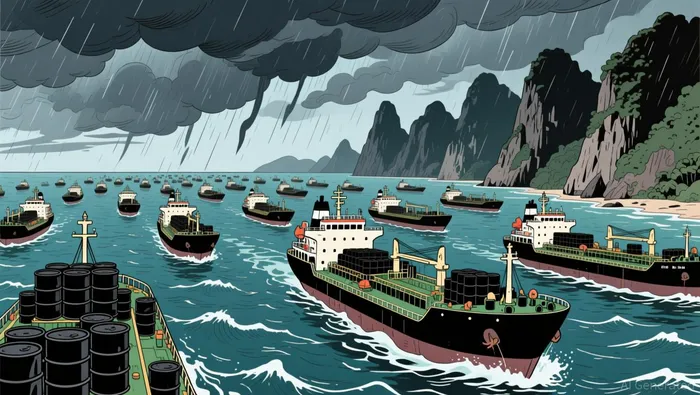
The pile-up of Iranian crude at sea is part of a broader trend of global overstocking, with tankers carrying crude for extended periods as buyers delay taking delivery. J.P. Morgan analysts warn that without production cuts, oil prices could plunge into the $30s by the end of 2027, with global supply growing three times faster than demand in 2025 and 2026. The forecast is based on an assumption that the market will struggle to find equilibrium until a combination of lower prices and voluntary or involuntary production cuts take effect.
Why the Standoff Happened
China's appetite for Iranian crude has waned, partly due to U.S. sanctions on key terminals in the country. These sanctions have hindered the discharge of shipments, forcing some tankers to divert to alternative ports and increasing delays. Chinese private refiners, or "teapots," are also facing a shortage of import quotas needed to bring in crude from overseas, further reducing their demand. The country's state-owned refiners, including Sinopec and PetroChina, have canceled previously ordered shipments from Russia, adding to the broader slowdown in crude imports according to OilPrice.
The smaller independent refiners in Shandong are more willing to take sanctioned barrels due to the heavy discounts, but they too are constrained by the lack of available government quotas. Sanctions on Shandong Yulong Petrochemical, a new entrant in the refining sector, have further complicated the picture for these smaller players according to OilPrice.
Risks to the Outlook
The growing stockpile of Iranian crude is compounding an already fragile oil market. Saudi Aramco, another major player, has also taken steps to raise capital through asset sales, as oil prices have fallen by about 20% this year. The firm is considering its biggest disposals yet, moving beyond pipeline infrastructure to include product terminals in key trade hubs. These moves reflect a broader shift as OPEC+ and other producers struggle to balance supply with weakening global demand.
Meanwhile, discussions between Moscow and Beijing on expanding Russian oil exports to China add another layer of complexity. Russian Deputy Prime Minister Alexander Novak highlighted plans to extend oil supply agreements through 2033, signaling a long-term strategy to shift crude flows away from Western buyers. The U.S. sanctions on Rosneft and Lukoil have not stopped this trend, with private refiners in China adapting to sanctions through ship-to-ship transfers and other logistical workarounds according to OilPrice.
What This Means for Investors
Investors are closely watching how these developments affect oil prices and global energy markets. StoneX Group Inc., a major player in the energy derivatives sector, reported strong financial results in its fiscal 2025 fourth-quarter earnings, with net operating revenues up 26% year-over-year. The firm's performance highlights the volatility in the sector and the importance of adapting to shifting market conditions. Energy ETFs, such as the Energy Select Sector SPDR Fund, have seen mixed performance, reflecting the uncertainty in the broader market.
The potential for a Russia-Ukraine peace deal is also influencing investor sentiment. While such a deal could ease geopolitical tensions, it could lead to an increase in Russian oil exports, further pressuring prices in an already oversupplied market. The Trump administration's pressure on Ukraine has led to speculation about the effectiveness of sanctions on Rosneft and Lukoil, with some analysts suggesting that confidence in strict enforcement is fading.
With oil prices near one-month lows and global demand showing signs of softening, the market is bracing for continued volatility. The interplay between sanctions, supply surpluses, and geopolitical developments will likely shape the energy landscape in the months ahead.







Comentarios
Aún no hay comentarios