
Iran's Internet Blackout and the Resilience of Bitcoin: Geopolitical Risks and Hashpower Redistribution in Crypto Infrastructure Investment
The 2025 internet blackout in Iran, a 12-day digital siege orchestrated through DNS poisoning, protocol whitelisting, and Deep Packet Inspection (DPI), has exposed the fragility of centralized infrastructure in times of geopolitical conflict. While the Iranian government justified the blackout as a defensive measure against Israeli cyberattacks, the economic toll was staggering: $1.5 million in losses per hour, disrupted evacuation efforts, and a public trust crisis. For the crypto ecosystem, the blackout underscored both Bitcoin's inherent resilience and the vulnerabilities of regional mining infrastructure. As hashpower redistribution accelerates amid geopolitical turbulence, investors must recalibrate their strategies to account for energy policy, regulatory crackdowns, and the strategic weaponization of digital infrastructure.
The Blackout's Impact on BitcoinBTC-- Mining: A Test of Resilience
Iran contributes approximately 4.2% of the global Bitcoin hashrate, a figure that, while non-dominant, highlights its role in the network's geographic diversification. During the blackout, industrial mining operations continued due to their reliance on stable power and intermittent connectivity. However, smaller and illicit miners-accounting for over 95% of Iran's mining activity-faced operational paralysis, including delayed firmware updates and coordination failures with mining pools.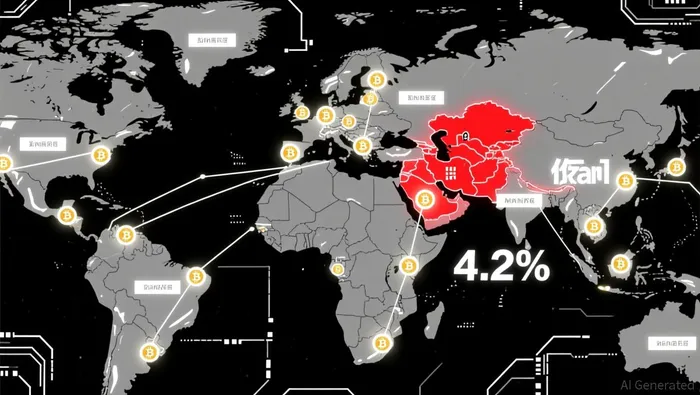 This fragility exposed a critical truth: while Bitcoin's decentralized protocol remains robust, its physical infrastructure is vulnerable to localized disruptions.
The blackout also amplified broader trends. Iran's crypto inflows have already declined amid escalating tensions with Israel, exemplified by the $90 million hack of Nobitex, the country's largest exchange. Simultaneously, the government intensified its crackdown on unregulated mining, seizing devices and cutting off subsidized electricity-a move aimed at curbing capital flight and asserting control over a sector it views as a threat to economic stability. These developments signal a shift: hashpower is no longer just a technical metric but a geopolitical asset, subject to the same risks as oil or rare earth minerals.
Hashpower as a Geopolitical Battleground
The redistribution of Bitcoin mining activity post-blackout mirrors a global realignment driven by energy policy and political stability. Iran's 4.2% hashrate, though modest, represents a potential flashpoint in a broader conflict where hashpower could be weaponized. Analysts warn that sustained instability in Iran may push miners to migrate to jurisdictions with cheaper, renewable energy and less regulatory hostility-such as Kazakhstan, Russia, or even North Africa. This migration, however, introduces new risks: over-reliance on energy-rich autocracies could centralize hashpower in regions with their own geopolitical agendas.
The 2025 blackout also echoes the 2021 Chinese mining ban, which saw hashrate shift to the U.S. and Central Asia. Yet unlike China's abrupt exodus, Iran's transition is gradual and fragmented, with illicit miners operating in a regulatory gray zone. This duality-state control versus decentralized innovation-creates a paradox for investors: while Bitcoin's protocol remains resilient, its infrastructure is increasingly shaped by the same forces that destabilize traditional markets.
Implications for Crypto Infrastructure Investment
For investors, the Iranian case underscores three key principles:
Energy Arbitrage and Political Risk: Mining profitability hinges on access to cheap, reliable energy. However, as Iran's blackout demonstrates, even energy-rich regions face risks from geopolitical volatility. Investors must prioritize jurisdictions with both low energy costs and stable governance-such as Canada, Scandinavia, or parts of South America-while hedging against exposure to conflict zones.
Decentralized Infrastructure as a Hedge: The blackout highlighted the limitations of centralized systems (e.g., Google Maps' inaccessibility during evacuations). Similarly, over-concentration of hashpower in any single region-whether China, Iran, or Kazakhstan-introduces systemic risks. Diversifying mining infrastructure across geographies and energy sources (e.g., renewables, stranded gas) can mitigate these vulnerabilities.
Regulatory Adaptability: Governments are increasingly treating hashpower as a strategic resource. Iran's crackdown on illegal mining and its misinformation campaigns reflect a broader trend of regulatory overreach. Investors must prioritize compliance-friendly models, such as institutional-grade mining pools or partnerships with state-sanctioned entities, to navigate evolving legal landscapes.
Conclusion: The New Normal for Crypto Infrastructure
Bitcoin's resilience during the 2025 blackout reaffirms its value as a decentralized store of value. Yet the incident also serves as a cautionary tale: the physical layer of the network remains exposed to geopolitical shocks. For investors, the path forward lies in balancing energy efficiency with political stability, decentralization with operational scalability, and innovation with regulatory pragmatism. As hashpower becomes a geopolitical asset, the winners in crypto infrastructure will be those who treat it not just as a technical challenge, but as a strategic imperative.






Comentarios
Aún no hay comentarios