
Iran's Currency Collapse: A Tipping Point for Geopolitical Risk and Commodity Arbitrage Opportunities?
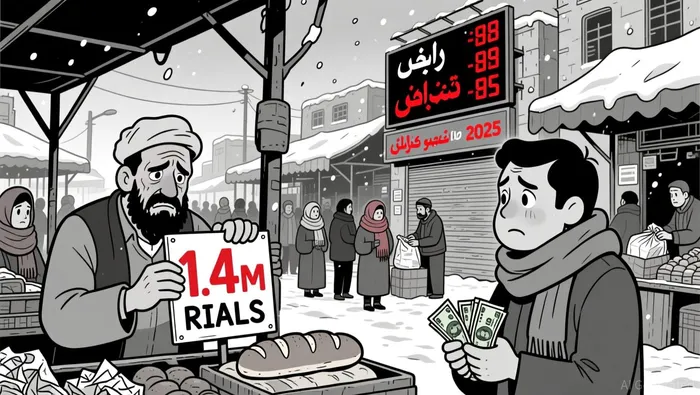
The Iranian rial's collapse in late 2025 has reached a critical inflection point, with the currency hitting 1.445 million rials to the U.S. dollar by December 28, 2025. This devaluation, driven by years of U.S. sanctions, fiscal mismanagement, and geopolitical tensions, has pushed inflation to 42.4%-a level that threatens to destabilize not just Iran but the broader Middle East. As the rial's free-market value diverges sharply from its official rate, the crisis has created a unique intersection of geopolitical risk, commodity arbitrage opportunities, and regional economic fragility. For investors, the question is no longer whether to act but how to position for a world where Iran's economic unraveling reshapes trade flows, asset classes, and global stability.
The Rial's Collapse: A Catalyst for Geopolitical Risk
Iran's economic crisis is no longer a domestic issue. The rial's depreciation has accelerated food insecurity, with essential goods like medical supplies and fuel rising by 50–72%, sparking nationwide protests. Meanwhile, the Strait of Hormuz-a critical artery for 20% of global crude oil- faces renewed risks as regional tensions between Iran and Israel escalate. A report by the U.S. Energy Information Administration highlights that even minor disruptions in this chokepoint could trigger a 20–30% spike in oil prices.
The U.S. and its allies have intensified sanctions, particularly after the UK, France, and Germany reinstated measures in 2025. These actions have crippled Iran's oil exports, which account for 40% of its total exports, and forced the government into a "resistance economy" model reliant on austerity and fiscal tightening. Yet, as the World Bank warns, Iran's GDP is projected to contract by 1.7% in 2025 and 2.8% in 2026, with public discontent likely to fuel further instability.
Commodity Arbitrage: Gold, Oil, and the Rial's Shadow
The rial's collapse has created fertile ground for arbitrage in commodities. Gold, for instance, has surged to $4,600 per ounce in early 2026 as Iranians and global investors seek safe-haven assets. This surge is not merely a local phenomenon; it reflects broader anxieties about the U.S. Federal Reserve's independence amid political polarization. For investors, the gap between the rial's official and black-market rates offers a compelling opportunity to exploit gold's price differential in Iran versus global benchmarks.
Oil markets, however, present a more nuanced picture. While Iran's oil exports hit a seven-year high in 2025-suggesting early signs of sanctions fatigue- the country's production remains constrained by U.S. pressure. Chinese refiners are importing Iranian crude at 30% discounts due to fragmented markets, creating arbitrage potential between Iranian oil and Brent crude. However, this opportunity is shadowed by the risk of renewed U.S. sanctions under a potential Trump administration, which could further depress Iran's output.
Emerging Market Debt: A High-Risk Bet in a Fractured Region
Emerging market (EM) debt in the Middle East has become increasingly volatile. Iran's crisis has spooked investors, with regional sovereign spreads widening as countries like Sudan and Lebanon face their own debt crises. The International Monetary Fund notes that public debt in the Middle East now exceeds 70% of GDP in several nations, compounding the risks of contagion.
For now, EM debt remains a speculative bet. While the S&P 500 and global bond markets have largely shrugged off Middle East tensions, the risk of spillover into oil-dependent economies like Saudi Arabia and the UAE remains high. A Fitch Ratings analysis underscores that any escalation in the Iran-Israel conflict could trigger a regional credit downgrade, particularly for countries reliant on oil exports.
Hard Currency Alternatives: The Dollar's Resurgence
As the rial collapses, hard currencies like the U.S. dollar and euro have gained traction in Iran's informal economy. By December 2025, the rial had depreciated to 1.32 million per dollar, with the euro also seeing increased demand. This trend mirrors historical patterns in hyperinflationary economies, where fiat currencies lose trust and hard assets dominate.
For investors, this dynamic suggests a near-term advantage in dollar-denominated assets. The Bloomberg Dollar Index has risen 8% in Q4 2025 as capital flows into U.S. Treasuries and dollar-pegged commodities. However, this strategy carries long-term risks if the U.S. dollar's hegemony weakens amid global multipolarity.
Strategic Positioning: Balancing Risk and Reward
The Iranian crisis demands a diversified approach. For commodities, gold and oil remain the most compelling plays. Gold's role as a geopolitical hedge is well-established, while oil's price volatility offers opportunities in both physical and futures markets. However, investors must hedge against the risk of a U.S.-China trade war or OPEC+ supply shocks, which could disrupt these positions.
In EM debt, caution is warranted. While some regional economies (e.g., Turkey, Egypt) show resilience, others are teetering on the edge of default. A better bet may lie in sovereign bonds of countries with strong fiscal buffers, such as the UAE or Saudi Arabia, which are less exposed to Iran's instability.
Finally, hard currencies-particularly the dollar-should remain a core holding. The U.S. dollar's dominance in global trade and its role as a safe haven during crises make it a logical choice for risk-averse investors. However, diversification into euros or Swiss francs could provide additional stability.
Conclusion: A Tipping Point for Global Markets
Iran's rial collapse is more than a local crisis-it is a harbinger of broader geopolitical and economic shifts. As sanctions fatigue, regime change risks, and commodity arbitrage opportunities converge, investors must act decisively. The next 12–18 months will test the resilience of global markets, with the Strait of Hormuz, gold prices, and EM debt volatility serving as key barometers. For those who position early, the rewards could be substantial-but the risks, if miscalculated, are equally profound.







Comentarios
Aún no hay comentarios