
IPO Underwriting Fee Efficiency and Investor Value Creation: A Comparative Analysis of India's Main Board and SME Segments
The efficiency of IPO underwriting fee structures in India has emerged as a critical factor influencing investor value creation, particularly as the country's capital markets navigate a surge in listings across both Main Board and SME segments. Recent data reveals stark contrasts in fee structures, subscription dynamics, and long-term performance between these two segments, offering valuable insights for investors and policymakers.
Underwriting Fee Structures: Cost Efficiency and Regulatory Frameworks
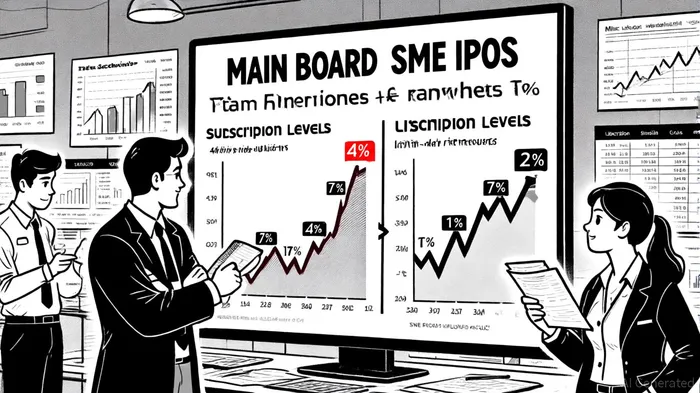
Underwriting fees for Main Board IPOs in India typically range from 4% to 7% of gross proceeds, reflecting the complexity and regulatory rigor associated with larger, more established companies, according to an IPO cost guide. In contrast, SME IPOs incur significantly lower fees, averaging 1% to 2% of the issue size, as shown in an SME IPO cost breakdown. This cost disparity is further amplified by regulatory distinctions: SME IPOs mandate 100% underwriting, with at least 15% of the underwriting obligation borne by the merchant banker, as highlighted in a comparative analysis, whereas Main Board IPOs allow for optional underwriting provided 50% of allocations go to Qualified Institutional Bidders (QIBs), according to an eligibility guide.
These structural differences underscore a trade-off between cost efficiency and risk mitigation. SME IPOs, with their rigid underwriting requirements, ensure full subscription but face lower demand due to perceived higher risk. Main Board IPOs, while more expensive to underwrite, benefit from broader investor confidence and liquidity.
Performance Metrics: Short-Term Gains and Long-Term Uncertainty
The performance of IPOs in FY25 highlights the divergent trajectories of these segments. Main Board IPOs, such as Vibhor Steel Tubes Ltd (195.53% listing-day return) and BLS E-Services Ltd (171.11%), demonstrated strong short-term returns, according to an FY25 IPO review. SME IPOs, however, outperformed in volatility and listing-day gains, with Vinsol Engineers Ltd (411%) and Kay Cee Energy & Infra Ltd (343.33%) leading the pack, per an IPO performance tracker.
Yet, long-term value creation remains elusive. A 2020 study found that while prestigious underwriters positively influence underpricing in SME IPOs, their reputation does not correlate with sustained performance, according to a 2020 SAGE study. Similarly, Main Board IPOs, despite their stability, face challenges in translating initial gains into enduring shareholder value. This suggests that underwriting fees-while critical for pricing efficiency-do not inherently guarantee long-term returns.
Investor Value Creation: Balancing Costs and Returns
The interplay between underwriting fees and investor returns is nuanced. For SME IPOs, lower fees (1–2%) reduce the drag on net proceeds, potentially enhancing capital deployment for growth. However, the lack of long-term performance data raises questions about whether these savings translate to sustained value. Main Board IPOs, with higher fees (4–7%), often involve more rigorous due diligence and investor outreach, which may mitigate post-listing volatility but come at the cost of reduced capital availability for issuers, as noted in an underwriting fees analysis.
A 2024 study on auctioned IPOs in China offers indirect insights: long-term underwriter-investor relationships improve pricing efficiency and reduce free-riding behaviors, as shown in a study on auctioned IPOs. While India's market dynamics differ, the principle of aligning underwriting incentives with information production remains relevant. For instance, incentive-based fees-where underwriters receive additional compensation tied to post-listing performance-could bridge the gap between short-term pricing and long-term value creation.
Policy Implications and Future Outlook
India's IPO market is poised for continued growth, with SEBI approving 24 IPOs and 62 pending approvals as of October 2025, according to the FY25 IPO review. To enhance investor value creation, policymakers could consider:
1. Standardizing incentive-based underwriting fees to align underwriter interests with long-term company performance.
2. Enhancing transparency in SME IPOs by mandating extended market-making requirements beyond the current three-year period, as suggested in the comparative analysis.
3. Encouraging retail participation through educational initiatives, given the rising retail investor interest in SME IPOs, as discussed in a mainboard vs SME primer.
Conclusion
India's IPO market presents a compelling case study in the balance between underwriting efficiency and investor value creation. While SME IPOs offer cost advantages and explosive short-term gains, their long-term viability remains unproven. Main Board IPOs, though more expensive, provide stability but lack mechanisms to ensure sustained returns. As the market evolves, a recalibration of fee structures and regulatory frameworks will be essential to align underwriting incentives with the broader goal of long-term value creation.







Comentarios
Aún no hay comentarios