
Is IonQ a Viable Millionaire-Maker Stock in the Quantum Computing Era?
The quantum computing revolution is no longer a distant promise but an emerging reality, with companies like IonQIONQ-- at the forefront of technological innovation. As the sector races toward scalable, fault-tolerant systems, investors are scrutinizing which players can deliver exponential returns. IonQ, a pioneer in trapped-ion quantum computing, has positioned itself as a key contender. This analysis evaluates whether IonQ's unique technology, competitive advantages, and market dynamics make it a viable "millionaire-maker" stock in the quantum era.
Trapped-Ion Technology: A Foundation for Quantum Supremacy
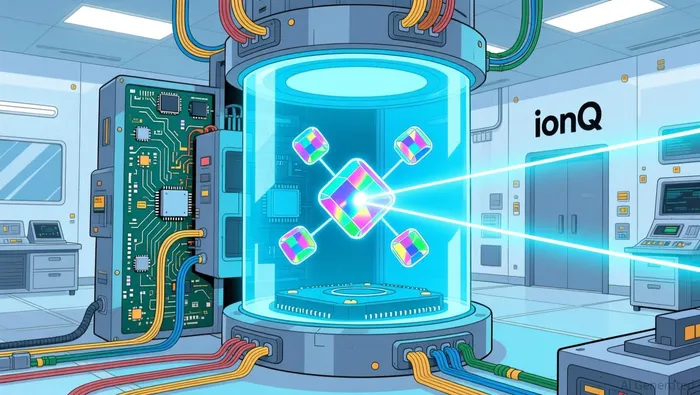
IonQ's trapped-ion architecture distinguishes it from superconducting qubit-based competitors like IBM and Google. Trapped ions, naturally identical and stable, offer 99.99% two-qubit gate fidelity-a world record achieved in October 2025 according to IonQ-and coherence times orders of magnitude longer than superconducting qubits as reported in analysis. These metrics are critical for executing deep, error-resistant quantum circuits, enabling applications in drug discovery, logistics, and materials science as per IonQ's roadmap.
Recent engineering breakthroughs, such as the "enchilada trap" developed at Sandia National Laboratories, have further advanced scalability. This innovation allows up to 200 ions to be stored in a single trap, reducing power dissipation and paving the way for larger qubit counts according to quantum industry analysis. IonQ's roadmap-100 physical qubits in 2025, 10,000 by 2027, and 2 million by 2030 as detailed in their official blog-is underpinned by strategic acquisitions, including Lightsynq for photonic interconnects and Oxford Ionics for high-density ion traps as reported in their roadmap. These moves address the sector's most persistent challenge: scaling quantum systems without compromising performance.
Competitive Positioning: Trapped-Ion vs. Superconducting Qubits
While IBM and Google focus on superconducting qubits, IonQ's trapped-ion approach offers inherent advantages. Superconducting qubits require cryogenic environments and face decoherence challenges, whereas trapped ions operate at room temperature and maintain stability as analyzed in industry reports. IBM's roadmap targets 4,000 qubits by 2025 according to industry forecasts, but its error rates and scalability hurdles remain unresolved. Google, meanwhile, aims for error-corrected logical qubits by 2029 as reported in market analysis, but its reliance on fragile superconducting materials introduces technical risks.
IonQ's partnerships with industry leaders like AstraZeneca, AWS, and NVIDIA underscore its commercial viability. A 20x speedup in quantum-accelerated drug development workflows and breakthroughs in quantum chemistry simulations as demonstrated in their research demonstrate tangible value creation. By 2030, IonQ projects logical error rates as low as 1E-12, a threshold necessary for enterprise-grade operations as outlined in their roadmap, further solidifying its edge in fault-tolerant computing.
Market Expectations and Investor Sentiment
IonQ's stock has delivered a 983.2% return over three years according to financial analysis, reflecting investor confidence in its technology and growth potential. However, its valuation remains contentious. A price-to-book (P/B) ratio of 7.7x as reported by financial analysts far exceeds the U.S. Tech industry average of 2.2x, signaling both optimism and overvaluation risks. Critics argue that quantum computing's commercialization timeline is uncertain, with revenue growth potentially lagging behind hardware advancements.
Yet, the sector's trajectory is robust. The quantum computing market is projected to grow from $1.07 billion in 2024 to $2.2 billion by 2027 according to industry data, driven by $2.6 billion in venture capital investments and $44.5 billion in global public funding as detailed in market research. IonQ's $24.5 billion market cap as reported in financial analysis and 68% year-over-year revenue growth position it as a leading pure-play stock. Its integration with cloud platforms like AWS and Azure as described in industry analysis also aligns with the rising trend of Quantum-as-a-Service (QaaS), democratizing access and accelerating adoption as noted in market trends.
Risks and Mitigations
Despite its strengths, IonQ faces challenges. Decoherence and error correction remain industry-wide hurdles, though IonQ's Electronic Qubit Control (EQC) technology-replacing lasers with precision electronics-enhances stability and scalability as reported in technical results. Hybrid quantum-classical workflows further mitigate risks by leveraging classical computing for error correction as discussed in community forums.
The company's aggressive roadmap hinges on successful execution. Delays in scaling to 2 million physical qubits by 2030 could erode investor confidence. However, its partnerships with academic institutions and industry leaders as detailed in their roadmap provide a buffer against technical roadblocks.
Conclusion: A High-Risk, High-Reward Proposition
IonQ's trapped-ion technology, combined with its strategic acquisitions and commercial partnerships, positions it as a leader in the quantum computing race. Its ability to achieve 99.99% gate fidelity as demonstrated in technical results and scale to 2 million physical qubits as outlined in their roadmap by 2030 could unlock transformative applications in healthcare, climate modeling, and AI. However, its elevated valuation demands scrutiny. For investors willing to tolerate volatility, IonQ represents a compelling bet on the quantum future-provided it can maintain its technical edge and meet ambitious scaling targets.
In the quantum era, the path to a "millionaire-maker" stock lies not just in innovation but in execution. IonQ has laid the groundwork; now, it must deliver.





Comentarios
Aún no hay comentarios