
IonQ vs. Rigetti Computing: Which Quantum Stock Offers a Better Path to Quantum Advantage?
The race for quantum computing dominance has intensified in 2025, with IonQIONQ-- and Rigetti ComputingRGTI-- emerging as two of the most prominent pure-play stocks in the sector. While both companies are advancing toward the elusive goal of quantum advantage, their divergent technological approaches, financial trajectories, and valuation multiples paint a starkly different picture of their long-term potential. This analysis evaluates which stock offers a more compelling investment thesis by dissecting their technical roadmaps, revenue growth, and valuation realism.
Technological Differentiation: Trapped-Ion Precision vs. Modular Superconducting Scalability
IonQ's trapped-ion technology has consistently demonstrated a critical edge in quantum gate fidelity, a metric that directly impacts the feasibility of fault-tolerant computing. As of 2025, IonQ achieved a world-record two-qubit gate fidelity of 99.99%, significantly outpacing Rigetti's 99.5% median two-qubit gate fidelity for its Cepheus-1-36Q system according to reports. This precision reduces the overhead required for error correction, accelerating the path to practical quantum advantage. IonQ's roadmap emphasizes global commercial expansion and full-stack integration, with plans to deploy interconnected fault-tolerant systems by 2028 and scale to 2 million physical qubits by 2030.
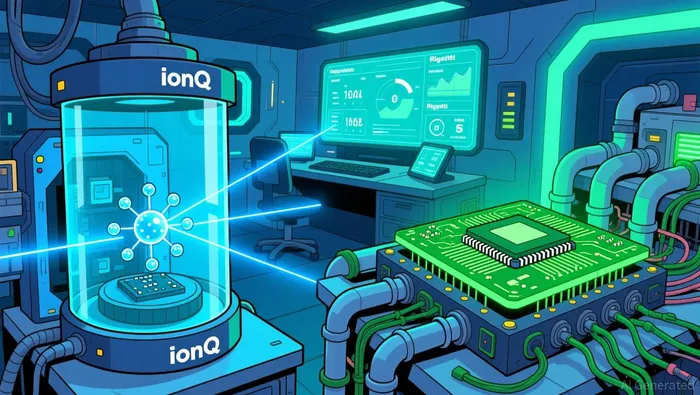 Rigetti, by contrast, is betting on modular superconducting qubits and chiplet-based architectures to achieve scalability. Its 2025 roadmap includes delivering a 100+ qubit system by year-end and scaling to 1,000+ qubits by 2027. While this approach mirrors semiconductor-style scaling, it faces inherent challenges in maintaining coherence and fidelity as qubit counts rise. Rigetti's recent $5.8 million Air Force contract to advance superconducting quantum networking highlights its focus on defense applications, but its reliance on government partnerships raises questions about long-term commercial viability.
Growth Trajectories: Explosive Revenue vs. Declining Revenues
IonQ's financial performance in 2025 has been nothing short of meteoric. The company reported a 222% year-over-year revenue increase in Q3 2025, reaching $39.9 million-37% above its guidance-and has grown nearly 2000% since 2021. This growth is driven by enterprise and government adoption of its quantum platform, bolstered by strategic acquisitions like Oxford Ionics and Vector Atomic. Analysts project IonQ's revenue to grow at a 94% CAGR through 2027, reaching $316 million.
Rigetti, however, has struggled to convert technical progress into revenue. Its Q3 2025 revenue declined 18% year-over-year to $1.95 million, despite securing a $5.8 million Air Force contract according to reports. With a projected 63% CAGR through 2027 (reaching $47 million in revenue), Rigetti's growth remains heavily dependent on government funding and academic collaborations, such as its partnership with India's Centre for Development of Advanced Computing. The company's Q3 2025 net loss of $201 million underscores the financial risks of its R&D-heavy strategy.
Valuation Realism: A Tale of Two Price-to-Sales Ratios
IonQ trades at a price-to-sales (P/S) ratio of 55.9 based on 2027 estimated sales according to analysis, while Rigetti's P/S ratio is a staggering 177.7 according to market data. At first glance, IonQ's lower multiple appears more attractive, but this must be contextualized with its explosive revenue growth and stronger cash position ($3.5 billion pro forma after a $2 billion equity offering). Rigetti's higher P/S ratio reflects its speculative nature and reliance on long-term scalability promises, which remain unproven.
The disparity in valuations also highlights differing investor perceptions of risk. IonQ's trapped-ion technology, with its demonstrated fidelity and enterprise partnerships (e.g., Oak Ridge National Laboratory, Geneva's quantum network), offers a clearer path to commercialization. Rigetti's modular roadmap, while ambitious, faces near-term technical hurdles in maintaining coherence across chiplets and scaling to 1,000+ qubits.
Conclusion: IonQ's Balanced Approach Outpaces Rigetti's High-Risk Bet
While both companies are advancing quantum computing, IonQ's combination of technical leadership, explosive revenue growth, and stronger commercial traction justifies its lower P/S ratio. Its trapped-ion technology provides a defensible edge in gate fidelity, reducing the need for extensive error correction and accelerating the timeline for quantum advantage. Rigetti's modular superconducting approach, though promising, remains a high-risk, high-reward proposition with uncertain scalability and revenue potential.
For investors seeking a more balanced bet in the quantum computing race, IonQ's disciplined execution and global partnerships position it as the clearer winner in 2025. RigettiRGTI--, while innovative, may require a higher tolerance for volatility and a longer time horizon to realize its vision.







Comentarios
Aún no hay comentarios