
Is IonQ a Quantum Nvidia or a Quantum Dot-Com?
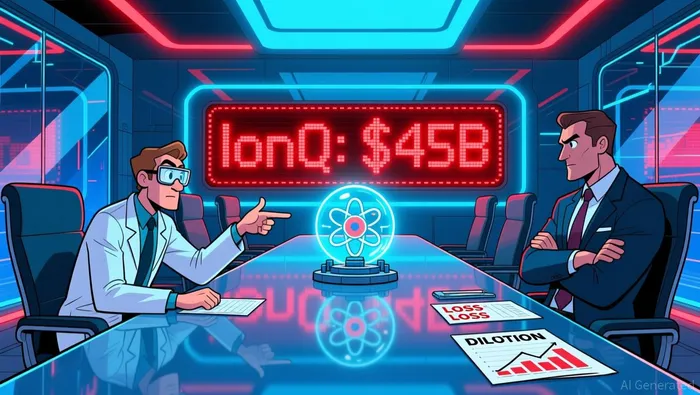
The quantum computing sector has become a battleground for investors weighing the promise of revolutionary technology against the risks of speculative overvaluation. At the center of this debate is IonQIONQ--, a company that has captured headlines with record-breaking revenue growth, technical milestones, and a recent $2 billion equity offering that triggered a sharp selloff. As the market grapples with whether IonQ is the "Nvidia of quantum computing" or another dot-com-era cautionary tale, the stakes for investors hinge on two critical questions: Can IonQ justify its valuation through sustainable commercialization, and is its aggressive capital-raising strategy a path to growth or a recipe for shareholder dilution?
The Revenue Surge and the Shadow of Losses
IonQ's third-quarter 2025 results underscored its dual identity as a high-growth innovator and a cash-burning work in progress. The company reported $39.9 million in revenue, a 222% year-over-year increase and 37% above its own guidance, driven by expanding partnerships and enterprise contracts. This performance has led to a revised full-year revenue forecast of $106 million to $110 million, a figure that would represent a dramatic leap from its 2024 results.
Yet, these gains mask a deeper challenge: IonQ's net loss for the quarter ballooned to $1.1 billion, primarily due to R&D and capital expenditures. While such spending is typical for pre-profit tech firms, the magnitude of the loss-equivalent-to 28 times its revenue-raises red flags. Adjusted EBITDA losses are projected to hit $211 million for 2025, a trajectory that mirrors the "build now, monetize later" playbook.
Dilution as a Double-Edged Sword
To fund its ambitions, IonQ raised $2 billion in October 2025 through a mix of common stock and pre-funded warrants, swelling its cash reserves to $3.5 billion. This followed a $1 billion shelf registration in July, signaling a reliance on continuous capital infusions. While the funds aim to accelerate R&D and acquisitions (such as Oxford Ionics and Vector Atomic), the offering triggered a 30% drop in its stock price.
Dilution is not unique to IonQ but is particularly acute in the quantum sector, where companies trade at multiples far exceeding historical norms. IonQ's price-to-sales ratio of 303x and Rigetti's 1,111x are reminiscent of the dot-com bubble's peak, when speculative fervor drove valuations disconnected from fundamentals. Unlike the 2000s, however, quantum firms today have tangible assets-working qubits, enterprise clients, and government contracts-but these may not yet justify the stratospheric multiples.
Sector-Wide Hype vs. Real-World Constraints
The quantum computing market is projected to grow to $28 billion–$72 billion by 2035, fueled by $2 billion in 2024 investments and a 30% CAGR through 2045. IBM and Finland's IQM have carved out leadership roles, but the sector remains fragmented, with most firms still in the "proof of concept" phase. IonQ's technical achievements-such as a 99.99% two-qubit gate performance and an early "algorithmic qubit" milestone-position it as a leader in hardware innovation.
However, commercialization hurdles persist. Quantum computing requires overcoming error rates, scalability, and cost barriers that have stymied progress for decades. Even if IonQ achieves its roadmap, the market for fault-tolerant quantum systems may take years to materialize. Meanwhile, classical computing advancements could erode the "quantum advantage" that justifies today's valuations according to market analysts.
The Bubble Debate: Hype or Hubris?
Critics argue that the quantum sector is in a speculative bubble, with valuations driven by hype rather than revenue. IonQ's $45 billion market cap in late 2025, despite minimal commercial traction, echoes the dot-com era's "story stocks". The parallels are striking: pre-revenue models, aggressive dilution, and a reliance on long-term promises. Yet, proponents counter that quantum computing is fundamentally different. Unlike the internet startups of 2000, quantum firms have working prototypes and strategic partnerships with governments and Fortune 500 companies according to industry experts.
The broader tech landscape also complicates the analogy. In 2025, other high-growth sectors like eVTOL and small modular reactors trade at similarly inflated multiples, suggesting a systemic shift toward betting on future potential. This environment raises the question: Is IonQ being unfairly judged by 2000s standards, or is the sector collectively overestimating its timeline for commercial success?
Conclusion: A High-Risk, High-Reward Proposition
IonQ occupies a precarious position at the intersection of innovation and speculation. Its revenue growth and technical progress validate its role as a quantum computing pioneer, but its financials and dilution practices expose it to the same risks that plagued dot-com-era darlings. For investors, the key is to balance optimism about the sector's long-term potential with skepticism about near-term realities.
If IonQ can navigate its capital structure, scale its technology, and secure a dominant position in the quantum ecosystem, it could emerge as the "Nvidia" of this new frontier. But if it falters in execution or faces a market correction, it may join the ranks of speculative casualties. In the quantum race, the difference between a breakthrough and a bust may come down to whether the company can turn its qubits into profits before the bubble pops.





Comentarios
Aún no hay comentarios