
Why IonQ Could Be the Quantum Computing Leader to Multiply Your Investment by 2035
The quantum computingQUBT-- revolution is no longer a distant promise. By 2035, experts project the global quantum tech market to reach $28 billion, driven by breakthroughs in drug discovery, AI, and cryptography. Among the contenders, IonQ (IONQ) stands out as a potential leader, poised to capitalize on its technological edge, strategic partnerships, and scalable roadmap. For aggressive investors willing to embrace long-term risk, IonQIONQ-- could offer a transformative opportunity—but only if it executes flawlessly.
The Technological Edge: Trapped Ions vs. Competitors
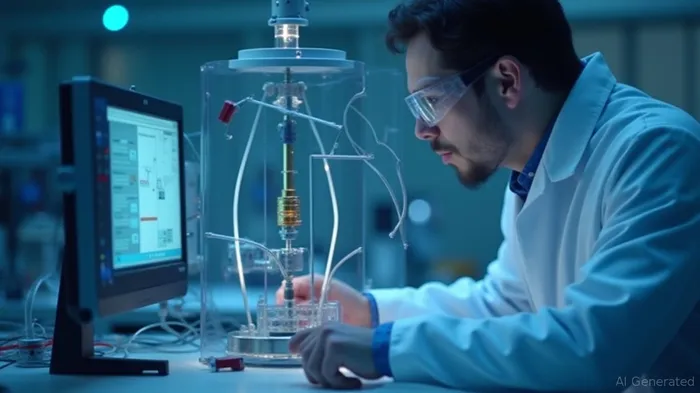
IonQ's trapped-ion technology leverages charged atoms suspended in electromagnetic fields, enabling qubits with exceptional coherence times and error rates as low as 1E-12—critical for fault-tolerant applications. By contrast:
- D-Wave (QBTS) relies on quantum annealing, optimized for optimization problems but less versatile.
- Rigetti (RGTI) uses superconducting qubits, which face scalability challenges due to higher error rates and manufacturing yield issues.
IonQ's roadmap aims to scale to 2 million physical qubits by 2030, with a 20,000-qubit system targeted by 2028. This ambition is backed by strategic acquisitions:
- Lightsynq Technologies: Accelerating photonic interconnects for fault tolerance.
- Oxford Ionics: A $1 billion investment to advance R&D, now part of IonQ's $1.075 billion acquisition in 2025.
IonQ's Q1 2025 revenue hit $7.6 million, with full-year guidance of $75–95 million—nearly double 2024's $43 million. D-Wave's revenue grew to $15 million in Q1 2025 but faces booking declines, while Rigetti's revenue collapsed 52% to $1.5 million in the same period.
Partnerships and Ecosystem: Enterprise-Ready Solutions
IonQ's partnerships validate its commercial viability:
- AstraZeneca: Collaborating on quantum-powered drug discovery, achieving 20x speedups in simulations.
- NVIDIA: Integrating quantum computing with AI workflows.
- DARPA: Secured a $81.3 million contract for quantum networking projects, underscoring government confidence.
Its systems are cloud-integrated with AWS, Azure, and Google Cloud, making them accessible to developers worldwide. In contrast, D-Wave's focus on niche optimization problems and Rigetti's reliance on modular chiplets lack IonQ's broad ecosystem appeal.
Growth Trajectory: Financial Health and IP Dominance
IonQ's $364 million cash reserves (end of 2024) dwarf competitors:
- D-WaveQBTS-- holds $304 million in cash but faces booking declines.
- Rigetti's cash reserves fell to $217 million in 2024.
IonQ's aggressive R&D and acquisitions are funded without overleveraging. Its patent portfolio—expanded to ~900 granted/pending patents via the ID Quantique acquisition—creates a moat in quantum networking and security.
Risks and Challenges
- Execution Risk: Scaling to 2 million qubits requires maintaining qubit fidelity and integrating Lightsynq's technology.
- Competition: IBM's Starling system and Google's advancements threaten IonQ's lead.
- Valuation: IonQ's $10.4 billion market cap faces pressure to justify its premium—currently trading at ~25x sales, though analyst targets imply upside.
Investment Thesis: High-Risk, High-Reward
For investors with a 10-year horizon, IonQ's Strong Buy rating (average target: $43, implying 11% upside) aligns with its potential to dominate scalable quantum computing. Key catalysts include:
- Delivering its 20,000-qubit system by 2028.
- Securing government contracts and enterprise partnerships.
Risk-Adjusted Play: Aggressive investors should allocate a small portion of their portfolio to IonQ, balancing its potential with the sector's volatility.
Conclusion
IonQ's trapped-ion technology, strategic partnerships, and financial resilience position it as the most balanced competitor in quantum computing. While risks loom, its roadmap to 2030 offers a path to multiplicative returns for those willing to endure the journey. For the bold, IonQ is a quantum leap worth taking.
Disclosures: Quantum computing remains highly speculative. Past performance does not guarantee future results.





Comentarios
Aún no hay comentarios