
IonQ: Betting on the Quantum Infrastructure S-Curve
IonQ is building the foundational hardware for a computing paradigm shift. The company operates on the steep part of the quantum technology S-curve, where today's massive investments are the necessary fuel for tomorrow's exponential adoption. The market's potential is staggering, with projections suggesting the quantum computing segment alone could reach $72 billion by 2035. This isn't just incremental growth; it's the emergence of a new technological substrate that could transform industries from pharmaceuticals to finance.
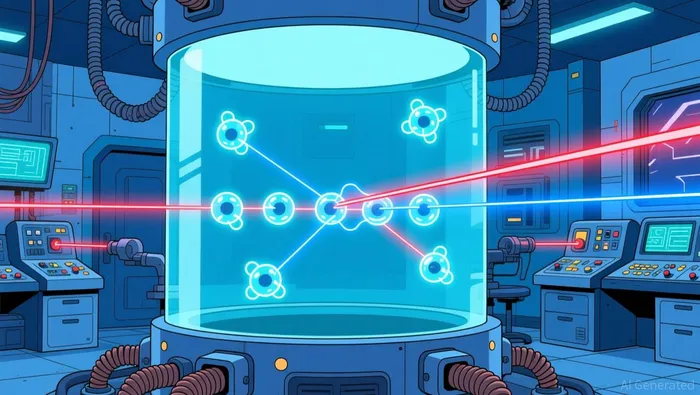
At the core of IonQ's strategy is its trapped-ion architecture, a leading approach that recently achieved a critical fidelity milestone. The company demonstrated a world-record 99.99% two-qubit gate performance, a key step toward fault-tolerant computing. This achievement isn't a distant promise; it's a tangible marker on the path to scaling to millions of physical qubits and tens of thousands of logical qubits by 2030. It validates the company's technical roadmap and its bet on a specific hardware paradigm that aims to deliver the reliability needed for mission-critical applications.
This pre-profit build-out requires immense capital. IonQ's financials reflect this reality, with a net loss of $1.1 billion in the third quarter. Yet that loss is the cost of constructing the infrastructure layer. The company's recent $2 billion equity offering has given it a powerful runway, resulting in a pro-forma cash position of $3.5 billion. This war chest is the essential fuel for accelerating product development, completing strategic acquisitions, and expanding into enterprise and government markets. In the quantum race, the company with the deepest pockets and the clearest technical path to fault tolerance is positioning itself as the indispensable rails for the next computing era.
Financials: The Pre-Profit Investment Phase
The numbers tell a classic story of an infrastructure play in its build-out phase. IonQ's third-quarter revenue surged 222% year-over-year to $39.9 million, a figure that beat guidance and signals accelerating demand for its quantum contracts. Yet this explosive growth is paired with a staggering net loss of $1.1 billion for the quarter. This disconnect is the direct financial cost of scaling quantum hardware. The company is spending heavily on technology, global operations, and strategic acquisitions, all to lay the physical rails for a future computing paradigm.
This aggressive investment is reflected in the company's raised outlook. Management has lifted its full-year 2025 revenue guidance to a range of $106 million to $110 million. The midpoint of that guidance implies a massive year-over-year growth rate, confirming the momentum. However, the company also reaffirmed its adjusted EBITDA loss midpoint at about ($211 million). This pattern-soaring top-line growth alongside deepening bottom-line losses-is the expected profile for companies constructing foundational technology. The market is paying for the future capability, not the present profit.
This is the typical capital-intensive path for infrastructure plays. As seen across the quantum sector, most public companies remain pre-profit, making cash runway and technical progress the primary investment metrics. IonQ's recent $2 billion equity offering and resulting pro forma cash position of $3.5 billion provide a critical buffer. It funds the steep climb up the S-curve, where today's massive spending is the necessary fuel for tomorrow's exponential adoption. The financials here are not a red flag; they are a blueprint for building the next computing substrate.
Insider Activity: Confidence in the Build-Out
The numbers tell a clear story of conviction. Over the last six months, IonQIONQ-- insiders have accumulated shares at a significant clip, purchasing 1.39 million shares while selling only 514,000 shares. This net positive accumulation is a powerful signal. It suggests that those closest to the company's operations and technical roadmap see the current pre-profit investment phase not as a financial strain, but as the necessary build-out of a foundational infrastructure layer.
This buying occurred alongside a notable sale of $1.03 million, which included conversions and tax payments. These are routine, non-bearish transactions that do not reflect a loss of confidence. In fact, they are the kind of planned liquidity events that often accompany stock awards or other compensation structures. The fact that insiders continued to buy with their own capital even while managing these routine sales underscores a deliberate, long-term bet.
Viewed through the lens of the quantum S-curve, this activity makes sense. Insiders are betting on the exponential payoff of trapped-ion infrastructure. They are not trading on quarterly earnings; they are positioning themselves for the paradigm shift that lies ahead. The recent $2 billion equity offering and the resulting cash war chest provide the runway for this build-out. For insiders, buying shares now is akin to purchasing adjacent land when you discover gold-anticipating the massive value that will be unlocked once the technology scales. It is a vote of confidence in the long-term value of the rails being laid today.
Catalysts and Risks: The S-Curve Inflection
The path to exponential adoption is defined by a few critical inflection points. The primary catalyst is achieving fault-tolerant quantum computing. This isn't just another milestone; it's the technical S-curve inflection that unlocks commercial viability. IonQ's recent world-record 99.99% two-qubit gate performance is a direct step toward this goal, securing the fidelity required to scale to full fault tolerance. Reaching this point would validate the trapped-ion architecture's path to millions of physical qubits and tens of thousands of logical qubits by 2030, transforming quantum from a lab curiosity into a reliable infrastructure layer for mission-critical industries.
Early market adoption provides the parallel validation signal. Securing high-value contracts with major enterprises and national labs demonstrates that the technology is moving from theory to application. IonQ's recent contract with Oak Ridge National Laboratory is a prime example, focused on advanced energy applications. These wins are the first commercial proofs of concept, building the case for broader industry investment and accelerating the adoption curve.
Yet the risks that could delay this inflection are substantial. Technological execution is the most fundamental. The quantum field is a race of intense competition, with multiple hardware approaches vying for dominance. Any significant delay in IonQ's roadmap to fault tolerance-whether due to engineering hurdles or unforeseen physics-could erode its technical lead and investor confidence. The prolonged timeline before the market reaches exponential adoption is another key risk. As McKinsey's report notes, the quantum market is gaining widespread traction worldwide, but the shift from stabilizing qubits to widespread commercial use is still unfolding. For now, most quantum companies remain pre-profit, making cash runway and credible adoption key factors. IonQ's deep war chest mitigates this, but the market's patience for a decade-long build-out is not infinite.
The bottom line is that the quantum infrastructure bet hinges on a successful inflection. The company is executing on the technical milestones and securing early contracts that will validate its thesis. But the path is fraught with technological uncertainty and competitive pressure. The market's exponential payoff is real, but it is still a future event. For investors, the next few years will be a test of whether IonQ can navigate the risks and reach the inflection point that makes the S-curve truly steep.





Comentarios
Aún no hay comentarios