
Invitation Homes: A Strong Buy in a Rental Market Poised for Growth
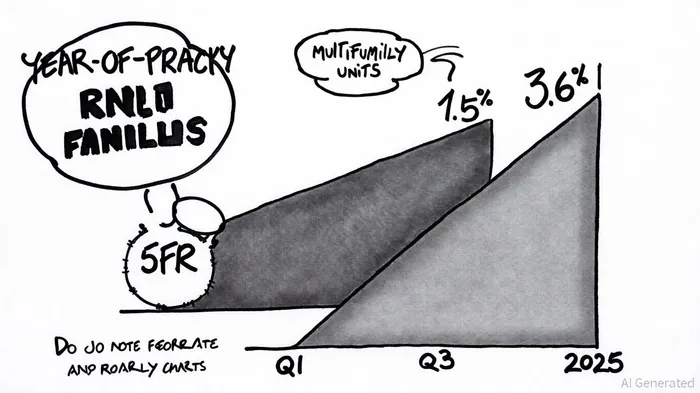
The U.S. housing market in 2025 remains a study in contrasts. Elevated mortgage rates (6–7%) and affordability challenges have stifled homeownership demand, pushing more Americans toward rentals[1]. Yet, within this constrained environment, the single-family rental (SFR) sector has emerged as a bright spot. Invitation HomesINVH-- (INVH), the largest SFR-focused REIT, is uniquely positioned to capitalize on these dynamics, with its valuation metrics and operational performance suggesting significant undervaluation.
Tailwinds for the Rental Market
The SFR sector has outperformed multifamily rentals in 2025, with rents rising 3.6% year-over-year through June[2]. This growth, though below pandemic-era peaks, aligns with pre-2020 norms and reflects persistent demand driven by high homeownership costs and urbanization trends. Occupancy rates for SFRs rebounded to 94.5% in Q2 2025, with lease renewal rates climbing to 82%—a sign of strong tenant retention[2].
Meanwhile, the broader housing market remains a buyer's market. Inventory surged to over 2 million homes in May 2025, up 14.1% year-over-year, while home sales fell 6% in the same period[1]. These imbalances are likely to prolong the shift toward rentals, particularly in Sun Belt regions where affordability gaps are widest. Analysts project that SFRs will continue to outperform multifamily assets as suburban neighborhoods gain traction amid remote work trends[2].
Invitation Homes: Operational Excellence and Strategic Positioning
Invitation Homes has leveraged these trends with disciplined execution. In Q1 2025, the company reported a 4.4% year-over-year revenue increase to $674 million, with net income rising 16.4% to $166 million[3]. Same-store occupancy reached 97.3% in May 2025, and blended rent growth hit 4.1%—well above the SFR sector average[3]. Notably, new lease rate growth turned positive in May, rising to 2.5% from -0.1% in Q1 2025[3].
The company's geographic diversification—spanning 17 U.S. markets, including high-growth areas like Florida and the Western U.S.—has insulated it from regional volatility[4]. Its focus on starter and move-up homes further aligns with demographic shifts, as younger households delay homeownership and older residents downsize[4].
Valuation Metrics Suggest Undervaluation
Despite these strengths, Invitation Homes trades at a discount relative to its fundamentals. The stock's P/FFO ratio of 17.91 exceeds the residential REIT sector average of 14.3x[5], but this premium is justified by its superior operational performance and lower leverage. Its debt-to-EBITDA ratio of 5.63 is below the sector average of 6.3[5], reflecting a conservative balance sheet. Meanwhile, the 3.97% dividend yield offers an attractive income stream compared to the REIT industry average of 4.38%[5].
Analysts project a 19.4% undervaluation relative to intrinsic value, with a mean price target of $36.84[6]. This gap reflects market skepticism about short-term volatility but overlooks the company's long-term tailwinds. For instance, J.P. Morgan Research forecasts stronger pricing power for SFRs in late 2025 as 2024's new supply is absorbed[7], a trend that should bolster Invitation Homes' margins.
Long-Term Catalysts and Risks
The SFR sector's growth is underpinned by structural factors: an aging population, rising construction costs, and limited labor availability, which will further delay home price corrections and favor rentals[8]. Invitation Homes' 85,000-home portfolio represents less than 0.5% of the U.S. SFR market[3], leaving ample room for expansion. The company's focus on stabilized, income-producing assets also positions it to benefit from suburbanization trends, as urban dwellers seek more space[2].
Risks include macroeconomic headwinds, such as a potential slowdown in GDP growth (currently projected at 1.5% for 2025)[9], and regional rent stagnation in Sun Belt markets. However, Invitation Homes' diversified portfolio and strong tenant retention rates mitigate these risks.
Conclusion: A Strong Buy Case
Invitation Homes combines operational excellence, favorable sector dynamics, and an undervalued stock. Its P/FFO premium is justified by superior performance, while its balance sheet and dividend yield offer downside protection. As the U.S. housing market continues to tilt toward rentals, Invitation Homes is poised to outperform both the residential REIT sector and broader real estate indices. Investors seeking exposure to a defensive, high-growth asset class should consider upgrading to a “Strong Buy.”





Comentarios
Aún no hay comentarios