
Should Investors Buy Intel Before 2025 Ends? A Deep Dive into Manufacturing Turnaround, Foundry Potential, and AI-Driven Demand
The question of whether to invest in IntelINTC-- (INTC) as 2025 nears its end hinges on three critical pillars: its manufacturing resurgence, the scalability of its foundry business, and the strength of AI-driven demand. After a decade of setbacks, Intel appears to be navigating a pivotal inflection point, driven by advancements in its 18A process node, strategic partnerships, and a recalibrated focus on AI infrastructure. Let's dissect these factors to assess the investment case.
Manufacturing Turnaround: The 18A Process as a Game Changer
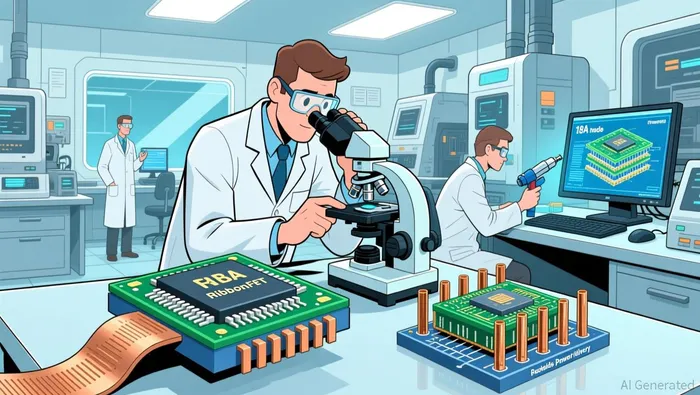
Intel's 18A process node, featuring RibbonFET gate-all-around transistors and PowerVia backside power delivery, has emerged as the cornerstone of its 2025 revival. As of late 2025, the technology is in risk production, with yields climbing to 60%, sufficient to begin mass shipments of Panther Lake client processors according to market analysis. This progress marks a stark departure from past delays, as the 18A process reduces EUV lithography steps, enhancing both performance and cost efficiency.
The company's U.S. manufacturing footprint is also gaining traction. Fab 52 in Arizona recently processed its first 18A wafer, while volume production is set to begin in Oregon as Arizona's facilities ramp up. Meanwhile, the 14A node is advancing, with early Process Design Kits distributed to key customers. However, challenges persist: yields are still projected to reach industry-standard levels by 2027, and the foundry division reported a $2.3 billion operating loss in Q3 2025. These hurdles underscore the need for continued investment and operational refinement.
Foundry Potential: Securing a Place in the Global Supply Chain
Intel Foundry's ability to attract industry giants like Apple, NVIDIA, and Google has been a major development. Apple has signed a non-disclosure agreement and received the 18A-P PDK design kit, signaling potential adoption for future M-series chips as early as 2027. NVIDIA's $5 billion equity stake and collaboration to integrate NVLink further validate the foundry's appeal.
Google and Meta are also exploring Intel's advanced packaging technologies, such as EMIB, for AI accelerators as reported by industry analysts. These partnerships highlight Intel's pivot from a purely in-house manufacturing model to a competitive foundry player. While the foundry business remains unprofitable, its strategic alignment with U.S. government incentives-such as the CHIPS and Science Act-positions it to scale efficiently in the coming years.
AI-Driven Demand: A New Era for Intel's Data Center Strategy
The AI boom has reshaped Intel's product roadmap. Its Gaudi 3 accelerators are gaining traction, with IBM Cloud already offering them for AI workloads. The company's Xeon 6 processors, optimized for energy efficiency, have demonstrated 50% efficiency gains in enterprise pilots. Meanwhile, the upcoming Crescent Island GPU-a 160GB data center GPU-targets real-time inference tasks, addressing a growing niche in token-as-a-service models.
A pivotal partnership with NVIDIA underscores this shift: the two firms are co-developing custom x86 CPUs for AI platforms, combining Intel's manufacturing prowess with NVIDIA's GPU expertise. This collaboration could redefine data center architectures, offering tightly integrated CPU-GPU systems that cater to both performance and cost-sensitive markets.
Financials and Analyst Outlook: A Mixed but Manageable Picture
According to Q3 2025 results, Intel showed modest progress, with revenue rising 3% year-over-year to $13.7 billion and non-GAAP EPS of $0.23 exceeding expectations. However, the foundry division's losses and Q4 guidance-projecting revenue between $12.8 billion and $13.8 billion-highlight near-term risks. Analysts remain cautiously optimistic, with a consensus "Hold" rating and a 12-month median price target of $40, implying ~10% upside from current levels.
The company's financial resilience is bolstered by a $5.7 billion U.S. government funding and a $5 billion investment from NVIDIA. These inflows, coupled with a $100+ billion plan to expand U.S. manufacturing, suggest Intel is well-positioned to weather short-term volatility.
Conclusion: A Calculated Bet for 2026
Intel's 2025 journey has been one of cautious optimism. The 18A process is delivering tangible progress, foundry partnerships are gaining momentum, and AI-driven demand is reshaping its product portfolio. While challenges-such as yield improvements and foundry profitability-remain, the company's strategic alignment with U.S. manufacturing priorities and AI infrastructure trends offers a compelling long-term narrative.
For investors, the decision to buy before 2025 ends hinges on risk tolerance. The stock's current valuation reflects both its transformative potential and lingering uncertainties. Those willing to bet on Intel's ability to execute its turnaround-particularly as Panther Lake and Clearwater Forest processors hit the market-may find the current price a compelling entry point. However, patience is key: the full rewards of this transformation are likely to materialize in 2026 and beyond.







Comentarios
Aún no hay comentarios