
Investor Implications of DOJ Crackdowns on Crypto Mixers: Navigating Regulatory Risk in Privacy-Focused Crypto Tools
Regulatory Tightening and Legal Uncertainty
The DOJ's enforcement actions have been complemented by evolving regulatory frameworks. In 2023, the Financial Crimes Enforcement Network (FinCEN) designated crypto mixing as a "primary money laundering concern," signaling stricter oversight for international mixers according to the policy tracker. However, the 2024 Fifth Circuit Court ruling overturning OFAC's sanctions on Tornado Cash introduced legal ambiguity. The court argued that immutable smart contracts could not be regulated as "property" under existing laws, challenging the Treasury's authority to sanction decentralized protocols. This legal back-and-forth has created a fragmented regulatory landscape, 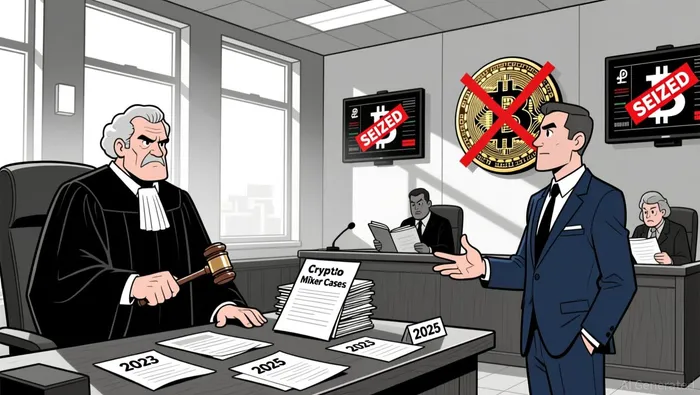 leaving investors uncertain about the long-term viability of privacy tools.
Market Reactions and Investor Behavior
Despite regulatory headwinds, privacy coins like ZcashZEC-- (ZEC) have shown resilience. In October 2025, Zcash surged over 25% in a single day, reaching nearly $735, driven by demand for anonymity amid rising surveillance concerns. This surge coincided with the DOJ's crackdown on North Korean-linked cyber operations, including the seizure of $15 million in USDT tied to APT38, a hacking group linked to Pyongyang. While such enforcement actions highlight the DOJ's commitment to disrupting illicit flows, they also underscore the paradox of privacy coins: increased scrutiny often fuels demand among users seeking to evade financial surveillance.
Institutional investors, however, appear more cautious. A 2025 survey by AIMA and PwC found that 47% of institutional investors cited the evolving U.S. regulatory environment as a factor in increasing digital asset allocations. Yet, 55% of traditional hedge funds in 2025 had exposure to digital assets, up from 47% in 2024, suggesting a gradual embrace of crypto despite risks. This trend is partly driven by tokenization, with 52% of hedge funds exploring tokenized fund structures for improved liquidity and operational efficiency.
Balancing Compliance and Innovation
The DOJ's actions have also reshaped investor preferences. As enforcement agencies demonstrate enhanced capabilities to trace crypto transactions, investors are increasingly favoring transparent, regulated platforms over high-risk privacy tools. For instance, the prosecution of Kunal Mehta-a key figure in a $263 million crypto theft case-highlighted the DOJ's ability to dismantle illicit networks using mixers and exchanges according to Decrypt. Such cases reinforce the importance of due diligence, pushing investors toward compliance-focused strategies.
However, the legal uncertainty surrounding decentralized tools complicates this shift. The Tornado Cash case revealed gaps in regulatory authority over immutableIMX-- smart contracts. This ambiguity may deter institutional adoption of privacy coins while encouraging innovation in hybrid models that balance privacy with compliance.
Conclusion: Strategic Considerations for Investors
For investors, the DOJ's crackdowns on crypto mixers underscore the need for a nuanced approach. While privacy-focused tools remain attractive to users prioritizing anonymity, their regulatory risks are undeniable. Institutional investors are likely to continue hedging their bets by diversifying into tokenized assets and regulated platforms, even as they monitor developments in privacy coin markets.
The coming years will test the resilience of privacy-focused crypto tools in the face of regulatory scrutiny. Investors must weigh the potential for innovation against the likelihood of enforcement actions, recognizing that the DOJ's efforts are part of a broader global trend toward crypto regulation. As one legal expert notes, "The DOJ's actions are not just about punishing bad actors-they're about redefining the boundaries of financial privacy in the digital age."







Comentarios
Aún no hay comentarios