
The Value Investor's Guide to Greg Abel's Berkshire
Greg Abel officially took the helm of Berkshire Hathaway on January 1, 2026, marking the formal end of Warren Buffett's era as CEO. While Buffett remains Chairman and a guiding presence, he has named Abel the ultimate "decider" on capital allocation. In a rare show of personal endorsement, Buffett has stated he would rather have Abel manage his own money, a testament to his confidence in the new leader's judgment.
Abel's background is a study in disciplined, operational excellence. A native of Alberta, Canada, he built his career in energy and utilities, joining Berkshire through the acquisition of MidAmerican Energy in 1999. His rise was steady and hands-on, culminating in his role as Vice Chairman overseeing all non-insurance businesses. This experience, particularly in capital-intensive industries, has shaped his management style-a focus on long-term value creation through reinvestment and operational discipline.
The core challenge Abel now faces is monumental. He inherits a company with a , a sum that has grown due to years of selling holdings and reduced buybacks. This hoard, parked largely in treasuries yielding over 4%, is idle money that must be deployed. The pressure is real, as the market rally continues and shareholders expect action. Yet, as Buffett himself noted, most quality businesses now come with hefty price tags, making the search for a compelling return a difficult puzzle.
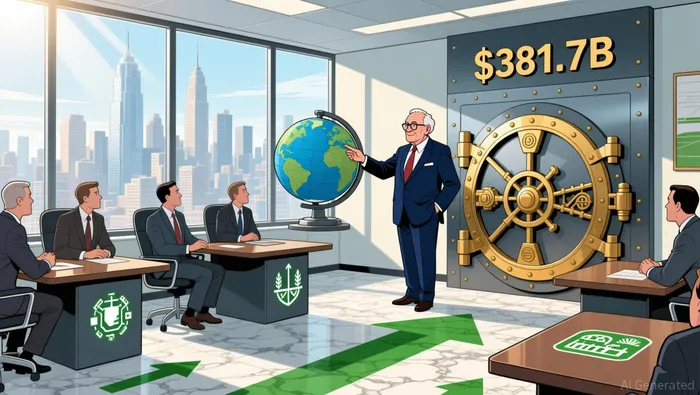
The thesis for Abel's tenure is one of continuity with a subtle shift. He is expected to maintain Berkshire's core value investing principles, but his energy background and more hands-on management style may lead to a more active, yet still disciplined, deployment of this cash. He has demonstrated a capacity for strategic reinvestment, having expanded Berkshire Hathaway Energy aggressively into renewables. His personal alignment is clear, with a . The long-term test will be whether he can navigate the vast capital hoard to find new growth avenues, all while operating in the long shadow of his legendary predecessor.
Operational Experience: The Energy and Utility Blueprint
Greg Abel's rise to CEO of Berkshire Hathaway is not a story of financial engineering, but of hands-on operational mastery. His deep roots in the company's core business model are rooted in his transformative work at Berkshire Hathaway Energy. Abel didn't just manage a utility; he built it from a regional power provider into a global energy powerhouse with assets spanning North America, the UK, and the Philippines. This achievement was a direct result of his capital-intensive, reinvestment-focused management style-a model that is the bedrock of Warren Buffett's investment philosophy.
His success was built on businesses that generate significant, predictable cash flows. As noted, Berkshire Hathaway Energy benefited from its ability to retain earnings that could be reinvested in growth, rather than being paid out as dividends. This freedom allowed Abel to aggressively expand into renewables and acquire key assets like and . This operational blueprint-investing in durable, cash-generating assets and plowing profits back into the business-is the exact engine that Buffett has long preferred. It's a model that prioritizes compounding over short-term financial maneuvers.
This experience gives Abel an unparalleled, on-the-ground understanding of the 32 consumer and industrial businesses he now oversees. These are the very engine of Berkshire's cash generation, and Abel's career has been dedicated to the same principle: nurturing companies that produce substantial cash flows. As he has stated, ensuring that Berkshire's operating companies produce significant cash flows is "absolutely critical" to its long-term success. His operational background means he doesn't just see these businesses as financial assets; he understands the capital needs, growth trajectories, and reinvestment opportunities that drive their value. This deep, practical insight is his most valuable asset as he steps into the CEO role.
The Transition: From Buffett's Shadow to the Helm
Warren Buffett officially stepped down as CEO on Thursday, passing the torch to his hand-picked successor, Greg Abel. The transition is a moment of profound change for the world's most famous conglomerate. While Buffett will remain chairman and a daily presence, Abel now faces the immense task of guiding Berkshire through a new era. The company's growth has slowed as it has ballooned in size, making it harder to find large, meaningful acquisition targets. This sets the stage for a critical test: Abel must maintain the decentralized model that has been a hallmark of Berkshire's success while navigating a period of slower growth and a record cash pile.
Abel has made it clear that the core investment philosophy will remain unchanged. He has stated that the company's approach-buying cash-generative companies at reasonable prices-will continue. This is a crucial signal for investors, as it anchors the company's strategy in a proven framework. Abel shares Buffett's view that Berkshire's massive cash reserves, which stood at about , are an enormous asset that provides a safety net and independence. He has reiterated that the focus will be on nurturing businesses that produce significant cash flows, a strength he intends to ensure continues.
Yet, the shift in leadership brings new dynamics. Abel is viewed as more hands-on than Buffett and has already announced leadership changes, signaling a more traditional approach to managing Berkshire's nearly 400,000 employees. This may lead to greater pressure to deploy capital. Historically, Berkshire has favored reinvesting profits over paying dividends. Abel, however, is expected to face increased scrutiny to start paying a dividend or making large acquisitions, especially given the sheer scale of the cash hoard. The market's patience for a CEO who is hesitant to spend may be less than it was for Buffett.
The bottom line is that Abel inherits a legacy of success but also a complex challenge. His ability to uphold the decentralized model while guiding the company through a high-priced market and a record cash pile will be the key test. He must demonstrate that he can be the "decider" Buffett envisioned, making disciplined capital allocation decisions that justify the premium placed on his leadership. The strategy may not change, but the execution will be his.
Implications for Shareholders: What to Watch
The transition at Berkshire Hathaway is now complete, but the real test for shareholders begins. With Greg Abel as the new CEO, the focus shifts from legacy to leadership. The forward-looking scenario hinges on one critical catalyst: Abel's first major acquisition or investment decision. This move will be the clearest signal of his appetite for risk and his discipline in valuing opportunities. It will reveal whether he leans into his energy background, potentially eyeing a larger stake in Occidental Petroleum, or if he follows Buffett's lead into proven growth names like Alphabet. The market will be watching for a decision that aligns with the company's core philosophy: buying cash-generative businesses at reasonable prices.
A primary risk is the pressure to deploy Berkshire's massive cash pile quickly. The company sits on a record , and while Abel has stated the "value relative to the risks has to be right" before pulling the trigger, shareholder expectations for capital allocation are rising. In a high-priced market, yielding to this pressure could lead to suboptimal returns if the "value relative to risks" isn't compelling. Abel's challenge is to balance patience with purpose, avoiding the trap of spending cash simply because it is available.
For investors, the key metrics to monitor are straightforward. First, track the pace of capital deployment. A slow, deliberate approach would signal adherence to Buffett's philosophy, while a sudden, aggressive spending spree would indicate a shift in strategy. Second, watch the performance of Berkshire's existing businesses under Abel's oversight. His hands-on management style, demonstrated in building Berkshire Hathaway Energy, suggests he will be more involved than Buffett was. The health of operations like BNSF Railway and See's Candies will be a barometer of his operational acumen. Finally, keep an eye on the cash pile itself. If it continues to grow, it may signal a lack of attractive opportunities, but if it shrinks meaningfully, it will confirm Abel is actively hunting for the next great investment. The bottom line is that Abel's leadership will be judged not by his first quarterly report, but by the quality of his first major bet.







Comentarios
Aún no hay comentarios