
The Investment Risks and Market Reactions to Trump's Proposed 10% Credit Card Rate Cap
The financial sector is no stranger to regulatory shifts, but President Donald Trump's proposed 10% cap on credit card interest rates-set to take effect on January 20, 2026-has introduced a new layer of uncertainty. This policy, aimed at reducing consumer debt burdens, has already triggered sharp market reactions and raised critical questions about its long-term implications for financial sector profitability and credit availability. Drawing on historical precedents and recent market trends, this analysis examines the risks and opportunities for investors navigating this evolving landscape.
Immediate Market Reactions and Regulatory Uncertainty
The announcement of a temporary 10% cap on credit card rates has already rattled financial sector stocks. According to a report by , U.S. financial stocks declined sharply in early 2026 following the proposal, as investors grappled with concerns over reduced profit margins from lending activities. This reaction mirrors historical patterns, such as the 2009 Credit Card Accountability, Responsibility, and Disclosure (CARD) Act, which similarly disrupted credit card issuer revenues and led to a reevaluation of risk-based pricing models.
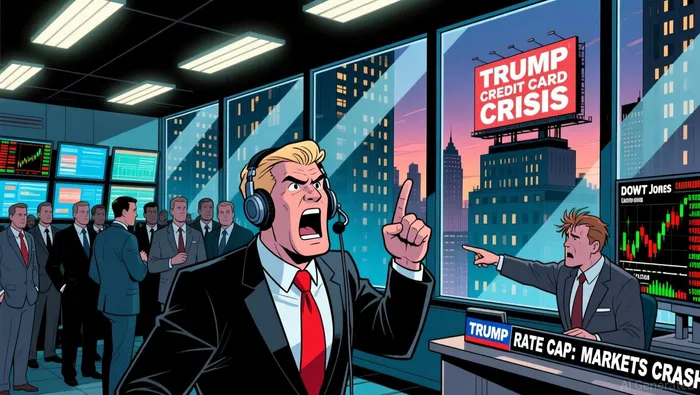 The regulatory ambiguity surrounding Trump's proposal compounds the uncertainty. While the president has not clarified whether the cap will be implemented via executive action or congressional legislation, lawmakers like Senator Bernie Sanders and Representative Alexandria Ocasio-Cortez have already introduced legislative alternatives, such as the 10 Percent Credit Card Interest Rate Cap Act (S.381). Critics argue, including Senator Elizabeth Warren, that legislative action is the only viable path to enforceability. This lack of clarity creates a volatile environment for investors, who must weigh the likelihood of regulatory adoption against the potential for legal challenges or sectoral pushback.
Long-Term Implications for Financial Sector Profitability
Historical data suggests that credit card rate regulations can significantly alter the financial sector's revenue streams. The 2009 CARD Act, for instance, restricted risk-based penalty pricing and late fees, leading to a sharp decline in fee revenue for borrowers with low FICO scores. For those with scores below 620, fee revenue dropped by over 50% post-enactment. A 10% rate cap could exacerbate such trends, forcing credit card companies to offset lost interest income by reducing rewards programs, tightening credit limits, or increasing non-interest fees.
Moreover, the proposed cap may disproportionately affect smaller banks and credit unions, which rely more heavily on credit card income than larger institutions. As noted in a 2025 FDIC report, regional banks like U.S. Bancorp and Bank of AmericaBAC-- have already been identified as relatively safer investments due to their diversified operations and stronger capitalization. This suggests that investors may need to reassess their exposure to smaller financial institutionsFISI--, which could face margin compression and liquidity challenges under a rate cap.
Consumer Credit Availability: A Double-Edged Sword
While the cap aims to alleviate consumer debt burdens, its impact on credit availability remains contentious. Historical precedents demonstrate, such as the 1978 Marquette National Bank decision, how deregulation can lead to a surge in high-interest lending by enabling credit card companies to operate in states with lax usury laws. Conversely, the CARD Act's restrictions on risk-based pricing reduced credit access for high-risk borrowers, pushing them toward alternative, often costlier forms of credit like payday loans.
A 10% rate cap could replicate this dynamic. Banks and financial analysts warn that the policy might incentivize consumers to take on more debt at the lower rate, only to face higher interest costs when the cap expires. Additionally, credit card companies may tighten underwriting standards, further limiting access for individuals with lower credit scores. This could drive demand for unregulated alternatives, such as "buy now, pay later" services, which have gained traction in recent years.
Strategic Considerations for Investors
For investors, the key risks lie in regulatory uncertainty, margin compression, and shifts in consumer behavior. The financial sector's stock performance has historically been sensitive to credit card regulation, as seen in the post-CARD Act period, when banks adjusted their pricing strategies and credit policies. Similarly, Trump's proposal could trigger a wave of sector-specific repositioning, with investors favoring institutions with diversified revenue streams or stronger capital buffers.
However, the policy also presents opportunities. If the cap reduces delinquency rates and stabilizes consumer spending, it could indirectly benefit banks with robust deposit-taking capabilities or those offering alternative credit products. For example, consumer finance companies might see increased demand for their high-interest loans, though this would depend on state-level interest rate ceilings.
Conclusion
Trump's 10% credit card rate cap represents a high-stakes experiment in balancing consumer protection with financial sector stability. While the policy could deliver short-term savings for borrowers, its long-term effects on credit availability, profitability, and market dynamics remain uncertain. Investors must remain vigilant, monitoring regulatory developments, sector-specific adaptations, and consumer behavior trends. In a landscape where policy shifts can rapidly reshape financial markets, agility and a nuanced understanding of historical precedents will be critical to navigating the risks and opportunities ahead.





Comentarios
Aún no hay comentarios