
Investment Risk Assessment in a Politicized Crypto Landscape: Trump's Pardons and Market Sentiment
The cryptocurrency market in 2025 has been a rollercoaster of regulatory shifts, political maneuvering, and speculative fervor. At the center of this turbulence lies a recurring theme: the TrumpTRUMP-- administration's pardons of high-profile crypto figures and their cascading implications for market sentiment and regulatory clarity. For investors, the challenge lies in disentangling the signal from the noise-a task complicated by the administration's apparent prioritization of political loyalty over consistent enforcement.
The Pardons: A Double-Edged Sword for Market Confidence
In late 2025, President Trump issued pardons to three of the most controversial names in crypto: Binance founder Changpeng "CZ" Zhao, BitMEX co-founders Arthur Hayes and Benjamin Delo, and Silk Road founder Ross Ulbricht. These decisions were met with immediate market reactions. BitcoinBTC-- surged over 2.18% to $109,955.70, and Binance Coin (BNB) jumped 5.3% in the wake of Zhao's pardon. On the surface, these pardons signaled a regulatory "reset" for the industry, with the administration framing them as a commitment to fostering innovation.
However, the pardons also sparked ethical and political debates. Critics highlighted potential conflicts of interest, noting that Binance had invested $2 billion in Trump's stablecoin venture, World Liberty FinancialWLFI--, and had previously paid $450,000 to a Trump-linked lobbying firm. Similarly, Crypto.com's $10 million contribution to Trump's super PAC and $1 million to his inauguration raised questions about whether financial ties influenced the pardons. These controversies created a paradox: while the market initially celebrated regulatory leniency, the perception of a "pay-to-play" administration introduced long-term uncertainty.
Regulatory Responses: Silence as a Signal
U.S. financial authorities like the SEC and CFTC did not issue direct regulatory responses to the pardons. However, their inaction spoke volumes. The pardons effectively reversed the previous administration's enforcement priorities, signaling a shift toward reduced scrutiny of crypto players. For instance, the SEC had previously secured years-long director bans against FTX and Alameda executives, while the CFTC had imposed a $100 million penalty on BitMEX for Commodity Exchange Act violations. By pardoning these individuals, the Trump administration undermined the deterrence effect of such penalties, raising concerns about regulatory capture and politicized oversight.
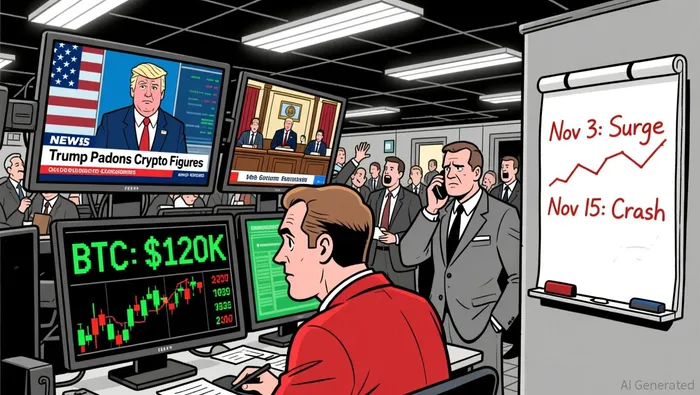
This regulatory ambiguity has left investors in a precarious position. While the administration's pro-crypto rhetoric-such as the repeal of restrictions on digital assets and the creation of a Strategic Bitcoin Reserve-has generated optimism, the lack of consistent enforcement creates a "Wild West" environment. Financial analysts now emphasize the need for updated anti-money laundering (AML) and know-your-customer (KYC) frameworks to navigate this shifting landscape.
Political Risks: Beyond Pardons
The pardons are part of a broader pattern of politicized crypto policy under Trump. Executive orders and policy initiatives like Strengthening American Leadership in Digital Financial Technology and the establishment of a Strategic Bitcoin Reserve have positioned the U.S. as a pro-crypto leader. Yet, these policies coexist with contradictory measures, such as a ban on central bank digital currencies and proposals for capital gains taxes. For investors, this duality complicates risk assessment.
Macroeconomic factors further muddy the waters. Trump's 100% tariffs on China in October 2025 triggered a $19bn liquidation event and a 40% drop in EthereumETH-- prices. While the administration's deregulatory stance initially buoyed the market, global trade tensions and tightening monetary policy ultimately overshadowed these gains. This highlights a critical lesson: political narratives alone cannot insulate crypto from macroeconomic headwinds.
Investor Implications: Navigating a Fractured Landscape
For institutional investors, the 2025 crypto market underscores the importance of diversifying risk assessments. Traditional frameworks must now account for political variables, such as the likelihood of regulatory reversals or executive overreach. The GENIUS Act, which imposed AML and KYC requirements on stablecoin issuers, offers a glimmer of structure. However, the administration's simultaneous promotion of deregulation creates conflicting signals.
Retail investors, meanwhile, face heightened volatility. The market's reaction to Trump's $TRUMP memecoin launch-a 15% surge in 24 hours-demonstrates how political symbolism can drive speculative behavior. Yet, such moves also expose investors to liquidity risks, particularly in a sector already prone to FOMO-driven bubbles.
Conclusion: A Call for Caution
Trump's pardons and broader crypto policies have reshaped the market's risk profile. While the administration's pro-crypto agenda has unlocked short-term gains, the politicization of regulation and enforcement introduces long-term instability. Investors must adopt a dual strategy: leveraging regulatory tailwinds while hedging against political overreach. As the 2025 market downturn illustrates, the crypto sector remains a volatile asset class-even in the most favorable political climates.
In this environment, the key to survival is adaptability. Investors who can distinguish between genuine regulatory progress and political theater will be best positioned to navigate the next phase of the crypto cycle.






Comentarios
Aún no hay comentarios