
Investment Opportunities in Digital-First Banking Amid UK Regional Bank Branch Closures
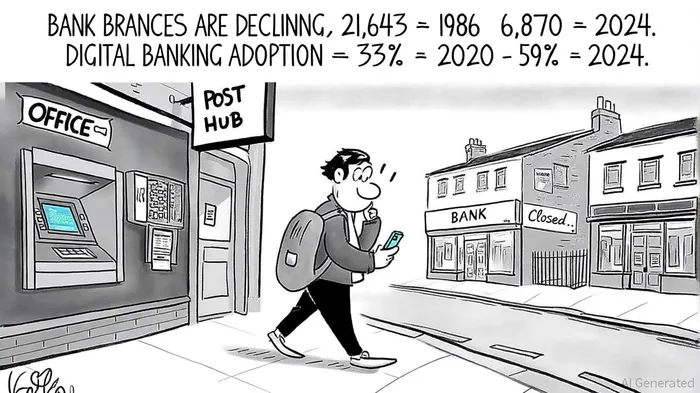
The UK's banking sector is undergoing a seismic shift. Over the past decade, the number of physical bank branches has plummeted by 68%, from 21,643 in 1986 to just 6,870 in 2024 [1]. This collapse is not merely a byproduct of economic cycles but a structural transformation driven by technological innovation, shifting consumer behavior, and cost pressures. For investors, the disintegration of the traditional branch model presents both risks and opportunities—particularly in the digital-first banking sector, which is rapidly filling the void left by retreating incumbents.
The Catalysts for Disruption
The acceleration of branch closures has been fueled by three interlocking forces. First, digital banking adoption has surged. By 2024, 59% of UK adults used mobile banking, up from 33% in 2020 [2]. Major banks like BarclaysBCS-- report that 74% of their customers now prefer digital channels [3], while LloydsLYG-- notes a 48% decline in in-person transactions over five years [4]. Second, cost-cutting imperatives have forced banks to abandon unprofitable physical locations. Barclays alone closed 177 branches in 2023, with 636 closures planned through 2025 [5]. Third, the pandemic acted as a catalyst, normalizing remote interactions and eroding the perceived necessity of in-person banking.
The consequences are uneven. Rural and low-income areas face “banking deserts,” where access to cash and personalized services is dwindling [6]. Yet for investors, the retreat of legacy banks creates fertile ground for digital-native players.
Digital-First Banking: A Resilient Sector
The UK's fintech ecosystem has demonstrated remarkable resilience despite macroeconomic headwinds. In H1 2025, fintechs raised $7.2 billion, outpacing all other European markets combined [7]. Payments, banking technology, and investment platforms accounted for 55% of Q1 2025 funding, reflecting demand for seamless digital solutions [8]. Late-stage funding rounds, such as Rapyd's $500 million Series F and Dojo's $190 million private equity deal, underscore investor confidence in scaling platforms [9].
Challenger banks like Revolut, Monzo, and Starling have captured 40% of UK adults, leveraging AI-driven personalization and low overheads to undercut traditional rivals [10]. Meanwhile, strategic partnerships between fintechs and legacy institutions are proliferating. For instance, Santander's branch closures have opened opportunities for digital platforms to serve its former customer base [11].
Strategic Opportunities for Investors
- Payments and Embedded Finance: The payments sector remains a growth engine, with 55% of Q1 2025 fintech funding directed here [12]. Startups enabling real-time cross-border transactions or embedded lending (e.g., BNPL services) are particularly attractive.
- AI and RegTech: Regulatory scrutiny intensifies as the Financial Conduct Authority reviews motor finance commissions and cash access [13]. Firms specializing in AI-driven compliance tools or fraud detection are well-positioned to profit.
- Banking Hubs and Post Office Partnerships: The UK government's plan to establish 350 banking hubs by 2029 [14] creates infrastructure opportunities. Post Office's role as a cash access provider could also attract investment in hybrid models blending digital and physical services.
- Consolidation and M&A: The sector's fragmentation invites consolidation. The $3.1 billion acquisition of Preqin by BlackRock highlights the appeal of mature fintechs with recurring revenue streams [15].
Risks and Mitigations
While the outlook is bullish, challenges persist. Fintech funding in Q1 2025 fell 65% year-on-year [16], reflecting macroeconomic uncertainty. Regulatory shifts, such as the FCA's evolving rules on commissions and data privacy, could disrupt business models. Additionally, the reliance on digital infrastructure exposes firms to cybersecurity risks.
However, these risks are manageable. Diversified portfolios that include both early-stage innovators and late-stage consolidators can balance growth and stability. Investors should also prioritize firms with robust AI-driven security frameworks and regulatory agility.
Conclusion
The UK's branch closure crisis is not a collapse but a pivot—a reimagining of banking in the digital age. For investors, the key lies in identifying platforms that address the unmet needs of a digitized, aging, and rural population. While the road ahead is not without potholes, the sector's resilience, innovation, and strategic adaptability make it a compelling arena for capital. As the Financial Conduct Authority mandates alternatives to branch closures [17], the winners will be those who bridge the gap between legacy infrastructure and the future of finance.





Comentarios
Aún no hay comentarios