
The Investment Implications of Taylor Swift's Republic Records Deal
The music industry's valuation landscape has undergone a seismic shift in the post-2025 era, driven in large part by Taylor Swift's landmark $360 million acquisition of her first six album master recordings from Shamrock Capital, according to a Northeastern report. This transaction, which culminated a decade-long battle over creative control, has redefined how artists, investors, and labels approach music ownership, streaming economics, and long-term revenue generation. For investors, Swift's Republic Records deal and its broader implications offer a compelling case study in the evolving power dynamics of the streaming-era music economy.
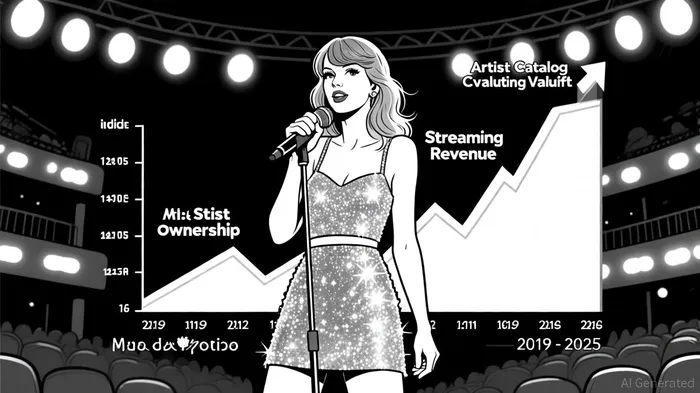
Valuation Shifts: From Label Dominance to Artist Empowerment
Historically, record labels held near-total control over master recordings, often locking artists into contracts that deferred ownership rights for decades. Swift's re-recording strategy-releasing "Taylor's Version" of her early albums-disrupted this model by devaluing the original masters while simultaneously creating a new revenue stream, as a UCLA Law Review analysis explains. By 2025, her catalog's streaming performance had surged, with titles like Fearless (Taylor's Version) and Red (Taylor's Version) outperforming their original counterparts by 55.1% and 430% in streams, respectively, according to Yahoo Entertainment. This demonstrated that artist-owned catalogs could generate higher returns than label-held assets, a revelation that has since influenced valuation multiples for music rights.
Investors now price music catalogs using a 18–24 times annual cash flow multiple, a range validated by Swift's $15–$20 million annual earnings from her reclaimed masters, as reported by The Tennessean. This shift has spurred a wave of catalog sales, with institutional players like BlackRock and Blackstone investing over $20.4 billion in music rights since 2019, according to WIPO. Legacy catalogs (e.g., Queen's $1.2 billion deal with Sony) and emerging artists alike are now valued with an eye toward ownership retention, a trend directly traceable to Swift's precedent, as Rareform Audio notes.
Streaming-Era Artist Power: Contracts, Control, and Creative Autonomy
Swift's Republic Records deal, finalized in 2023–2025, marked a strategic pivot in her career. Unlike her earlier contracts, this agreement granted her ownership of all new master recordings, including re-recordings, as IPWatchdog reports. This blueprint has since influenced a generation of artists, with emerging acts like Olivia Rodrigo and Maggie Rogers negotiating for upfront ownership or sunset clauses in their contracts, according to NPR. Labels, in turn, have responded by extending re-recording restrictions to 10–30 years in standard agreements, a defensive move to mitigate the risk of artist buybacks, as noted by Billboard.
The rise of artist-centric streaming models further amplifies this power shift. Platforms like SpotifySPOT-- and Deezer have adopted "fan-powered royalties," where payments are tied directly to listener behavior rather than pro-rata distribution, according to AudiArtist. For artists with strong fanbases-like Swift-this model ensures a larger share of streaming revenue, reinforcing the financial viability of ownership strategies.
Investment Trends: Catalogs, AI, and the Future of Music Assets
Post-2025, music rights have become a cornerstone of alternative asset portfolios. The global recorded music market, driven by streaming, reached $64.8 billion in 2024, with 73% of revenue derived from digital platforms, per MIDiA Research. Investors are now prioritizing catalogs with re-recording potential, sync licensing opportunities, and AI-driven content creation capabilities. Swift's ability to block sync deals for her original masters, for instance, highlighted the strategic value of controlling licensing rights-a factor now factored into catalog valuations, as argued by Music & Copyright.
Emerging technologies further complicate the landscape. AI tools are being used for music production and marketing, while blockchain promises to streamline royalty distribution, according to Music Industry Weekly. For investors, the key lies in balancing traditional catalog investments with forward-looking bets on platforms that integrate these innovations.
Conclusion: A New Paradigm for Music Investment
Taylor Swift's Republic Records deal is more than a personal victory; it is a catalyst for systemic change in the music industry. By reclaiming her masters, she has demonstrated the financial and cultural power of artist ownership, reshaping valuation norms and investor strategies. For stakeholders, the lesson is clear: in the streaming era, control over creative assets is not just a matter of artistic integrity-it is a critical determinant of long-term profitability.





Comentarios
Aún no hay comentarios