
Investment Implications of Rising Farm Financial Distress on Rural Lenders and Commodity Markets
Farm Financial Distress: A Sector in Transition
Agricultural lenders surveyed in the 2025 ABA/Farmer Mac Agricultural Lender Survey project that only 52% of U.S. farm borrowers will be profitable in 2025, the lowest level since 2016. This decline is driven by soft commodity prices, elevated input costs, and high interest rates, which have eroded margins for crop producers-particularly those focused on corn, soybean, and cotton according to the survey. While the USDA forecasts total net farm income to reach $179.8 billion in 2025, a 40.7% increase from 2024, this figure relies heavily on government support. Excluding federal aid, net farm income is expected to stagnate, with real commodity sales declining due to two years of falling prices according to economic analysis.
Total farm sector debt is projected to climb to $386.4 billion in 2025, reflecting a 7% increase in 2024 and operating loan volumes rising over 30% for three consecutive quarters. Over 70% of lenders report worsening working capital among borrowers, signaling a systemic liquidity challenge according to industry data. These trends underscore a sector increasingly reliant on credit to sustain operations, with crop producers facing the most acute pressure.
Rural Lenders: Tightening Credit and Rising Delinquencies
The financial strain on farms is directly impacting rural lenders. Delinquency rates for farm loans rose to 1.45% in Q1 2025, up from 1.03% at the end of 2024. Lenders are responding by tightening underwriting standards, emphasizing liquidity, repayment capacity, and collateral monitoring. Nearly 93% of lenders anticipate further debt increases in 2025, a pattern reminiscent of past economic downturns.
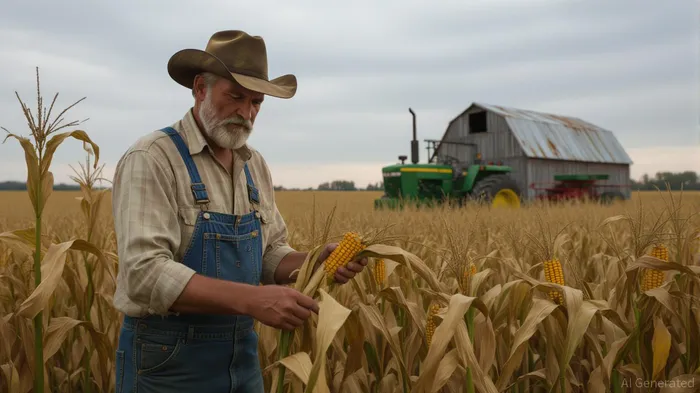
Agricultural lenders' top concerns for 2025 include deteriorating credit quality, exacerbated by carryover crops, low prices, and high production costs. While lenders continue to approve a high percentage of loan applications, their focus has shifted to operators demonstrating financial discipline. This shift may limit access to credit for smaller or less diversified farms, accelerating industry consolidation.
Commodity Market Volatility: Policy and Global Forces
Commodity price volatility in Q1 2025 is closely tied to U.S. agricultural financial stress. Trump-era tariffs have disrupted trade flows, with soybean exports to China dropping over 30% in 2025. Corn prices surged 18% in the same period, reflecting shifting global demand and trade policy uncertainty. The U.S. agricultural trade deficit is forecast to widen to $49 billion in 2025, driven by rising imports and stagnant exports.
Global factors further complicate the outlook. The World Bank projects a 7% drop in average agricultural commodity prices for 2025, attributed to abundant global supplies. These trends highlight the interplay of policy, trade, and market forces, creating a volatile environment for investors in agricultural commodities.
Federal Support: Adequacy and Political Challenges
Federal support remains a critical buffer for the sector. The American Relief Act of 2024 extended the 2018 Farm Bill through September 30, 2025, preserving programs like Agricultural Risk Coverage (ARC) and Price Loss Coverage (PLC). However, the farm bill expired at the end of September 2025, creating policy uncertainty according to policy analysis. The partisan "One Big Beautiful Bill" (OBB) Act, passed in July 2025, prioritized Republican goals, leaving unresolved issues like farm labor reform and disaster assistance frameworks.
While the American Relief Act allocated $10 billion for the Emergency Commodity Assistance Program (ECAP) to address 2024 production losses according to official documents, structural challenges persist. Rising input costs, global market volatility, and a fractured political landscape limit the long-term effectiveness of these measures according to analysis. Public priorities also appear misaligned with current policy allocations, with greater emphasis on food assistance over farm support.
Investment Implications: Navigating Risk and Opportunity
For investors, the agricultural sector presents a duality of risk and opportunity. Rural lenders face elevated credit risk but may benefit from disciplined underwriting and partnerships with financially resilient operators. Commodity markets offer speculative potential amid price swings, though trade policy uncertainty and global supply dynamics heighten volatility.
Federal support programs, while providing short-term relief, may not address structural challenges like input costs or climate risks according to financial analysis. Investors should monitor policy developments, particularly the resolution of the 2025 farm bill, which could reshape market stability and credit availability. Additionally, diversification into non-traditional income streams (e.g., renewable energy leases) may offer resilience for farms and lenders alike according to industry forecasts.
Conclusion
The U.S. agricultural sector is at a crossroads, with financial stress, credit risk, and policy uncertainty converging to redefine investment dynamics. While federal support and lender adaptability provide temporary safeguards, long-term stability will depend on addressing systemic challenges-both economic and political. Investors must balance caution with strategic foresight, recognizing that the sector's evolution will be shaped as much by policy as by market forces.







Comentarios
Aún no hay comentarios