
Investment Implications of a Prolonged Policy Pause in a High-Yield Environment
The Bank of Canada's decision to maintain its overnight interest rate at 2.25% in November 2025 underscores a cautious approach to navigating the dual challenges of economic resilience and inflationary uncertainty. With Canadian GDP expanding by 2.6% in the third quarter-driven largely by trade volatility-the central bank has signaled its intent to preserve the current policy stance until structural adjustments to the U.S. trade conflict and upcoming CUSMA negotiations stabilize the outlook. This prolonged policy pause, however, has significant implications for investors operating in a high-yield environment, where bond markets and equity valuations are recalibrating to a new normal.
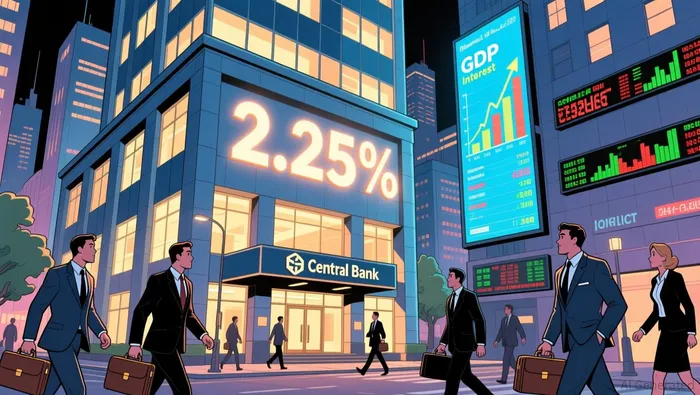
A Delicate Balance: Growth, Inflation, and Policy
The Bank of Canada's latest policy statement emphasized that the current rate is "at the appropriate level" to support inflation remaining near its 2% target while accommodating the economy's transition to a post-trade-conflict landscape according to the central bank. Despite this, fourth-quarter growth is expected to weaken due to declining net exports, a trend that could persist until 2026 according to economic forecasts. Meanwhile, core inflation remains stubbornly within the 2½% to 3% range, a level that, while closer to the target than in previous years, still reflects underlying price pressures. The central bank has acknowledged short-term volatility in headline inflation-such as from the GST/HST holiday-but remains confident in its ability to manage risks.
This policy stance has created a unique environment for investors. With the Bank of Canada unlikely to raise rates further, the focus has shifted to how markets price in prolonged low-rate conditions. Canadian 10-year bond yields, for instance, averaged 3.42% in November 2025, fluctuating narrowly as investors balanced optimism about economic resilience against concerns over trade uncertainty. A notable spike to 3.47% on December 9, 2025, eased to 3.44% by December 10 following the rate hold, illustrating the market's sensitivity to policy signals.
Equity Markets: Cautious Optimism Amid Mixed Signals
The equity market's response to the Bank of Canada's policy pause has been muted. While the absence of aggressive tightening has provided a floor for valuations, mixed economic data has limited upside potential. Investors are increasingly adopting a defensive posture, favoring sectors with stable cash flows over cyclical plays. This aligns with broader global trends, as U.S. Treasury yields have also stabilized between 4.0% and 4.25%, reducing the urgency for duration extensions in fixed income portfolios.
For Canadian investors, the high-yield corporate bond market has emerged as a compelling alternative. Spreads on Canadian high-yield bonds have tightened to their narrowest levels since 1998, reflecting strong demand for credit exposure amid a low-rate environment. Vanguard's Q4 2025 Active Fixed Income Perspectives report highlights that investors are capitalizing on higher coupons and price gains, particularly in sectors with robust fundamentals. However, the report also cautions against overexposure to lower-quality credits, urging a disciplined approach to risk management.
Strategic Implications for Investors
The Bank of Canada's prolonged policy pause necessitates a recalibration of investment strategies. In fixed income, the focus should remain on intermediate-duration bonds, which balance yield capture with reduced sensitivity to rate volatility. Canadian 10-year bonds currently yield 3.44%, offering a modest premium over short-term instruments, making them attractive for investors seeking income without excessive duration risk.
In equities, sector rotation toward defensive industries-such as utilities, healthcare, and consumer staples-appears prudent. These sectors are less exposed to trade-related disruptions and benefit from stable demand, even in a weak growth environment. Conversely, cyclical sectors like industrials and materials may face headwinds until net export trends stabilize according to central bank analysis.
For high-yield bond investors, the key challenge lies in differentiating between resilient issuers and those vulnerable to economic shocks. Vanguard's analysis underscores the importance of fundamental research, particularly in a market where spreads are compressed and liquidity is robust according to Vanguard's insights. Investors should prioritize companies with strong balance sheets and predictable cash flows, even if it means accepting slightly lower yields.
Conclusion
The Bank of Canada's November 2025 policy decision reflects a strategic pivot toward stability, balancing the need to support growth with the imperative to control inflation. For investors, this environment presents both opportunities and risks. A prolonged policy pause has created a high-yield landscape where fixed income and equities can coexist, but success requires careful positioning and disciplined risk management. As the central bank monitors trade negotiations and inflation dynamics, investors must remain agile, leveraging the current conditions to build resilient portfolios capable of weathering future uncertainties.







Comentarios
Aún no hay comentarios