
The Investment Implications of a Potential $133.5 Billion U.S. Tariff Refund: Assessing Legal, Fiscal, and Market Risks for Trade-Related Sectors
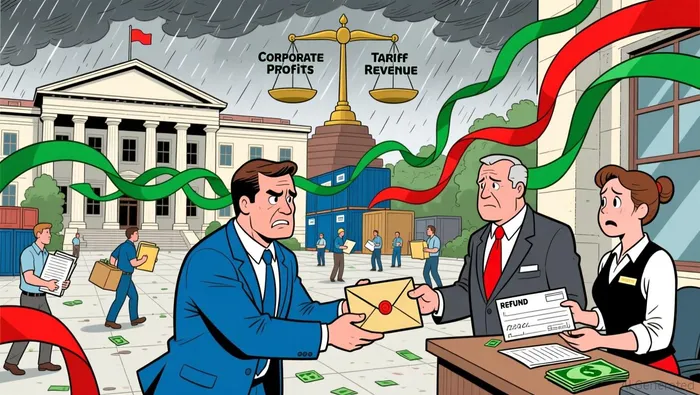
The U.S. tariff refund saga, centered on $133.5 billion in duties imposed under the International Emergency Economic Powers Act (IEEPA), has created a complex web of legal, fiscal, and market risks for trade-related sectors. As the U.S. Supreme Court prepares to rule on the legality of these tariffs, investors must grapple with the cascading implications for federal budgets, corporate profitability, and global supply chains. This analysis synthesizes the latest developments to evaluate the investment risks and opportunities in manufacturing, retail, and other trade-dependent industries.
Legal Risks: Procedural Limbo and Strategic Litigation
The legal status of the IEEPA tariff refund cases remains in procedural limbo, pending the Supreme Court's decision on whether the Trump administration's emergency tariffs were lawful. The Court of International Trade has stayed all refund litigation, effectively freezing claims until the high court's ruling. This uncertainty has prompted a surge in protective lawsuits filed by importers to preserve their rights to potential refunds. Companies are also pursuing administrative remedies, such as requesting extensions for entry liquidation or submitting post-summary corrections to U.S. Customs and Border Protection (CBP), to avoid losing eligibility for refunds.
The Supreme Court's decision will determine whether refunds are retroactively issued, applied prospectively, or left to lower courts for resolution. Legal experts caution that refunding $133.5 billion in tariffs will require a meticulously designed process, potentially involving congressional intervention or administrative rulemaking. For investors, the legal outcome will set a precedent for future tariff disputes and influence corporate strategies for managing trade-related liabilities.
Fiscal Implications: Budgetary Pressures and Revenue Volatility
The fiscal impact of the potential refund is profound. If the Supreme Court invalidates the tariffs, the federal government could face a $133.5 billion outflow, significantly offsetting the $88 billion in revenue generated by 2025 tariffs year-to-date. The Congressional Budget Office projects that these tariffs will reduce the federal deficit by $3.0 trillion over the long term, but this estimate excludes the economic costs of higher prices and retaliatory measures.
The Trump administration's tariffs have already raised $23 billion in August 2025 alone, contributing to a weaker U.S. dollar and increased compliance costs for businesses. However, the refund risk introduces volatility into federal revenue projections. If refunds are mandated, the deficit could widen unless offset by spending cuts or new revenue streams. For investors, this fiscal uncertainty underscores the importance of monitoring congressional actions and CBP administrative decisions, which could reshape the economic landscape.
Market Risks: Sector-Specific Vulnerabilities
Manufacturing: Supply Chain Shifts and GDP Drag
The manufacturing sector faces significant headwinds from the Trump 2025 tariffs. J.P. Morgan Global Research estimates that the average effective tariff rate has risen to 15.8%, projected to reduce U.S. GDP by 0.5% in the long run. Tariff-sensitive industries, such as semiconductors and industrial machinery, have seen mixed outcomes: while industrial output rose 3.5% year-to-date, higher input costs and retaliatory tariffs from countries like Brazil and India have eroded profit margins.
Global supply chains are also shifting. Manufacturers are relocating production to Vietnam, Mexico, and India to avoid U.S. tariffs on Chinese goods. However, sectors with high capital expenditures and complex production processes, such as aerospace and automotive, are less likely to reshore, creating uneven impacts across industries. The Tax Foundation warns that these tariffs could reduce U.S. GDP by 0.8% over the next decade, even before accounting for foreign retaliation.
Retail: Price Pressures and Consumer Behavior Shifts
The retail sector is grappling with the dual challenges of rising import costs and shifting consumer behavior. Tariffs have driven core goods prices 1.9% above pre-2025 trends, with imported goods prices rising 4% since the tariffs were implemented. Retailers like Best Buy have reduced sourcing from China by 55% to 30–35%, while increasing reliance on lower-tariff regions like Vietnam and Taiwan.
Consumer responses are equally critical. A MakerSights survey found that 58% of shoppers would seek cheaper alternatives if prices rose by 10–20%, with apparel and footwear being the most vulnerable categories. Retailers are adopting strategies such as price elasticity modeling, supplier diversification, and tariff engineering to mitigate these risks. However, small businesses-60% of which list tariffs as a top concern-face existential challenges, potentially leading to industry consolidation.
Strategic Adaptation and Investment Considerations
Investors must weigh the interplay of legal, fiscal, and market risks when evaluating trade-related sectors. For manufacturing, the focus should be on companies with flexible supply chains and diversified sourcing strategies. Retailers with agile pricing models and strong e-commerce platforms may better navigate consumer price sensitivity. Meanwhile, the outcome of the Supreme Court's ruling will have immediate implications for CBP refund processes and corporate cash flow management.
In the broader market, the Trump administration's tariff policies have created a volatile environment for global trade. Retaliatory measures from key partners, such as China's suspension of retaliatory tariffs and new duties on Canadian and Mexican goods, add further complexity. Investors should monitor developments in foreign trade zones and real-time scenario planning tools as companies adapt to the new normal.
Conclusion
The potential $133.5 billion tariff refund represents a pivotal moment for U.S. trade policy and its economic ramifications. Legal uncertainties, fiscal pressures, and sector-specific market risks demand a nuanced investment approach. As the Supreme Court's decision looms, stakeholders must prepare for a range of outcomes-from retroactive refunds to prolonged legal battles-and adjust their strategies accordingly. For trade-related sectors, adaptability and foresight will be the keys to navigating this turbulent landscape.







Comentarios
Aún no hay comentarios