
Investment Implications of Falling French 10-Year Bond Yields in European Fixed Income Markets
The recent decline in French 10-year government bond yields, despite persistent political and fiscal challenges, has sparked renewed debate about the dynamics of European fixed income markets. As of late September 2025, the yield on France's 10-year bond stood at 3.47%, having fallen three basis points during the month, according to Tradeweb's government bond update. This decline occurred amid heightened uncertainty, including the collapse of Prime Minister François Bayrou's government on September 8 and ongoing debates over fiscal reform, which Tradeweb also documented. While the yield briefly spiked to a three-year high of 3.61% on September 2, the subsequent pullback underscores shifting investor sentiment and broader macroeconomic forces at play, as noted in the same Tradeweb analysis.
French Yields in a Broader Eurozone Context
The Eurozone's 10-year central government bond par yield curve reached 3.24% in late September 2025, up from 3.21% the previous day and significantly higher than the 2.98% recorded a year prior, according to YCharts' 10-year curve. This upward trend reflects the European Central Bank's (ECB) tightening cycle, which has pushed bond yields higher across the region. However, France's yields have diverged from this pattern in recent weeks. The yield spread between French and German 10-year bonds widened to 76 basis points in late September-the widest in three weeks-highlighting investor concerns about France's fiscal health, a trend Tradeweb flagged in its update.
This divergence is driven by two key factors:
1. Political Instability: France's inability to form a stable government has raised fears of delayed fiscal reforms and a potential budget crisis. The country's debt-to-GDP ratio now exceeds 114%, and recent credit rating downgrades have amplified investor caution, points that were emphasized in the Tradeweb analysis.
2. Global Capital Flows: European fixed income markets have gained traction as a relative safe haven amid U.S. economic uncertainty. Goldman Sachs Asset Management notes that steeper yield curves and U.S. monetary easing have created "relative value opportunities" in European bonds.
Investment Implications for Fixed Income Portfolios
The interplay between falling French yields and broader Eurozone trends presents both risks and opportunities for investors.
1. Diversification and Risk Management
The widening yield spread between France and Germany underscores the importance of diversification. While French bonds remain vulnerable to political shocks, other Eurozone markets, such as Italy and Spain, have shown resilience due to recent credit rating upgrades (see YCharts data). Investors should balance exposure to higher-yielding European bonds with hedging strategies to mitigate sovereign risk.
2. Relative Value Opportunities
The ECB's tightening cycle has compressed yield differentials across the Eurozone, but France's political instability has created pockets of mispricing. For instance, Greece's 10-year bond yields briefly dipped below France's in September 2025-a historically unusual development attributed to Greece's improved fiscal trajectory, as reported in a Morningstar article. This suggests that structural reforms and growth prospects, rather than absolute debt levels, are increasingly driving investor decisions.
3. Geopolitical and Macroeconomic Volatility
Cross-market correlations in European fixed income have become more complex due to U.S. trade policies and geopolitical tensions, an effect Goldman Sachs Asset Management discussed in its fixed-income outlook. BlackRock highlights that investors must remain agile, as shifts in U.S. monetary policy or European fiscal consolidation efforts could trigger sudden repricing of bonds, a point covered by the Morningstar article referenced above.
Conclusion
Falling French 10-year bond yields reflect a delicate balance between domestic political risks and global capital flows. While the ECB's tightening cycle has elevated Eurozone yields, France's unique challenges-coupled with its pivotal role in the region-make its bond market a critical barometer for European financial stability. For investors, the key takeaway is clear: diversification, active risk management, and a nuanced understanding of macroeconomic interdependencies will be essential in navigating this volatile landscape.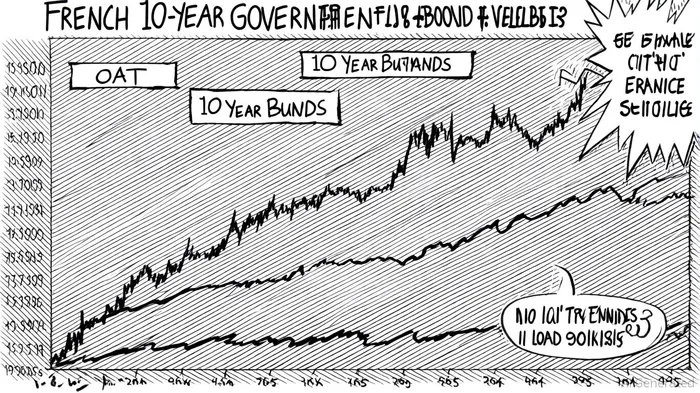







Comentarios
Aún no hay comentarios