
Investment Implications of Breakthroughs in Deep Space Observation Technology
Technological Advancements in Deep Space Observation
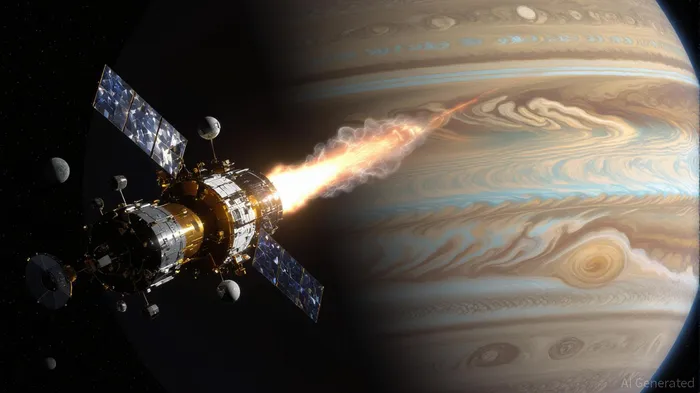
The ESA's JUICE mission, en route to Jupiter, leveraged its trajectory to observe 3I/ATLAS between November 2 and 25, 2025, using five of its instruments to capture remote-sensing data as reported by IFLScience. While JUICE is not optimized for such observations at its current location near the Sun, the mission's unexpected campaign underscores the adaptability of modern spacecraft. Meanwhile, the ExoMars TGO and Mars Reconnaissance Orbiter (MRO) enhanced precision tracking of 3I/ATLAS by tenfold using triangulated data from Mars. This milestone in planetary defense-improving trajectory predictions for interstellar objects-demonstrates the strategic value of Mars-based observation systems. Such capabilities are critical for mitigating threats from space and could attract increased funding for planetary defense initiatives.
AI Imaging and Satellite Technology
The integration of (AI) into aerospace systems is reshaping satellite operations and data analytics. AI-driven algorithms are enabling faster, more accurate interpretations of vast datasets from deep space missions, including Earth observation and interplanetary environments. For instance, the ExoMars TGO's Colour and Stereo Surface Imaging System (CaSSIS) captured detailed images of 3I/ATLAS's coma, revealing insights into its composition. This application of AI in imaging is not limited to scientific research; it is also enhancing commercial satellite operations, such as weather forecasting and resource mapping, by improving data resolution and processing speeds as noted in industry analysis.
Moreover, AI is revolutionizing , where real-time decision-making and adaptive navigation systems are essential for deep space missions according to industry experts. Startups like Spire GlobalSPIR-- and Planet LabsPL-- are leveraging AI to provide Earth-imaging insights with unprecedented accuracy, addressing challenges like climate change and global connectivity as reported by market analysis. These innovations are attracting VC interest, as investors recognize the potential for AI to optimize satellite lifespans and reduce operational costs through predictive maintenance and debris monitoring according to investment research.
Venture Funding Trends in Aerospace
The aerospace sector has seen a surge in VC investments in 2025, as reported by market data. This growth is driven by advancements in AI, small satellites, and interplanetary data collection. For example, the U.S. Department of Defense's $849.8 billion budget request highlights the strategic importance of AI in aerospace, supporting unmanned systems and space technologies according to defense analysis. Similarly, the ESA's Flight Ticket Initiative is fostering European startups by providing access to launchers for testing innovations in space.
Startups such as Benchmark Space Systems and Varda Space Industries have secured significant funding in 2025, with the latter . These companies are capitalizing on the demand for cost-effective small satellite systems and advanced communication networks, which are critical for both commercial and defense applications as detailed in industry reports. The global aerospace market is projected to exceed $430 billion by 2025, fueled by demand for electric propulsion systems, sustainable aviation technologies, and urban air mobility (UAM) solutions according to market forecasts.
Strategic Investment Opportunities
The synergy between planetary science and investment trends is evident in ESA's collaborations with Japan's JAXA and the growing Japanese space startup ecosystem as reported in market analysis. ESA's ICE Cubes and Bartolomeo platforms on the International Space Station are also enabling research and experimentation, supporting European industry in developing cutting-edge technologies according to ESA business reports. Investors should consider aerospace ventures that leverage ESA mission data, such as those focused on planetary defense, Earth observation, and autonomous systems.
Additionally, the 531 Funded Aerospace Startups report highlights the scale of VC activity in the sector, with notable investments in companies like Galactic Energy and Stoke Space. These startups are at the forefront of building satellites, launch vehicles, and space infrastructure, reflecting a shift toward private-sector leadership in space exploration.
Conclusion
Breakthroughs in deep space observation technology are not only advancing scientific understanding but also creating a robust ecosystem for investment. The precision tracking of interstellar objects, AI-driven imaging, and the proliferation of small satellites are driving demand for innovative aerospace solutions. As governments and private investors prioritize planetary defense, sustainable technologies, and autonomous systems, the sector offers compelling long-term gains for those who can navigate its complexities. Investors should focus on startups and technologies that bridge the gap between deep space exploration and commercial applications, capitalizing on the convergence of AI, satellite tech, and interplanetary data collection.







Comentarios
Aún no hay comentarios