
Investment Implications of U.S. Antitrust Regulatory Shifts: Navigating a New Enforcement Era
The U.S. antitrust landscape has entered a period of profound transformation, driven by regulatory shifts under the 2024-2025 Trump administration. These changes, which mark a departure from the Biden-era focus on expansive enforcement and novel theories of harm, are reshaping investment dynamics across key sectors. For investors, understanding the evolving priorities of the Department of Justice (DOJ) and Federal Trade Commission (FTC) is critical to navigating risks and identifying opportunities in an increasingly complex regulatory environment.
Regulatory Shifts: From Aggressive Innovation to Traditional Enforcement
The most significant policy reversal came in December 2024, when the DOJ and FTC jointly withdrew the Antitrust Guidelines for Collaborations Among Competitors, a 24-year-old framework that had provided clarity on the legality of competitor collaborations[2]. The agencies cited rapid technological advancements and evolving market dynamics as reasons for the withdrawal, urging businesses to rely instead on case law and statutes[4]. This move, coupled with the elimination of a 1977 report deeming the Robinson-Patman Act “ineffective,” signals a renewed emphasis on pricing strategies and algorithmic competition[1].
The Trump administration's approach has also prioritized deregulation and streamlined enforcement. For instance, the FTC reinstated the Hart-Scott-Rodino (HSR) early termination program in January 2025, allowing mergers to clear regulatory hurdles faster[4]. Meanwhile, the DOJ has signaled openness to negotiated remedies, such as divestitures, in merger cases—a stark contrast to the Biden administration's reluctance to accept such solutions[5]. These shifts suggest a regulatory environment that, while still rigorous, may offer greater predictability for businesses.
Sector-Specific Implications: Tech, Pharma, and Healthcare in the Crosshairs
The technology sector remains a focal point of antitrust scrutiny, particularly regarding AI-driven “surveillance pricing” and algorithmic collusion. In July 2024, the FTC issued information requests to companies leveraging AI for personalized pricing, signaling heightened concerns over data-driven anticompetitive practices[1]. For investors, this underscores the need to assess not only a company's compliance with evolving guidelines but also its exposure to litigation risks. For example, the FTC's ongoing trial against Meta, which began in April 2025, highlights the agency's commitment to challenging Big Tech monopolies[4].
In healthcare and pharmaceuticals, the regulatory environment has become increasingly litigious. The Biden administration's 2023 Merger Guidelines, which emphasized labor market impacts and innovation, led to aggressive enforcement actions, such as the October 2024 blocking of the Tapestry-Capri merger[2]. However, the Trump administration's focus on traditional theories of harm—such as price effects and market concentration—may create more favorable conditions for mergers in these sectors. For instance, the FTC's adoption of a 30% market share threshold in merger reviews could influence deal strategies in pharma and medical devices[2].
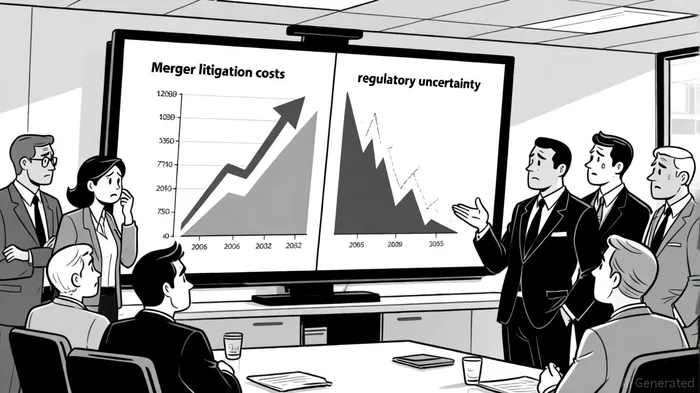
Private antitrust litigation has also surged, with settlements in 2024 reaching $8.41 billion—a 20% increase from 2023[3]. This trend suggests that even deals cleared by regulators may face legal challenges, adding another layer of risk for investors.
Market Reactions and Investment Strategies
The regulatory uncertainty has already influenced market behavior. HSR filings in 2024 rose by 18% compared to 2023, reflecting heightened scrutiny of cross-industry consolidations[3]. However, the reinstatement of early termination and the anticipated regulatory reset under the Trump administration could spur M&A activity in 2025, particularly in sectors like technology and healthcare[2].
Investors should also monitor the FTC's renewed focus on labor markets. The agency's Joint Labor Task Force, established in early 2025, is investigating anticompetitive practices such as no-poach agreements and non-compete clauses[5]. While this aligns with broader pro-worker policies, it could increase compliance costs for employers, particularly in high-turnover industries.
Looking Ahead: Balancing Risk and Opportunity
For investors, the key challenge lies in balancing the risks of regulatory overreach with the opportunities presented by a more predictable enforcement framework. Sectors poised for growth include AI-driven technologies (despite scrutiny) and healthcare innovation, where the focus on traditional competition metrics may reduce regulatory friction. Conversely, industries reliant on pricing strategies or vertical integration—such as Big Tech and pharma—will need to navigate a dual threat of enforcement and litigation.







Comentarios
Aún no hay comentarios