
The Investment Imperative in Workforce Reskilling Platforms Amid a Global Skills Crisis
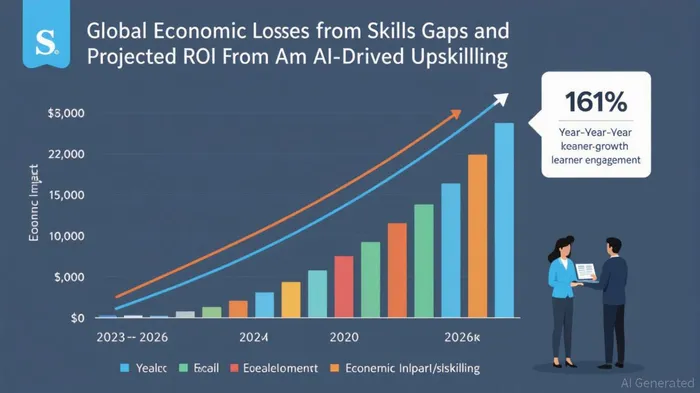
The global skills crisis is no longer a distant threat but an urgent economic emergency. According to a report by IDC, skills gaps will cost organizations over $5.5 trillion by 2026, driven by delays in digital transformation, reduced customer satisfaction, and lost revenue [1]. This staggering figure underscores a systemic failure to align workforce capabilities with the rapid evolution of technologies like artificial intelligence, cybersecurity, and cloud computing. For investors, the crisis presents a dual opportunity: addressing a critical societal need while capitalizing on a market where ed-tech platforms are redefining the rules of value creation.
The Skills Gap as a Systemic Risk
The skills shortage is not confined to a single sector or region. Nearly two-thirds of organizations report digital transformation delays averaging 10 months, with AI skills identified as the most critical and hardest-to-fill gap [2]. IDC analysts note a dangerous imbalance: while enterprises invest heavily in AI tools, they lag in training employees to use them effectively [3]. This disconnect threatens to stifle innovation and productivity, with 56% of IT leaders warning that unaddressed skill gaps pose a medium-to-high risk to business continuity [4].
Ed-Tech as the Strategic Lever
Enter platforms like SkillsoftSKIL--, which are transforming workforce reskilling from a cost center into a strategic asset. Skillsoft’s Interactive Skill Benchmarks (ISBs) exemplify this shift. By combining hands-on virtual labs, AI-powered feedback, and real-world scenario simulations, ISBs enable learners to bridge theoretical knowledge with practical application [1]. The results are measurable: a 20% average skill gain per learner and a 161% year-over-year increase in completions [5]. For enterprises, this translates to faster onboarding, reduced reliance on external hiring, and a 70–92% cost saving compared to traditional recruitment [6].
Skillsoft’s AI Skills Accelerators further amplify this impact. By integrating secure GPT-4 sandboxes and instructor-led workshops, the platform addresses the urgent demand for AI literacy. Case studies like CGI’s upskilling of 70,000 professionals in three months—resulting in 90% confidence in applying AI concepts—demonstrate the scalability of such models [5]. These initiatives align with broader trends: 72% of IT decision-makers now prioritize training existing talent over hiring, recognizing that reskilling is both economically and strategically superior [4].
ROI: Beyond Cost Savings
The return on investment in AI-driven upskilling extends far beyond reduced hiring costs. A 2025 study by Disco.co found that AI-driven programs delivered a 250% ROI, driven by accelerated productivity and innovation [1]. Similarly, companies investing in employee development report 218% higher income per employee, a metric that reflects both operational efficiency and competitive advantage [6]. Skillsoft’s 2024 IT Skills and Salary Report reinforces this, noting that 94% of IT leaders observed tangible benefits from training, including improved morale and talent retention [5].
For investors, the data is compelling. Organizations that adopt blended learning models—combining AI tools with human-led instruction—see a 40% productivity boost post-training [3]. Meanwhile, certified staff add an estimated $25,000 in annual value per employee, a figure that grows as AI adoption intensifies [5]. These metrics position ed-tech platforms not just as mitigators of risk but as engines of growth in an AI-driven economy.
The Road Ahead
The urgency of the skills crisis will only intensify. As McKinsey notes, AI’s long-term potential could add $4.4 trillion in productivity gains, but this requires a workforce capable of leveraging these tools [7]. Platforms like Skillsoft are uniquely positioned to fill this gap, with their focus on outcome-oriented learning and scalable AI integration. For investors, the strategic allocation in ed-tech is no longer speculative—it is a calculated response to a $5.5 trillion market failure.
However, success hinges on execution. The BCG AI Radar 2025 highlights that less than one-third of companies have upskilled a quarter of their workforce in AI, signaling a vast untapped potential [3]. Investors must prioritize platforms that demonstrate agility in adapting to emerging technologies and measurable ROI in diverse industries.
Conclusion
The global skills crisis is a defining challenge of the 21st century, with economic and social ramifications that transcend borders. For those seeking to align capital with impact, the ed-tech sector offers a rare confluence of necessity and innovation. By investing in platforms like Skillsoft, which combine AI-driven tools with proven ROI, investors can not only mitigate systemic risks but also unlock value in a market poised for exponential growth.
Source:
[1] IDC predicts $5.5 trillion in economic losses by 2026 due to skills gaps [https://www.ciodive.com/news/tech-talent-skills-gaps-cost-trillions-idc/716523/]
[2] AI skills shortages delay digital transformation by 10 months [https://www.computerworld.com/article/2135541/within-two-years-90-of-organizations-will-suffer-a-critical-tech-skills-shortage.html]
[3] BCG AI Radar 2025: Less than one-third of companies upskill workforce [https://www.bcg.com/publications/2025/closing-the-ai-impact-gap]
[4] 56% of IT leaders warn of business risks from unaddressed skill gaps [https://www.businesswire.com/news/home/20241113929992/en/Skillsofts-New-IT-Skills-Salary-Report-Highlights-Trends-Impacting-Technology-Careers-Investments-and-Talent-Strategies-for-2025]
[5] Skillsoft’s 161% YoY growth in learner engagement [https://www.skillsoft.com/press-releases/skillsoft-reports-surge-in-learner-growth-and-engagement-as-enterprises-accelerate-technology-skilling]
[6] 218% higher income per employee for companies investing in development [https://pierpoint.com/blog/upskilling-and-reskilling-economic-impact/]
[7] McKinsey: AI could add $4.4 trillion in productivity gains [https://www.mckinsey.com/capabilities/mckinsey-digital/our-insights/superagency-in-the-workplace-empowering-people-to-unlock-ais-full-potential-at-work]







Comentarios
Aún no hay comentarios