
Investing in Utility Resilience Amid Operational Disruptions: The Case of Istanbul
The Water Supply Imbalance: A Gini Coefficient of 0.65
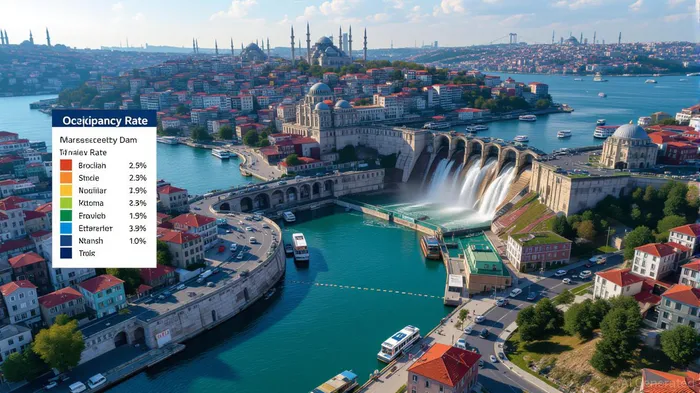
Istanbul's water management system is under strain. A 2023-2025 analysis of the city's ten main dams revealed a Gini coefficient of 0.65, a stark indicator of inequality in water resource distribution, according to a Paturkey report. Northern dams operate with stable occupancy rates, while those closer to the city center exhibit erratic performance, driven by urban encroachment, aging infrastructure, and climate variability, as noted in a NCBI analysis. This imbalance threatens not only equitable access but also the reliability of utility systems, particularly during droughts or extreme weather events.
Compounding the issue is land subsidence. A global study identified Istanbul as one of 48 coastal cities sinking due to groundwater overuse and rising sea levels, with areas like Arnavutköy experiencing subsidence rates of up to 13.2 cm per year, as reported in the Paturkey report. Such geological shifts risk damaging pipelines, reservoirs, and treatment facilities, creating operational disruptions that ripple through the economy.
The Istanbul Resilience Project: A $650 Million Bet on Stability
To address these challenges, the World Bank has committed $650 million to the Istanbul Resilience Project, part of a broader $5.4 billion in external funding for the city, according to a World Bank press release. The initiative focuses on upgrading public infrastructure, including 50 critical buildings such as schools and community centers, designed to withstand seismic and climate shocks, as described in the World Bank press release. These structures incorporate green infrastructure-solar power, rainwater harvesting, and energy-efficient systems-positioning them as self-sufficient hubs during crises, according to the World Bank press release.
While the project emphasizes disaster preparedness and institutional capacity building, its direct impact on water supply disruptions remains opaque. No specific metrics quantify how these investments will reduce operational outages or stabilize dam performance, according to the NCBI analysis. For investors, this gap underscores the need for complementary strategies, such as private-sector partnerships to modernize aging pipelines or AI-driven monitoring systems to predict infrastructure failures, as suggested in the NCBI analysis.
Scalability and the Path Forward
The scalability of the Istanbul Resilience Project's components is a key consideration. Public building upgrades and green infrastructure are modular, allowing for phased expansion, as noted in the World Bank press release. However, scaling these efforts to address the city's water supply challenges requires targeted interventions. For instance, optimizing dam operations through integrated modeling-suggested by recent studies-could balance regional disparities and enhance climate resilience, as described in the NCBI analysis.
Investors should also monitor regulatory shifts. Stricter groundwater extraction rules, as recommended by subsidence studies, could alter the cost structure for utilities and create opportunities for sustainable water-tech solutions, according to the Paturkey report.
Conclusion: A Call for Precision and Innovation
Istanbul's water supply risks and infrastructure vulnerabilities present both challenges and opportunities. While the Istanbul Resilience Project is a critical first step, its success hinges on addressing unmet needs-such as quantifiable water supply improvements and advanced infrastructure diagnostics, as suggested in the NCBI analysis. For investors, the lesson is clear: resilience is not a one-size-fits-all proposition. It demands precision, innovation, and a willingness to navigate the complex interplay of climate, urbanization, and governance.







Comentarios
Aún no hay comentarios