
Investing in the River: Viking Cruises' Strategic Dominance in a Booming Niche Market
The global river cruise market is undergoing a transformative phase, driven by post-pandemic shifts in travel preferences and a growing appetite for sustainable, immersive experiences. With the market valued at USD 4.8 billion in 2023 and projected to reach USD 10 billion by 2030 (CAGR of 11.1%) [1], operators like VikingVIK-- River Cruises are redefining the sector through innovation, sustainability, and strategic fleet expansion. For investors, Viking's position as a market leader in this niche segment offers compelling long-term potential, particularly as it aligns with broader trends in experiential tourism and environmental responsibility.
The Post-Pandemic River Cruise Renaissance
The pandemic disrupted global travel, but it also accelerated demand for smaller, more flexible itineraries. River cruises, with their intimate scale and cultural immersion, emerged as a preferred alternative to mass-market ocean voyages. According to a report by Grand View Research, the U.S. river cruise market alone is expected to grow at a CAGR of 14.5% from 2025 to 2030 [4], fueled by domestic travelers seeking multi-destination trips and a younger demographic drawn to adventure-focused excursions.
Viking has capitalized on this shift by expanding its domestic U.S. routes, including the Mississippi River, where it offers access to iconic landmarks and cultural experiences. This strategy taps into the growing "staycation" trend, particularly among baby boomers and multi-generational families, who now account for a significant portion of the river cruise demographic [4].
Sustainability as a Competitive Edge
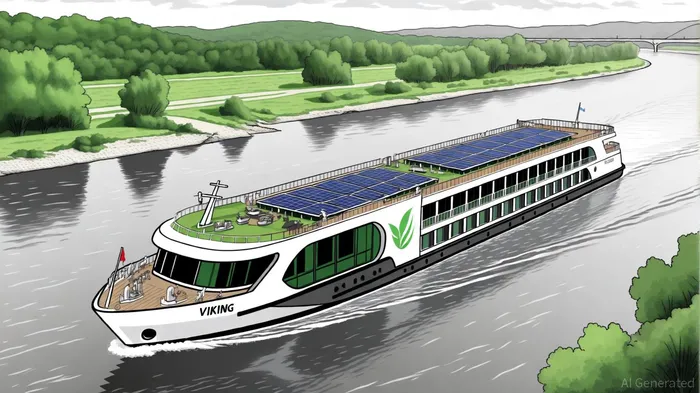
Viking's commitment to sustainability is not just a marketing tactic-it's a core component of its long-term strategy. The company has invested in hybrid-electric propulsion systems, solar panels, and shore power capabilities to reduce emissions [1]. More ambitiously, Viking plans to launch the world's first hydrogen-powered cruise ship, the Viking Libra, in 2026, followed by the Viking Astrea in 2027 [1]. These innovations position Viking as a pioneer in green maritime technology, a critical differentiator in an industry increasingly scrutinized for its environmental impact.
Moreover, Viking's partnerships with institutions like the University of Cambridge and NOAA integrate scientific research into its itineraries, allowing passengers to participate in environmental preservation efforts. This blend of luxury and purpose resonates with eco-conscious travelers, a demographic expected to drive 60% of global tourism growth by 2030 [3].
Financial Resilience and Strategic Fleet Growth
Viking's financial performance underscores its robust positioning. In Q1 2025, the company reported revenue of USD 897.1 million, a 24.9% year-over-year increase, with Adjusted EBITDA surging by USD 77.3 million [3]. Full-year 2024 revenue reached USD 5.33 billion, up 13.2% from 2023, while Adjusted EBITDA grew 23.7% to USD 1.35 billion [3]. These figures reflect strong demand and effective cost management, even amid macroeconomic headwinds.
The company's fleet expansion further solidifies its growth trajectory. Viking plans to add 11 new ships in 2025 and has exercised options for vessels scheduled to debut in 2027 and 2028 [3]. This aggressive scaling is supported by record advance bookings: as of February 2025, Viking had secured USD 5.3 billion in 2025 revenue, a 26% increase from the same period in 2024 [3].
Navigating Risks and Opportunities
While Viking's trajectory is largely positive, challenges persist. Fuel price volatility and economic uncertainty could pressure margins, though the company's focus on high-net-worth travelers-less sensitive to price fluctuations-mitigates this risk [2]. Additionally, the normalization of advance payment growth into 2026 may test Viking's pricing power [2].
However, Viking's diversified offerings (river and ocean cruises), strong brand loyalty, and first-mover advantage in sustainable technology provide a buffer. Moody's recent upgrade of Viking's credit rating to Ba3 in March 2025 further validates its financial stability [3].
Conclusion: A Blue Ocean Strategy in Niche Tourism
Viking River Cruises exemplifies the "blue ocean" strategy: creating uncontested market space by combining luxury, sustainability, and cultural immersion. As the river cruise market expands and travelers prioritize eco-friendly, experiential travel, Viking's strategic investments in technology, fleet growth, and domestic routes position it to outperform peers. For investors seeking exposure to a resilient, high-growth niche, Viking offers a compelling case-provided they remain mindful of macroeconomic risks.





Comentarios
Aún no hay comentarios