
Investing in Nuclear Waste Management: Castor Transports' Strategic and Operational Edge
Germany's nuclear phase-out has left a critical challenge: managing radioactive waste without a permanent repository. In this context, Castor Transports has emerged as a linchpin of interim storage infrastructure, leveraging strategic preparedness and operational reliability to navigate complex logistical and political landscapes. For investors, the company's role in safely relocating and storing nuclear waste offers a compelling case study in resilience and long-term planning.
Strategic Preparedness: A Blueprint for Scalability
Castor Transports' strategic initiatives in 2023–2025 underscore its central role in Germany's nuclear waste managementWM--. The Federal Office for the Safety of Nuclear Waste Management (BASE) recently approved the transport of spent fuel elements from the Research Neutron Source Heinz Maier-Leibnitz (FRM II) to the Ahaus interim storage facility, a move critical to freeing up space in FRM II's decay pool, which is nearing full capacity with 48 of 50 spots occupied [1]. Similarly, the first transport of seven Castor containers from the Sellafield reprocessing site in the UK to Zwischenlager Isar in Bavaria marked a significant milestone in returning foreign-generated nuclear waste to Germany [3].
These efforts are part of a broader strategy to expand interim storage capacity. Currently, 1,200 Castor containers are stored at 17 sites nationwide, with plans to scale to 1,800 containers as the country awaits a permanent solution [2]. The German Federal Environment Ministry has defended these transports as essential for nuclear safety, emphasizing that “there are no simple or convenient solutions for managing nuclear waste over the long term” [5].
Operational Reliability: Engineering Safety into Every Cask
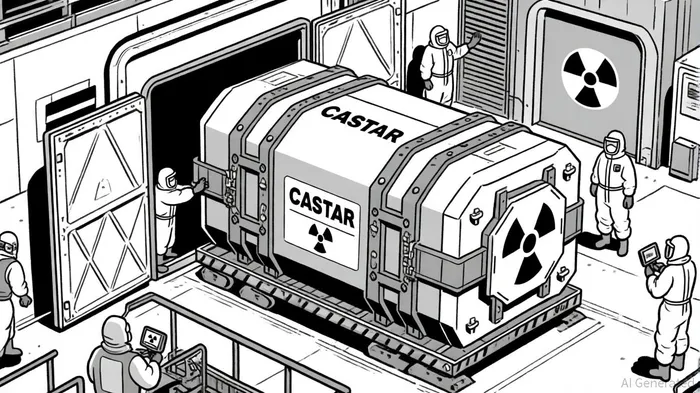
The operational reliability of Castor Transports hinges on the robust design of its containers. The CASTOR® casks, developed by GNS, are engineered to withstand extreme conditions, including fire, impact, and radiation leaks. Their “double lid system” ensures leaktightness, while their thick walls and subcriticality features meet International Atomic Energy Agency (IAEA) standards [3]. For instance, the HAW28M containers used in the 2025 transport from France to Philippsburg feature a dual-lid design and are tested to contain radiation for decades [2].
Logistical rigor further bolsters reliability. The April 2025 transport of seven Castor containers to Niederaichbach involved police accompaniment, real-time monitoring, and strict adherence to BASE protocols [6]. Such measures reflect a commitment to minimizing risks, a priority for a sector where public trust is paramount.
Investment Considerations: Necessity and Long-Term Value
For investors, Castor Transports' operations highlight the necessity of interim storage infrastructure. Germany's lack of a final repository means that interim facilities will remain critical for decades. The scale of the task is immense: the Jülich project alone involves relocating 152 Castor casks containing 300,000 fuel element spheres, one of the largest road-based nuclear waste transports in history [4].
Moreover, the technical and regulatory frameworks supporting Castor Transports align with long-term metrics storage principles. The use of time-series databases for real-time monitoring, object storage for archival, and automated lifecycle policies ensures compliance with standards like SOC 2 [6]. This infrastructure not only supports operational efficiency but also attracts institutional investors seeking resilient, low-volatility assets.
Conclusion: A Model for Sustainable Infrastructure Investment
Castor Transports exemplifies how strategic foresight and operational excellence can address complex societal challenges. As Germany continues to phase out nuclear power, the company's role in safely managing radioactive waste will only grow. For investors, this represents a unique opportunity to support infrastructure that balances technical rigor with public responsibility—a rare combination in today's energy transition landscape.





Comentarios
Aún no hay comentarios