
Investing in Human Capital: The Strategic ROI of Higher Education in a Technology-Driven Economy
The Evolving ROI of Higher Education
Recent data underscores a nuanced picture of return on investment (ROI) in higher education. In Utah, certificate programs at public technical colleges demonstrate a compelling short-term ROI, with a 10-year net present value exceeding $350,000-surpassing four-year institutions due to lower costs and faster entry into the workforce according to Utah Foundation data. However, over a 40-year horizon, bachelor's degrees yield stronger financial returns, emphasizing the long-term advantages of extended education according to Utah Foundation analysis. Nationally, 70% of public university graduates can expect a positive ROI within a decade, though this varies by state, with Washington, D.C., at 82% and North Dakota at 53% according to financial research. These disparities highlight the interplay between affordability, program alignment with job markets, and regional economic conditions.
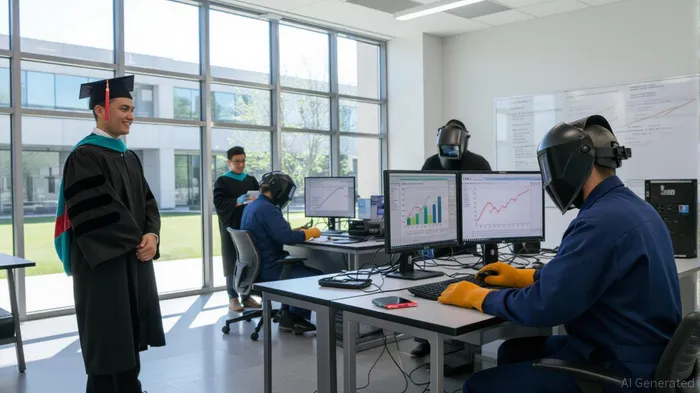 The pressure on colleges to demonstrate ROI has intensified, with institutions like Michigan State University collaborating with industry leaders to reshape curricula and integrate internships, aiming to close the gap between academic training and employer needs according to financial analysis. Despite such efforts, 52% of recent graduates find themselves in jobs that do not require a degree according to a 2025 survey, signaling a misalignment that challenges the perceived value of traditional higher education.
Vocational Training: A High-Yield Alternative
Vocational and technical education programs are increasingly positioned as viable alternatives, particularly in high-demand sectors like healthcare, IT, and skilled trades. These programs typically require one to two years of training, enabling graduates to enter the workforce with minimal debt and competitive starting salaries. For instance, skilled trades such as plumbing and electrical work can yield median annual earnings of $60,000 to $75,000 within a few years of training according to industry reports. This model not only reduces financial risk but also addresses labor shortages in critical industries, offering a faster route to economic mobility.
Corporate Investment in Human Capital: A Strategic Shift
As technology redefines workforce demands, corporations are redefining their investment strategies. The 2025 Global Human Capital Trends report by Deloitte emphasizes that human capital is no longer viewed merely as a cost center but as a strategic asset according to Deloitte research. Companies are leveraging AI-driven HR technologies to enhance workforce performance, innovation, and well-being, with global HR tech investment surging by 60% year-over-year according to SHRM analysis. This shift reflects a broader recognition that augmenting human capabilities through advanced training and technology integration is critical for sustaining competitive advantage.
For example, investment in AI for education and training has shown a direct correlation with GDP growth according to scientific research, underscoring the economic benefits of aligning workforce development with technological advancements. Corporations are now prioritizing programs that bridge skill gaps in emerging fields, such as cybersecurity and data science, ensuring their talent pools remain agile in a rapidly evolving landscape.
The Macroeconomic Implications
At the macroeconomic level, higher education in technology fields is a catalyst for growth. Digital transformation, supported by robust human capital investment, drives innovation and productivity, fostering high-quality economic development according to research findings. Institutions are adapting to these demands by reevaluating financial models to better align with labor market needs. This alignment is not just about cost efficiency but about cultivating a workforce capable of driving technological progress and, by extension, national competitiveness.
Conclusion
The ROI of higher education is no longer a one-size-fits-all proposition. While bachelor's degrees retain long-term financial advantages, vocational training offers a high-yield alternative for specific career pathways. For corporations and policymakers, the challenge lies in harmonizing educational investments with the dynamic needs of a technology-driven economy. By treating human capital as a strategic asset-whether through traditional degrees, technical certifications, or AI-enhanced training-societies can unlock sustainable economic growth and ensure that individuals and organizations thrive in an era of relentless innovation.







Comentarios
Aún no hay comentarios