
Investing in High-Growth Enablers of the $1.5 Trillion IoT Ecosystem by 2029
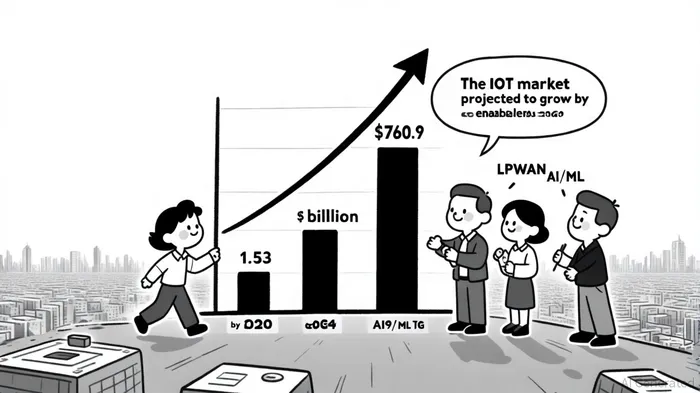
The Internet of Things (IoT) is no longer a futuristic concept-it is a $1.5 trillion juggernaut reshaping industries, cities, and daily life. By 2029, the global IoT market is projected to expand from $760.9 billion in 2024 to $1.53 trillion, growing at a compound annual growth rate (CAGR) of 15.05%, according to a Transforma Insights forecast. This explosive growth is driven by a confluence of technological enablers, from 5G and edge computing to AI-driven analytics and satellite connectivity. For investors, the question is no longer if to invest in IoT, but how to target the most transformative infrastructure and companies.
The Enablers Powering the IoT Revolution
1. 5G and LPWAN: The Backbone of Connectivity
The rollout of 5G networks has been a game-changer for IoT, enabling ultra-low latency and high-speed data transfer essential for real-time applications like autonomous vehicles and industrial automation, as noted in a Mordor Intelligence report. Meanwhile, Low-Power Wide-Area Networks (LPWAN)-including LoRaWAN and NB-IoT-are solving the puzzle of scalable, energy-efficient connectivity for remote and industrial IoT devices. For example, Siemens has leveraged LPWAN to retrofit legacy machinery in brown-field manufacturing sites, boosting operational transparency, per a Grand View Research analysis.
Investors should watch companies like Soracom and Telit Cinterion, which are pioneering 5G and LPWAN solutions. Soracom's recent partnership with NvidiaNVDA-- to integrate AI-driven analytics into its IoT platform exemplifies how connectivity providers are evolving into AIoT (AI + IoT) enablers, as featured in CRN's IoT list.
2. Edge Computing: Redefining Data Processing
Edge computing is another critical enabler, allowing data to be processed closer to the source, reducing latency and bandwidth costs. This is particularly vital for applications like predictive maintenance in manufacturing, where split-second decisions can prevent equipment failures, according to a Global Market Insights report.
Private 5G and edge computing solutions are being led by firms like Celona and HPE Aruba. Celona's private 5G networks, for instance, are being adopted by logistics giants to optimize warehouse automation, as reported by Yahoo Finance.
3. AI/ML Integration: The Brain Behind the Sensors
Artificial intelligence and machine learning are transforming raw IoT data into actionable insights. In healthcare, wearable devices paired with AI algorithms now enable continuous patient monitoring and early disease detection, according to Market Data Forecast. Similarly, JUMO's AIoT implementation in production lines has boosted sensor accuracy by 20%, per a Binariks analysis.
Investors should consider platforms like Terminus Technologies, which specializes in AI-driven smart city infrastructure, or Armis Security, which uses ML to secure industrial IoT ecosystems, as highlighted in a QuickMarketPitch roundup.
4. Satellite Connectivity: Bridging the Last-Mile Gap
Non-terrestrial networks (NTN) are extending IoT's reach to remote areas. Companies like Skylo Technologies and Sateliot are deploying satellite-based solutions for logistics tracking, precision agriculture, and energy grid monitoring, as outlined in Go2Sim's State of IoT. These technologies are critical for industries like EV charging, where IoT enables dynamic load balancing across dispersed stations, according to IoT Analytics.
High-Growth Sectors and Strategic Investment Opportunities
- Smart Manufacturing: Predictive maintenance and robot coordination are driving IoT adoption in factories. Siemens' record digital orders in 2023 underscore this trend (per Mordor Intelligence).
- Healthcare: Wearable health monitors and AI-powered diagnostics are creating a $153.2 billion IoT healthcare market by 2029, according to MarketsandMarkets.
- Smart Cities: Governments are investing heavily in IoT for traffic management, energy efficiency, and public safety. Terminus Technologies' smart city platforms are already deployed in 30+ cities, as reported by The Tech Edvocate.
- Agriculture: Precision farming tools, enabled by LPWAN and satellite sensors, are projected to grow at 18.8% CAGR, per a GlobeNewswire survey.
Navigating Risks and Challenges
Despite the optimism, challenges persist. High implementation costs and security vulnerabilities remain barriers, particularly in industrial IoT, according to a Fortune Business Insights report. However, advancements in blockchain for decentralized security and system disaggregation (decoupling hardware/software) are mitigating these risks, per a JustCreateApp roundup.
Conclusion: A $1.5 Trillion Opportunity
The IoT ecosystem's growth hinges on its enablers-connectivity, edge computing, AI, and satellite tech. For investors, the path to capturing this market lies in targeting companies at the intersection of these innovations. Firms like Soracom, Celona, and Skylo Technologies are not just participants in the IoT revolution; they are its architects. As the market accelerates toward $1.5 trillion by 2029, early bets on these enablers could yield outsized returns.







Comentarios
Aún no hay comentarios