
Investing in the Future of Food: Capitalizing on Global Shifts Toward Health-Conscious Eating
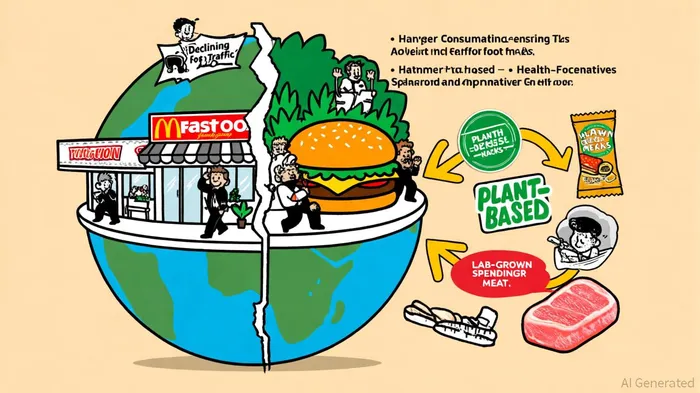
The global food industry is undergoing a seismic shift as consumers increasingly prioritize health, sustainability, and transparency. Fast-food chains, once synonymous with convenience and affordability, now face declining demand in developed markets, while health-conscious eating habits drive explosive growth in alternative protein and nutrient-dense food sectors. For investors, this transition represents a golden opportunity to align portfolios with long-term trends reshaping the $1.5 trillion global food market.
Market Growth: A $80.4 Billion Alternative Protein Boom
The alternative protein market, valued at $21.5 billion in 2025, is projected to surge to $80.4 billion by 2035, growing at a 14.1% CAGR[3]. Plant-based proteins dominate this space, capturing 62% of the market share in 2025, fueled by innovations in soy, pea, and mycelium-based products[3]. Meanwhile, lab-grown meat, though still nascent, is gaining regulatory traction—two U.S. lab-grown chicken products received USDA approval in 2024, signaling a critical inflection point[3].
Technological advancements are accelerating this growth. Precision fermentation and cellular agriculture are reducing production costs and improving scalability for animal-free dairy and meat proteins[3]. For instance, companies like Perfect Day (precision-fermented dairy) and Meati (mycelium-based whole-cut meats) have secured $90 million and $100 million in funding, respectively, underscoring investor confidence in these technologies[2].
Nutrient-Dense Foods: A $15.24 Billion Health-Driven Sector
Parallel to the alternative protein boom, the nutrient-dense food market is expanding rapidly. Valued at $7.16 billion in 2024, it is expected to reach $15.24 billion by 2032, driven by a 9.9% CAGR[2]. This growth is fueled by demand for functional foods addressing immunity, digestion, and cardiovascular health, as well as the rise of plant-based and clean-label products[2].
Key players like Nestlé and Kerry Group are leading the charge, introducing fortified breakfast cereals, probiotic-rich beverages, and plant-based protein bars[1]. Meanwhile, emerging brands such as RXBAR and Graze are capitalizing on the $12 billion functional snacking market, offering nutrient-packed, ready-to-eat options[1].
Investment Vehicles: From ETFs to Venture-Backed Innovators
For investors seeking exposure to these trends, multiple avenues exist:
1. Publicly Traded Companies: Firms like Beyond Meat, Oatly, and Steakholder Foods (cultivated meat) are now accessible to retail investors[1].
2. ETFs: The U.S. Vegan Climate ETF (VEGN) and VanEck Future of Food ETF (YUMY) offer diversified exposure to plant-based and food-tech equities[1].
3. Private Equity and Venture Capital: High-growth startups such as Formo (fermentation-based cream cheese) and Infinite Roots (mycelium protein) have attracted $50+ million in funding, reflecting strong institutional interest[2].
4. Crowdfunding and Public Holding Companies: Non-accredited investors can access alternative protein startups via platforms offering look-through equity or crowdfunding campaigns[1].
Regional Dynamics: North America Leads, Asia-Pacific Emerges
North America dominates the alternative protein market with a 48% share in 2025, driven by regulatory support and the presence of industry giants like Beyond Meat and Impossible Foods[2]. However, Asia-Pacific is emerging as a high-growth region, with rising disposable incomes and urbanization fueling demand for nutrient-dense and plant-based foods[4].
Europe, particularly Germany and the U.K., is also a key market, with 66% of alternative protein applications in the food and beverage segment[3]. Regulatory frameworks in Singapore and Israel further accelerate the commercialization of cultivated meat and algae-based proteins[2].
Challenges and Opportunities
Despite the optimism, challenges persist. High production costs for lab-grown meat and regulatory delays remain barriers[3]. However, advancements in AI-driven research and nanotechnology are improving bioavailability of nutrients and reducing costs[5]. For instance, CRISPR-edited crops and 3D-printed foods are enhancing both sustainability and nutritional profiles[1].
Conclusion: A Strategic Imperative for Investors
The convergence of health-conscious consumer behavior, technological innovation, and regulatory progress is creating a $95 billion investment opportunity by 2035. Investors who position themselves in companies leveraging precision fermentation, nutrient fortification, and plant-based scalability will be well-placed to capitalize on this shift. As the food industry evolves, the mantra of “eat well, live well” is no longer a niche trend—it's a market-defining force.





Comentarios
Aún no hay comentarios