
Investing in the Future: How ComEd and EPRI's Ag Pods Model Redefines Sustainable Agrifood Infrastructure
A Dual Impact: Decarbonization and Community Resilience
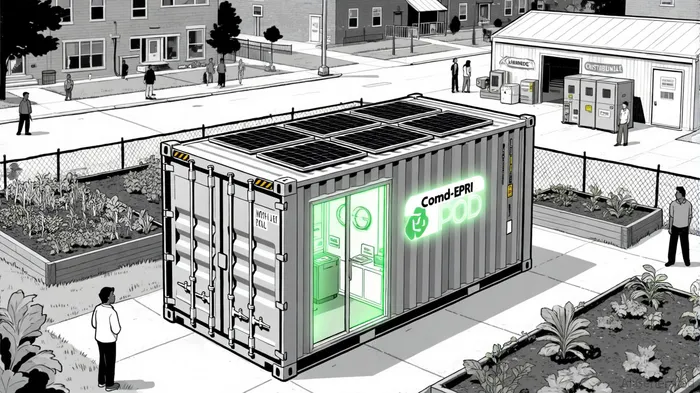
The Ag Pods, housed in repurposed shipping containers, leverage LED lighting, high-efficiency HVAC systems, and recirculating water pumps to enable year-round crop cultivation, according to ComEd and EPRI's Ag Pods Initiative. These units, managed by local organizations like the (YMEN) and Northern Illinois University's Edible Campus program, , herbs, and root vegetables in North Lawndale alone, according to the ComEd and EPRI completion announcement. Beyond food output, the program has created employment opportunities for youth and students, embedding agrifood education into community development, according to the ComEd and EPRI collaboration announcement.
Critically, the Ag Pods' energy use is monitored in real time via a custom verification system, providing granular data on electricity consumption and water efficiency, according to a Controlled Environment Agriculture Market Forecast. This aligns with broader industry trends: the global CEA market is projected to grow at a 14.5% CAGR through 2032, driven by urbanization and sustainability demands, according to the Controlled Environment Agriculture Market Size. For utilities like ComEd, such partnerships represent a strategic pivot toward grid-responsive infrastructure, where CEA farms act as distributed energy loads that can be optimized for peak demand management, as noted in Industry Signals – September 16, 2025.
The Investment Case: Clean-Tech Synergies and Scalability
While specific ROI figures for the Ag Pods remain unpublished, the broader CEA sector's financial trajectory is compelling. By 2025, , , according to the Controlled Environment Agriculture Market Size report. Hydroponics and LED lighting dominate segments, reflecting the sector's focus on resource efficiency. For utilities, the Ag Pods model exemplifies how clean-tech partnerships can diversify revenue streams. For instance, energy-smart farms-aligned with smart grid strategies-reduce operational costs while enhancing grid stability, according to the Global CEA Census.
The program's national study, involving 16 energy companies, underscores scalability, according to ComEd and EPRI's national study. By sharing data on energy use and crop yields, utilities can refine CEA operations for wider deployment. This aligns with industry signals like the Global CEA Census, which standardizes metrics to attract investors. Moreover, policy incentives, such as USDA's crop insurance for CEA, mitigate financial risks, further boosting scalability.
Challenges and the Path Forward
Despite its promise, the Ag Pods initiative faces hurdles. The absence of detailed financial benchmarks-such as cost savings from reduced water use or ROI from local produce sales-limits immediate investment assessments, according to the OECD-FAO Agricultural Outlook 2023-2032. However, the program's emphasis on data collection and community engagement addresses a critical gap: proving CEA's viability in rural and urban contexts. For investors, the key lies in long-term value creation. Modular, low-maintenance CEA systems, like those deployed in schools and supermarkets, offer distributed food infrastructure that reduces supply chain vulnerabilities, according to the 2025.
Conclusion: A Blueprint for the Next-Generation Agrifood Economy
ComEd and EPRI's Ag Pods Pilot Program exemplifies how utility-cleantech collaborations can drive decarbonization and economic equity. By embedding energy-efficient CEA into community ecosystems, the initiative bridges the gap between sustainable infrastructure and local food security. As the CEA market expands, utilities and investors must prioritize partnerships that prioritize data transparency, policy alignment, and scalable design. The Ag Pods model is not just a pilot-it's a prototype for a resilient, decentralized agrifood future.







Comentarios
Aún no hay comentarios