
Investing in Defense Tech: A Shield Against Modern Warfare's New Frontiers
The Russia-Ukraine conflict has become a proving ground for 21st-century warfare, where hypersonic missiles, swarming drones, and cyberattacks redefine battlefield dynamics. For investors, this escalating threat landscape presents a rare opportunity: strategic defense infrastructure firms are now at the epicenter of a global arms race. With Ukraine’s energy grids and cities under relentless attack, demand for advanced air defense systems, early warning technologies, and counter-drone solutions is soaring. Here’s why defense tech is no longer just a niche sector—it’s a critical growth engine for the next decade.
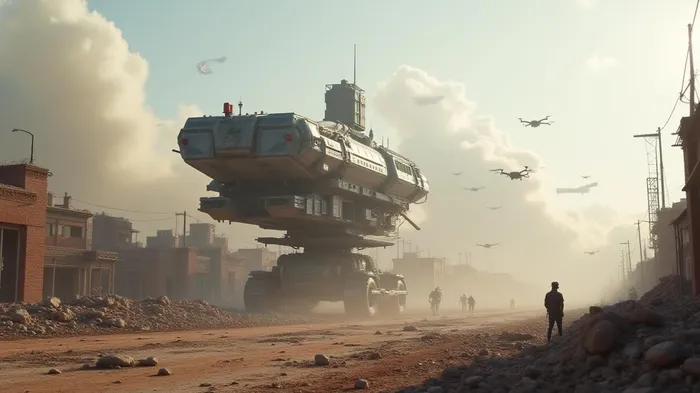
The Escalating Threat: Why Ukraine’s Energy Infrastructure is Ground Zero
Russian missile and drone strikes in 2025 have targeted Ukraine’s energy infrastructure with unprecedented precision. On May 20 alone, 108 Shahed drones struck regions like Donetsk and Dnipropetrovsk, crippling power plants and transmission lines. The Ukrainian Air Force has intercepted 35% of these drones, but 65% evade detection, highlighting critical gaps in defense capabilities.
The vulnerability of energy networks is not just a humanitarian crisis—it’s a geopolitical wake-up call. A single strike on a power plant can paralyze cities, disrupt military logistics, and destabilize entire regions. As Russian tactics evolve—from high-altitude drone swarms to decoy tactics—the demand for adaptive defense systems is surging.
The Defense Tech Playbook: Where to Invest Now
Investors should focus on four key technologies that are both mission-critical and underappreciated by broader markets:
- Long-Range Air Defense Systems
- Raytheon’s NASAMS: Deployed by Ukraine and NATO allies, NASAMS combines portable radar with high-altitude interceptors. With a 98% success rate against drones, it’s a frontline favorite.
Lockheed Martin’s Patriot: A $3.5 billion system upgrade in 2024 now includes AI-driven targeting. Germany’s 2025 order of 12 Patriot batteries signals widening demand.
Counter-Drone Technologies
- Boeing’s GLSDB (Guided Long-Range Standoff Missile): A $1.2 billion Pentagon contract in 2024 positions this 310-mile-range missile as a game-changer against drone swarms.
Israel’s Drone Dome: A $1.1 billion system using acoustic sensors and directed energy to neutralize drones at the edge of battlefields.
Early Warning & Cyber Defense
- Elbit Systems’ C-UAV Solutions: Combines radar, AI, and jamming tech to detect drones as far as 25km away. Adopted by NATO’s rapid response teams, this is a $2.3 billion market by 2028.
Northrop Grumman’s Cyber Resilience Platforms: Protecting energy grids from Russian hackers is now a $40 billion global priority.
Energy Infrastructure Hardening
- General Electric’s Grid Stability Systems: Hardened transformers and AI-powered grid monitoring are critical to Ukraine’s recovery. A $1.7 billion EU grant for Ukrainian grid repairs is just the start.
The Urgency: Why Delays in Aid Mean Faster Returns
Western military aid is bottlenecked by bureaucratic delays, creating a supply-demand imbalance for defense tech. For instance:
- Ukraine’s NASAMS order took 18 months to deliver—companies that cut production timelines win contracts.
- Acoustic sensor shortages have left 40% of NATO’s counter-drone systems understocked.
Investors should prioritize firms with vertical integration (e.g., Raytheon’s in-house radar manufacturing) and government partnerships (e.g., Elbit’s $500M Israeli MOD deal).
The Bottom Line: This is a Multi-Decade Growth Cycle
The Ukraine conflict is a stress test for modern defense systems—and the results are clear. Firms that dominate in counter-drone tech, grid hardening, and AI-driven targeting will dominate global markets. With Russia’s drone arsenal expanding and energy infrastructure vulnerabilities exposed, now is the time to position in this sector before valuations surge.
The next phase of the conflict will be fought in the skies—and the companies that equip Ukraine and its allies will be the winners of the next decade.
Act now. The battlefield is calling.







Comentarios
Aún no hay comentarios