
Investing in Climate Resilience: Southern California's Post-Disaster Recovery and Flood Mitigation Opportunities
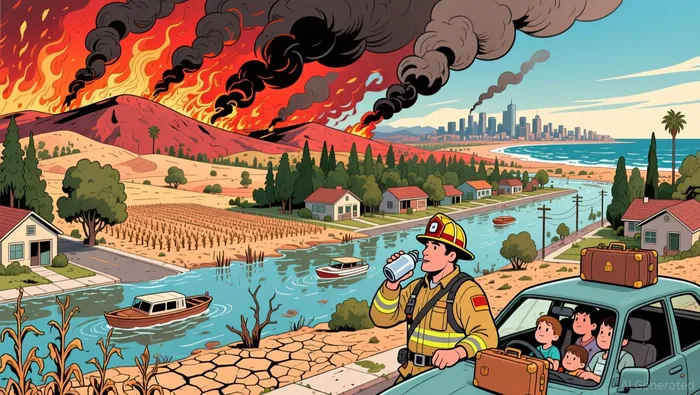
Southern California's vulnerability to climate-driven disasters has reached a critical inflection point. Between 2020 and 2025, the region has experienced a cascade of extreme weather events, including atmospheric river-induced floods, wildfires, and droughts, collectively costing over $100 billion in economic damage. The 2022–2023 atmospheric river sequence alone caused $4.7 billion in losses, while 2024–2025 storms added $5–11 billion in damages. The January 2025 wildfires, though not floods, further underscored the region's fragility, with $112 billion in total economic impacts-surpassing Hurricane Katrina's toll according to UCLA economic analysis. These events highlight an urgent need for climate resilience infrastructure, particularly in flood-prone areas where over $900 billion in assets are at risk.
The Surge in Demand for Climate Resilience Solutions
The escalating frequency and severity of disasters have driven a surge in demand for post-disaster recovery and risk mitigation solutions. Southern California's recent investments reflect this trend. Los Angeles County Public Works, for instance, has allocated $45 million to restore Baldwin Lake and improve the Mint Canyon Channel, focusing on sediment removal, shoreline stabilization, and flood risk reduction. Similarly, the Southern California Coastal Water Research Project received $75,000 in 2025 for post-wildfire monitoring, aiding debris removal and coastal water quality protection.
The market for sandbag distribution, debris removal, and flood control technologies is expanding rapidly. Companies like So Cal Sandbags, Inc. and TrapBag® are capitalizing on this demand. So Cal Sandbags, a 40-year-old firm, provides erosion control and stormwater compliance services, while TrapBag offers rapid-deploy flood barriers as an alternative to traditional sandbags. Erosion Control Experts (ECE) and Mayfield Environmental Solutions further diversify the landscape, offering sandbags, hydroseeding, and best management practices (BMPs) for erosion mitigation according to ECE's website. Meanwhile, 4Granite Inc. specializes in flood control facility construction, including drainage planning and storm sewer installation according to 4Granite's services page.
Strategic Investment Opportunities
The region's climate adaptation efforts are supported by both public and private funding. California's Proposition 4, a $10 billion climate resilience bond approved in 2025, targets wildfire resilience, flood protection, and ecosystem restoration. At the federal level, the Biden-Harris Administration has allocated $71.1 million through NOAA to bolster coastal resilience in Monterey Bay, emphasizing adaptive strategies for communities. These initiatives align with a broader shift in investor priorities, as insurance premiums rise and financial instruments tailored to climate risks emerge.
The economic rationale for investing in climate resilience is compelling. A 2025 report estimates that California would need $225 million to $1.8 billion annually over the next decade to address wildfire and flood risks. For investors, this represents a multi-billion-dollar opportunity in sectors such as debris removal, sandbag distribution, and nature-based solutions. The Emerald Necklace project, for example, integrates urban green spaces with stormwater management, demonstrating the viability of hybrid infrastructure.
Conclusion: A Call for Proactive Investment
Southern California's climate resilience market is poised for sustained growth, driven by escalating disaster costs and policy support. Companies specializing in sandbag distribution, debris removal, and flood control technologies are well-positioned to benefit from this demand. As the region grapples with $100+ billion in annual climate-related losses, strategic investments in these sectors are not merely prudent-they are essential. For investors, the message is clear: resilience infrastructure is no longer a niche market but a critical component of risk mitigation in an era of climate uncertainty.







Comentarios
Aún no hay comentarios