
Investing in Climate Resilience: Flood Mitigation and Economic Stability in the Pacific Northwest
The Pacific Northwest is at a critical juncture. In December 2025, the region was battered by historic flooding driven by a series of atmospheric rivers, with the Snohomish River crested at 34.15 feet-the highest level on record. The deluge overwhelmed highways, including US-2 and US-12, crippling regional commerce and tourism, particularly in communities like Leavenworth, where the "Village of Lights" display was delayed. As tens of thousands evacuated and emergency rescues unfolded, the crisis underscored a stark reality: climate-driven extreme weather is no longer a distant threat but an immediate economic and infrastructural challenge.
The Case for Flood Walls: A Proven Defense
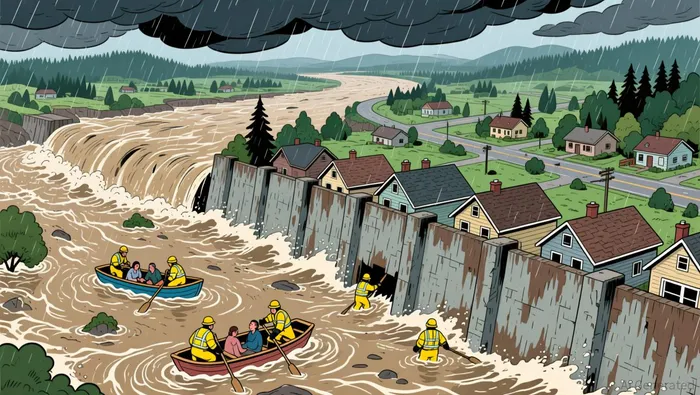 Flood walls have emerged as a linchpin of resilience in the Pacific Northwest. The 1.4-mile flood wall in Mount Vernon, Washington, exemplifies this. During the December 2025 floods, the structure shielded downtown Mount Vernon from the Skagit River's record crests, saving homes, businesses, and critical infrastructure. Local leaders, including Governor Bob Ferguson and Senator Patty Murray, hailed the wall as a "lifesaver", emphasizing its role in mitigating what could have been catastrophic losses.
Beyond Mount Vernon, Washington State's Floodplains by Design (FbD) program has demonstrated the economic and ecological value of integrated floodplain management. Since 2013, the program has allocated $359 million to reduce flood risk for 88 communities while restoring 171 miles of salmon habitat. For every $1 million invested, FbD generates $2.2–$2.5 million in economic activity, with 80% of that activity retained locally. These projects also leverage a 3:1 ratio of state funding with local and federal contributions, creating thousands of jobs and enhancing long-term resilience.
Government Funding and Emergency Declarations: A Catalyst for Resilience
The federal government has increasingly recognized the urgency of climate adaptation. The Bipartisan Infrastructure Law has allocated nearly $3 billion for coastal resilience and weather forecasting initiatives, including NOAA's Coupling Capabilities projects, which improve flood forecasting in the Pacific Northwest. Additionally, the Climate Resilience Regional Challenge, a $575 million initiative, funds transformative regional projects to address extreme weather according to reports.
Emergency declarations have also played a pivotal role. In December 2025, the Trump administration approved a federal emergency declaration for Washington State, providing 75% federal funding for recovery efforts in 16 counties and tribal nations. This aid, coupled with FEMA's involvement, highlights the growing reliance on federal support to address climate-related disasters. However, as Senator Murray noted, such assistance often takes months to materialize, leaving communities to grapple with immediate needs.
Economic Stability and Future Risks
The economic stakes are high. A 2024 study by Oregon State University found that every $1 million invested in flood-resilient infrastructure generates 40 jobs in construction and retail trade. Moreover, the National Institute of Building Sciences estimates that every $1 spent on flood mitigation saves $6 in avoided costs. These metrics underscore the dual benefits of resilience investments: they protect against disaster while stimulating growth.
Yet, future risks loom large. Research from the Pacific Northwest's coastal science community warns that a Cascadia subduction zone earthquake could cause sudden subsidence, doubling or tripling flood exposure by 2100 when combined with sea-level rise. This compounding threat necessitates a shift from reactive to proactive infrastructure planning.
Conclusion: A Call for Strategic Investment
The Pacific Northwest's flood crisis is a microcosm of a global challenge. Flood walls, nature-based solutions, and integrated floodplain management are not just engineering feats-they are economic imperatives. With federal funding mechanisms like the Bipartisan Infrastructure Law and state-led programs like FbD, the region has a blueprint for resilience. However, as climate impacts intensify, sustained investment and innovative financing-such as green bonds and resilience bonds-will be critical to scaling these efforts.
For investors, policymakers, and communities alike, the message is clear: climate resilience infrastructure is no longer optional. It is a cornerstone of economic stability in an era of escalating climate risks.







Comentarios
Aún no hay comentarios