
Investing in California's Grid Resilience: Opportunities in Post-PG&E Modernization
California's grid modernization efforts have entered a transformative phase, driven by the urgent need to address vulnerabilities exposed by the 2023 PG&E outages. With a $73-billion capital expenditure plan announced by Pacific Gas and Electric (PG&E) over five years, the state is prioritizing infrastructure upgrades, wildfire mitigation, and the integration of distributed energy resources (DERs) to ensure grid resilience amid climate-driven challenges
according to Power Magazine. For investors, this represents a confluence of policy, technological innovation, and capital flows that could redefine energy infrastructure markets in the coming decade.
PG&E's Strategic Reinvestment and the Broader Grid Modernization Push
PG&E's $73-billion investment plan, extending through 2030, underscores a shift toward undergrounding power lines, enhancing vegetation management, and deploying advanced wildfire mitigation technologies
according to Transformers Magazine. This aligns with a broader state strategy to address the dual pressures of extreme weather events and the rapid electrification of sectors like data centers and transportation.
According to a report by Power Magazine, PG&E's focus on grid hardening is expected to generate a compound annual growth rate (CAGR) of +10% in its rate base through 2028.
The state's progress in clean energy integration further amplifies these opportunities. California has added over 20,000 megawatts (MW) of new clean energy capacity since 2021, with battery storage capacity surging from 700 MW in 2020 to 13,000 MW in 2025 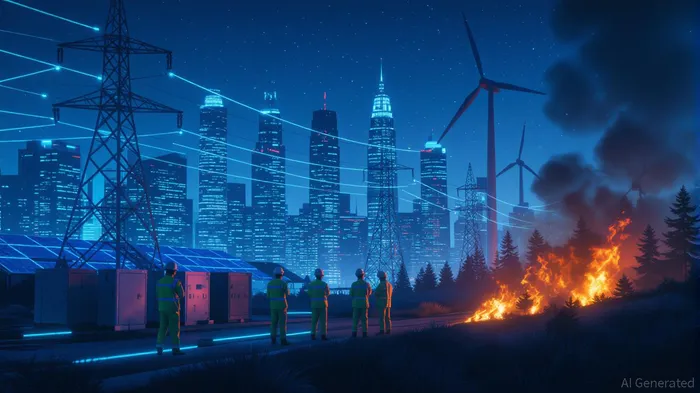
according to Energy CA.gov. This growth is not merely a response to environmental goals but a necessity for maintaining reliability during peak demand periods and wildfire-prone seasons.
Policy-Driven Funding and Innovative Financing Models
State and federal programs are creating a fertile ground for investment. The Community Energy Reliability and Resilience Investment (CERRI) Program, administered by the California Energy Commission (CEC), has allocated $170 million in federal funds to support projects that reduce outages and strengthen grid resilience, particularly in disadvantaged communities
according to Energy CA.gov. Similarly, the U.S. Department of Energy's Grid Resilience and Innovation Partnerships (GRIP) Program has allocated $10.5 billion nationwide, with California benefiting from initiatives like the Valley Children's Hospital microgrid in Madera, which features a 33 MWh long-duration energy storage (LDES) system
according to Energy CA.gov.
Innovative financing models are also emerging. PG&E and Citizens Energy have proposed a joint investment program that could channel up to $1 billion into grid upgrades, with after-tax profits directed toward financial assistance for low- and moderate-income customers
according to Citizens Energy. This approach not only addresses affordability concerns but also aligns with California's clean energy objectives.
Emerging Technologies and Key Players
The grid resilience sector is being reshaped by cutting-edge technologies and companies. Virtual power plants (VPPs), for instance, are gaining traction as a scalable solution. Leap, a grid technology firm, has expanded its VPP offerings in California, enabling distributed energy resource providers to participate in demand-side grid support programs
according to Leap Energy. Meanwhile, PG&E is testing the Vehicle On-Site Grid Support System (VOGSS), which leverages electric vehicle (EV) charging infrastructure to stabilize the grid during outages
according to PGE.
Long-duration energy storage (LDES) is another critical area. The California Energy Commission's LDES program has invested over $270 million in non-lithium-ion technologies, including zinc hybrid cathode and flow batteries, to enhance grid reliability
according to Energy CA.gov. These innovations are particularly vital for supporting critical facilities like hospitals and emergency shelters during prolonged outages.
Community-Centric Resilience Hubs and Microgrids
Investment opportunities are also emerging at the community level. PG&E's Resilience Hubs Grant Program has allocated $2 million to fund 35 projects in 2025, transforming community centers into safe spaces during climate-driven emergencies
according to PGE. For example, the Shoong Family Chinese Cultural Center in Oakland is retrofitting its facility with HVAC and air filtration systems to serve as a resilience hub
according to PGE.
Microgrids are another focal point. The Microgrid Incentive Program (MIP), managed by California's investor-owned utilities, offers $200 million in funding for community microgrids in high-risk areas, such as those prone to wildfires or earthquakes
according to Energy CA.gov. These projects not only enhance local resilience but also create jobs and advance decarbonization goals.
Conclusion: A Strategic Window for Investors
California's grid modernization agenda presents a unique intersection of necessity, policy support, and technological innovation. With PG&E's multi-decade investment plan, state-led funding programs, and the rise of DERs and LDES, the sector is poised for sustained growth. Investors who align with these trends-whether through infrastructure upgrades, storage technologies, or community resilience initiatives-stand to benefit from a market driven by both regulatory momentum and the urgent need to adapt to a changing climate.
As the state's energy leaders emphasize, the path forward is not just about preventing outages but reimagining the grid as a flexible, decentralized, and resilient system
according to Energy CA.gov. For those with the foresight to act, California's grid modernization offers a blueprint for the future of energy infrastructure.







Comentarios
Aún no hay comentarios