
Intuitive Machines' Strategic Expansion into Satellite Technology and Lunar Infrastructure: A Path to Dominating the Emerging Space Economy
The space economy is undergoing a seismic transformation, driven by technological innovation, government-led exploration initiatives, and the commercialization of off-world resources. At the forefront of this revolution is Intuitive Machines (LUNR), a company that has rapidly evolved from a lunar-focused startup to a multi-domain space infrastructure provider. Through strategic acquisitions, partnerships, and a clear-eyed vision for the future, Intuitive MachinesLUNR-- is positioning itself to dominate the $1.8 trillion space economy by 2035 while unlocking unprecedented revenue streams for investors.
Strategic Partnerships: Building the Lunar Infrastructure Ecosystem
Intuitive Machines has prioritized interoperability and scalability in its lunar infrastructure ambitions. A landmark collaboration with Leonardo and Telespazio in 2023 exemplifies this approach. The trio signed a strategic agreement to integrate Intuitive Machines' Space Data Network (SDN) with Telespazio's Lunar Communication and Navigation System (LCNS), creating a secure, interoperable communications backbone for lunar missions. This partnership is critical for supporting both commercial and institutional activities, from NASA's Artemis program to private-sector lunar mining ventures.
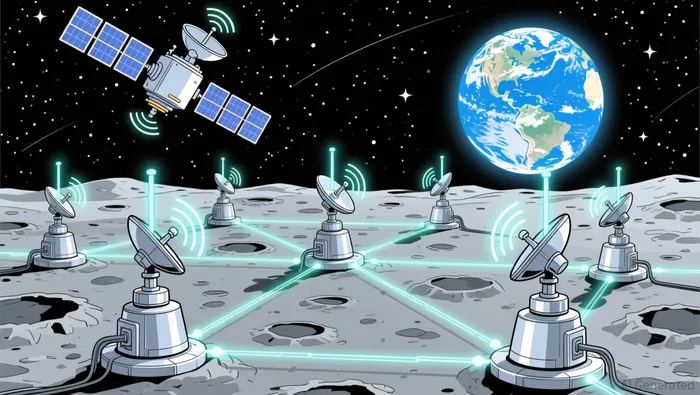 The company's recent acquisition of Lanteris Space Systems (formerly Maxar Space Systems) for $800 million further solidifies its infrastructure capabilities. Lanteris' expertise in satellite manufacturing and data services enables Intuitive Machines to operate across LEO, MEO, GEO, and deep space, transforming it into a vertically integrated space prime. The combined entity now boasts a pro forma revenue of $850 million and a contract backlog of $920 million, with plans to launch the first of five lunar satellites by mid-2026 to support GPS-like services on the Moon.
Revenue Catalysts: From Lunar Landers to National Security
Intuitive Machines' revenue growth is anchored in its NASA Near Space Network (NSNS) contract, valued at up to $4.82 billion. This contract, which includes the deployment of a lunar communications network, is a cornerstone of the company's long-term strategy. By 2026, the company aims to leverage its expanded capabilities to compete for the Lunar Terrain Vehicle (LTV) contract and other Artemis-related opportunities, further diversifying its revenue base.
The acquisition of KinetX, a deep-space navigation specialist, adds another layer of value. KinetX's precision navigation software is critical for interplanetary missions, and its integration into Intuitive Machines' offerings accelerates the company's ability to deliver secure data relay services. This move also opens doors to national security contracts, such as the Golden Dome missile defense initiative, where KinetX's expertise in orbital mechanics is highly sought after.
Market Positioning: Competing in a Crowded Space
While Intuitive Machines faces stiff competition from peers like Rocket Lab (RKLB), its focus on lunar infrastructure and government contracts provides a unique edge. Rocket Lab, with its Neutron rocket and small satellite launch capabilities, has demonstrated robust growth, including a 48% year-over-year revenue increase in Q3 2025. However, Intuitive Machines' $4.82 billion NSNS contract and its role in NASA's Artemis program position it as a key player in the high-margin, long-term lunar economy.
The company's recent 17% stock price surge, driven by optimism around its acquisition of Lanteris and Trump's aggressive space policy blueprint, underscores investor confidence. Analysts project Intuitive Machines' revenue to grow from $219 million in 2025 to $919 million in 2026, with a forward sales multiple of 6.17X-significantly lower than Rocket Lab's 27.35X-suggesting undervaluation relative to its growth potential.
The Road Ahead: A $1.8 Trillion Opportunity
The global space economy is projected to grow at a 9% annual rate, reaching $1.8 trillion by 2035. Intuitive Machines is uniquely positioned to capitalize on this growth through its multi-domain capabilities, government partnerships, and strategic acquisitions. By 2028, the company's investment narrative anticipates $502.2 million in revenue, requiring a 30.5% annual growth rate-a target achievable given its current backlog and expansion into LEO and deep space.
Moreover, the company's alignment with U.S. space policy, including Trump's 2030 lunar station initiative, ensures a steady pipeline of government contracts. This policy environment, combined with the commercialization of lunar resources and space-based manufacturing (e.g., its partnership with Space Forge), creates a flywheel effect: infrastructure begets more infrastructure, and infrastructure begets revenue.
Conclusion: A High-Conviction Investment
Intuitive Machines' strategic expansion into satellite technology and lunar infrastructure is not just a bet on the future-it's a calculated move to dominate the next frontier of the space economy. With a robust contract backlog, a clear path to profitability, and a leadership position in lunar communications, the company is well-positioned to outperform peers and deliver outsized returns for investors. As the space economy accelerates, Intuitive Machines is not merely participating in the revolution-it is leading it.





Comentarios
Aún no hay comentarios