
Interstellar Comet 3I/ATLAS and the Dawn of a New Era in Deep-Space Monitoring and Aerospace Investment
Hubble and ESA: Pioneering Observational Breakthroughs
The Hubble Space Telescope's repeated observations of 3I/ATLAS, including a critical revisit on November 30, 2025, using its Wide Field Camera 3, have provided unprecedented insights into the comet's trajectory and activity. At 286 million kilometers from Earth, Hubble captured the comet's teardrop-shaped coma and a sunward anti-tail, revealing dust mass-loss rates between 0.3 and 4.2 kg/s. These high-angular-resolution data are critical for refining models of interstellar object dynamics and testing the limits of current optical monitoring systems.
Complementing Hubble's efforts, ESA's Juice mission employed its Navigation Camera (NavCam) to image 3I/ATLAS in November 2025, capturing its glowing coma and dual tails-plasma and dust-shortly after the comet's perihelion according to ESA images. Despite data transmission delays until February 2026, Juice's scientific instruments (JANUS, MAJIS, UVS, SWI, and PEP) promise to deliver a comprehensive dataset on the comet's composition and activity. Such multi-platform collaborations underscore the growing reliance on hybrid ground- and space-based systems for deep-space monitoring, a trend likely to attract significant capital inflows.
Expert Insights: From Anomalies to Investment Catalysts
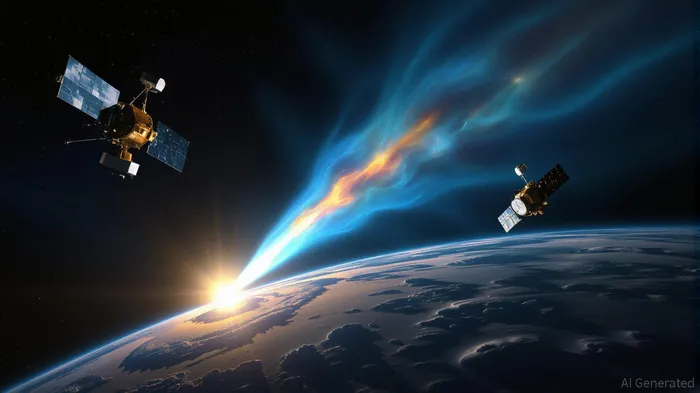 The scientific community remains divided on the implications of 3I/ATLAS's peculiar traits. Harvard astrophysicist Avi Loeb has sparked debate by suggesting the comet's production of nickel tetracarbonyl-a rare industrial alloy typically absent in natural comets-and its retrograde trajectory (aligned with the ecliptic plane at 0.2% probability) hint at potential artificial origins. While mainstream astronomers like Leslie Looney argue that 3I/ATLAS behaves like a typical comet, its anomalous features have nonetheless spurred interest in advanced materials science. For instance, the comet's emission of nickel tetracarbonyl at 4 grams per second, without detectable iron, has raised questions about whether similar chemical processes could inform aerospace material development.
Meanwhile, trajectory analyses have refined deep-space monitoring methodologies. Loeb's hypothesis of a "heartbeat"-like pulse in the comet's activity, though contested, has prompted calls for more rigorous technological signatures. These debates highlight the importance of investing in high-resolution imaging and AI-driven data analysis tools, which are becoming indispensable for distinguishing natural phenomena from potential anomalies.
Investment Opportunities: Infrastructure and Commercial Applications
The study of 3I/ATLAS has accelerated demand for cutting-edge aerospace infrastructure, particularly in three areas:
1. Optical and Spectroscopic Monitoring Systems: The need to track interstellar objects like 3I/ATLAS has driven advancements in adaptive optics and coronagraphic technologies. For example, the PUNCH mission and solar coronagraphs played a key role in monitoring 3I/ATLAS's perihelion activity, demonstrating the commercial viability of such systems for satellite tracking and planetary defense.
2. Predictive Modeling and AI Integration: Predictive models for 3I/ATLAS's magnitude drift and activity patterns have become essential for mission planning, leveraging AI to process vast datasets from observatories like Hubble and Juice. This trend aligns with broader industry investments in AI for autonomous spacecraft operations and real-time geospatial intelligence according to Grand View Research.
3. Planetary Defense and Deep-Space Navigation: The International Asteroid Warning Network (IAWN) and NASA's Planetary Defense Network have used 3I/ATLAS as a test case for readiness protocols, emphasizing the need for global collaboration and infrastructure upgrades.
Commercial applications are equally promising. The development of advanced optical monitoring systems for 3I/ATLAS has direct relevance to satellite constellations, deep-space navigation, and environmental monitoring of celestial bodies. Additionally, the comet's potential to inform materials science-such as nickel-based alloys for aerospace coatings-could spur investments in space-based manufacturing and in-situ resource utilization.
The Road Ahead: A Convergence of Science and Capital
As 3I/ATLAS continues its journey out of the solar system, its legacy will extend beyond scientific curiosity. The technologies and methodologies developed to study it are poised to become foundational for future deep-space missions. According to a report by Grand View Research, the global deep-space exploration market is projected to grow at a 5.1% CAGR through 2033, driven by private-sector involvement in lunar missions, asteroid mining, and satellite deployment. Meanwhile, DeepTech investments-spanning AI, quantum computing, and robotics-are expected to surge, with the market reaching $714.6 billion by 2031.
For investors, the key takeaway is clear: the study of interstellar objects like 3I/ATLAS is not merely an academic pursuit but a catalyst for transformative aerospace and deep-space monitoring technologies. As governments and private entities race to decode the mysteries of the cosmos, the infrastructure and innovations born from this endeavor will define the next frontier of space exploration-and profitability.







Comentarios
Aún no hay comentarios