
First Interstate's Capital Reallocation: A Strategic Path to 2026 Value Creation?
Share Repurchases: A Vote of Confidence
First Interstate's share repurchase program, announced in August 2025, according to a Bloomberg report, reflects management's confidence in liquidity and capital flexibility. By reducing the number of outstanding shares, the initiative aims to boost earnings per share (EPS) and signal undervaluation to investors. This strategy has drawn support from activist investor HoldCo Asset Management LP, which holds a 3.8% stake and advocates for exclusive focus on buybacks over acquisitions, as reported by Bloomberg.
The $150 million authorization, while modest compared to industry peers, is notable for its timing. With interest rates at historic lows, according to a Seeking Alpha analysis, the cost of capital remains favorable, allowing First InterstateFIBK-- to deploy cash flow into equity buybacks without straining liquidity. However, the program's success hinges on execution: if the bank overpays for shares or underutilizes its capital, the value proposition could falter.
Branch Divestitures: Streamlining for Efficiency
Parallel to the buyback program, First Interstate has divested 23 branches across Nebraska, Arizona, and Kansas. These transactions, including the sale of $280 million in deposits and $70 million in loans, were described in a Business Wire release and are part of a broader effort to reduce operational complexity and redirect capital to higher-return activities. The Nebraska branch sale to Security First Bank, for instance, is expected to close in early 2026, per the Business Wire release, freeing up capital for strategic reinvestment.
While the immediate financial terms of these deals remain undisclosed, an Investing.com filing indicates limited public detail on pricing and gain/loss recognition. The long-term implications are clearer: by shedding underperforming assets and high-cost branches, First Interstate can lower overhead and improve net interest margins. Analysts writing for Seeking Alpha suggest that the reduced deposit base may initially pressure NII, but the cost savings from streamlined operations could offset this drag.
Synergy and Uncertainty: The 2026 Outlook
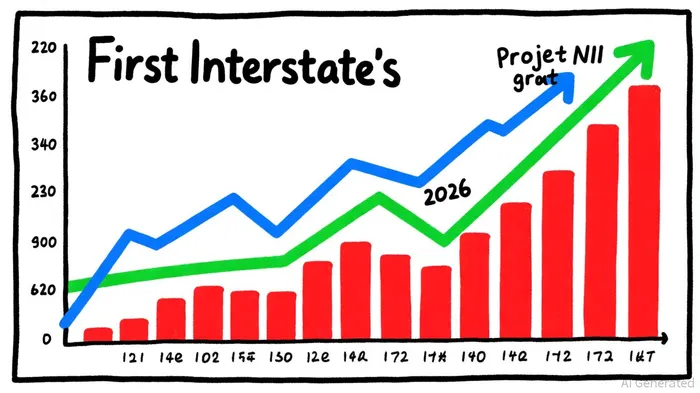
The interplay between share repurchases and branch divestitures creates a complex dynamic for 2026 NII. On one hand, reduced branch costs and lower capital expenditures could enhance profitability. On the other, the loss of deposits from sold branches might constrain loan growth and net interest income.
Current projections indicate a cautiously optimistic outlook for NII in 2026, driven by low interest rates and improved operating leverage, according to Seeking Alpha coverage. However, the absence of detailed analyst estimates linking these strategic moves to specific NII figures leaves room for skepticism. For example, while the Nebraska branch sale includes $280 million in deposits, it's unclear how this outflow will affect the bank's funding costs or loan origination capacity.
Risk and Reward: A Balanced Perspective
First Interstate's strategy is not without risks. The reliance on share repurchases as a primary value driver exposes the bank to market volatility, while the branch divestitures could erode customer relationships in key markets. Yet, the activist investor push for capital discipline has kept pressure on management to prioritize returns, as covered by Bloomberg, and the bank's demonstrated balance sheet flexibility is discussed in a Webull analysis, suggesting a calculated approach.
For investors, the key question is whether these moves will translate into sustainable EPS growth. If the $150 million buyback program is executed efficiently and the branch sales generate meaningful cost savings, First Interstate could position itself as a high-conviction play in the regional banking sector. However, without concrete data on NII synergies, the jury remains out on the full extent of long-term value creation.
Conclusion
First Interstate's dual focus on share repurchases and branch divestitures represents a bold reimagining of its capital allocation strategy. While the immediate benefits are evident-enhanced liquidity, reduced overhead, and shareholder returns-the 2026 NII trajectory will depend on how well these moves align with macroeconomic conditions and operational execution. For now, the bank's actions signal confidence, but the ultimate test lies in translating strategy into measurable financial performance.





Comentarios
Aún no hay comentarios