
Internet Computer (ICP) Outperforms Altcoins: A Structural and Adoption-Driven Case for Long-Term Exposure
Structural Advantages: Web3 at Web2 Scale
The Internet Computer's (ICP) architecture is fundamentally designed to bridge the gap between Web2 and Web3. Unlike Ethereum's modular Layer 1/Layer 2 model or Solana's PoH + PoS hybrid, ICP employs a subnet-based sharded architecture and Chain Key cryptography to achieve 10,000+ transactions per second while enabling on-chain storage of large assets at a cost of ~$5 per GB per year, as this Medium article notes. This eliminates the need for off-chain storage solutions, a critical bottleneck for decentralized applications (dApps).
ICP's reverse gas model, where developers pre-pay computation costs, further distinguishes it from Ethereum's high user-facing gas fees and Solana's low-cost but centralized validator set. By making user interactions effectively free, ICP lowers barriers to adoption for consumer-facing dApps. Meanwhile, its Network Nervous System (NNS)-an on-chain DAO-ensures decentralized governance without compromising scalability, a stark contrast to Solana's centralized governance concerns, as this Ledger article notes.
Ecosystem Growth: Developer Activity and Strategic Partnerships
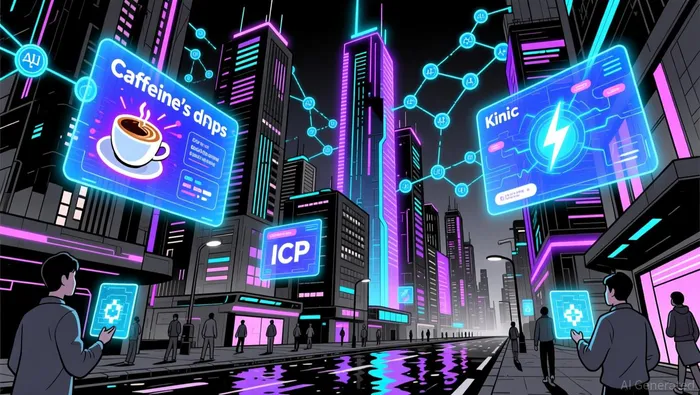
ICP's ecosystem has seen explosive growth in 2025, driven by strategic initiatives and developer engagement. The World Computer Hacker League, a global hackathon, attracted 11,774 developers who built 1,554 projects focused on DeFi, AI tools, and BitcoinBTC-- interoperability, according to a CoinMarketCap update. Notable dApps like Caffeine (AI-powered app creation), Kinic (AI memory vault), and Sonic DEX (multichain DeFi exchange) highlight ICP's versatility.
DFINITY's reorganization into a tech-venture-like structure-DFINITY 2.0-signals a shift toward productization and market agility. The foundation is also fostering for-profit ventures like Caffeine to drive cloud-rivaling usage, as noted in a Medium post. Meanwhile, strategic partnerships with entities like ICP DAS (energy management and IoT solutions) underscore ICP's real-world utility, as this PR release notes.
Market Sentiment and Comparative Metrics
ICP's recent performance outpaces mid-cap altcoins like ZcashZEC-- (ZEC) and DashDASH-- (DASH), which saw gains of 16.77% and 17.90%, respectively, according to a Blockchain Magazine article. This reflects investor confidence in infrastructure projects over legacy assets. While EthereumETH-- maintains a $94+ billion TVL and a 31,869-strong developer base, as noted in a CryptoNinjas article, Solana's 29.1% annual developer growth and 75.6 million daily transactions highlight its speed and cost advantages, as a CoinGecko publication notes. However, ICP's unique value proposition-on-chain AI integration, Bitcoin interoperability, and cloud-scale scalability-positions it to capture market share from both.
Long-Term Viability: A Strategic Rebalance
ICP's structural advantages and ecosystem momentumMMT-- suggest it is well-positioned to outperform altcoins in the long term. While Ethereum's composability and Solana's throughput remain strengths, ICP's focus on Web3-native AI applications and low-code development tools (e.g., ICP Ninja) addresses critical gaps in developer onboarding and user experience, as noted in the CoinMarketCap update. Additionally, ICP's tokenomics adjustments-such as reducing staking periods to combat inflation-signal a commitment to long-term sustainability, as the Medium post notes.
Conclusion
The Internet Computer (ICP) represents a paradigm shift in blockchain infrastructure, combining scalability, AI integration, and decentralized governance to address Web2's limitations. With a 56% price surge post-Caffeine launch, robust developer activity, and strategic partnerships, ICP is notNOT-- just outperforming altcoins-it is redefining the value proposition of infrastructure-layer projects. Investors seeking exposure to the next phase of crypto adoption should consider reallocating toward ICP as a strategic long-term hold.







Comentarios
Aún no hay comentarios