
International Paper (IP): A Breakout Candidate in a Weak Market Amid Strategic Restructuring and Volume Surge
In a market environment marked by volatility and sector-wide headwinds, International PaperIP-- (IP) has emerged as an unexpected outlier. Despite a broader economic slowdown and a 14.14% year-to-date decline in its stock price[1], the company has shown signs of resilience, driven by strategic restructuring, a surge in trading volume, and a favorable shift in analyst sentiment. This analysis argues that IP is a breakout candidate in a weak market, leveraging its operational pivot and capital reallocation to position itself for long-term growth.
Strategic Restructuring: A Catalyst for Renewal
International Paper's recent divestiture of its Global Cellulose Fibers (GCF) business to American Industrial Partners (AIP) for $1.5 billion[4] marks a pivotal shift in its strategic focus. By exiting the GCF segment—responsible for $2.8 billion in 2024 revenue—the company is reallocating capital to its core Industrial Packaging and Global Cellulose Fibers segments. This move aligns with industry trends favoring sustainable packaging and e-commerce logistics, where IP's North American operations hold a competitive edge.
The restructuring also includes a $250 million investment to convert the Riverdale mill in Alabama to containerboard production, while shuttering three underperforming facilities in Georgia and Alabama[4]. These adjustments, though painful for 1,100 employees, signal a commitment to operational efficiency. Analysts at Truist Securities and Argus Research have cited these moves as “a necessary step to unlock value,” with Michael Roxland raising IP's price target to $57.00[1] and David Coleman labeling it a “Buy” with a $52.00 target[1].
Trading Volume Surge: A Barometer of Investor Confidence
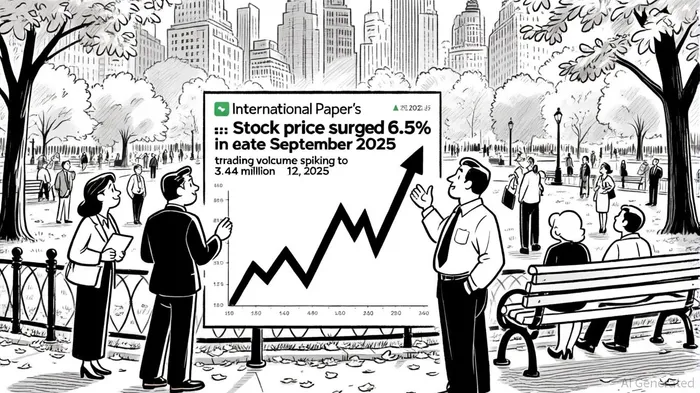
While IP's stock price has lagged the S&P 500 in 2025, its trading volume has told a different story. On September 12, 2025, the stock saw a surge to 3.44 million shares traded[5], a 13.5% increase from its 30-day average of 3.03 million shares[2]. This spike coincided with the company's updated 2025 guidance, which projected $27 billion in revenue—partly fueled by synergies from the DS Smith acquisition[5]. The volume surge suggests growing institutional interest, as highlighted by Amundi's $916.3 million stake in IP[5], and retail investor participation driven by the company's strategic clarity.
Analyst Optimism Amid Mixed Earnings
Analyst sentiment toward IP has trended cautiously bullish in recent months. As of September 2025, four analysts have upgraded their ratings, including George Staphos of B of A Securities, who moved from “Hold” to “Strong Buy” in late August[3]. The average price target of $52.50 implies a 13.6% upside from the current price of $46.21[1], with the highest estimate at $57.00[1]. However, this optimism is tempered by recent earnings misses, such as the Q3 2025 EPS of $0.23, which fell short of expectations[4].
The disconnect between earnings performance and analyst optimism reflects a broader industry narrative: while short-term profitability remains challenged, long-term structural trends—such as the shift to sustainable packaging and e-commerce—favor companies like IP that are adapting proactively. The American Forest & Paper Association (AF&PA) reported a 5% increase in August 2025 packaging shipments[1], underscoring the sector's resilience despite macroeconomic pressures.
Market Positioning: Outperforming in a Weak Market
IP's performance against the S&P 500 highlights its breakout potential. While the S&P 500 has returned -1.25% year-to-date[1], IP's -14.14% decline appears overcorrected relative to its fundamentals. Over the past three months, IP has gained 12.5%[3], outpacing the S&P 500's 4.5% return. This divergence suggests that the market is beginning to price in the company's strategic pivot.
Moreover, IP's debt-to-equity ratio and market capitalization remain robust compared to industry peers[1], providing a buffer against economic downturns. The company's focus on high-margin packaging solutions—such as lightweight containerboard and recycled materials—positions it to benefit from the $1.2 trillion global sustainable packaging market[2], which is projected to grow at a 6.5% CAGR through 2030.
Risks and Mitigants
Critics may point to IP's recent earnings misses and the uncertainty surrounding new tariffs in North American cross-border trade[2]. However, the company's restructuring efforts—including the GCF divestiture and facility closures—directly address these risks by reducing operational complexity and aligning with regulatory trends. Additionally, the 78.2% industry-wide bleached operating rate in August 2025[1] indicates that capacity constraints are easing, which could drive pricing power in the coming quarters.
Conclusion: A Strategic Bet for Resilience
International Paper's recent trading volume surge, strategic divestitures, and analyst upgrades paint a compelling case for its breakout potential. While the company faces near-term challenges, its alignment with sustainable packaging trends, operational efficiency gains, and capital reallocation efforts position it to outperform in a weak market. For investors seeking exposure to a sector poised for long-term growth, IP represents a calculated risk with asymmetric upside.





Comentarios
Aún no hay comentarios