
International Equities as a Compelling Diversification Play in a Fragmented Global Market
In a global market increasingly defined by fragmentation-marked by divergent monetary policies, trade tensions, and uneven growth trajectories-international equities have emerged as a strategic asset class for diversification. The Vanguard Total International Stock ETF (VXUS), which tracks the FTSE Global All Cap ex U.S. Index, exemplifies this trend. With a year-to-date (YTD) total return of 25.90% in 2025 and a 12-month return of 19%, VXUSVXUS-- has outperformed U.S. benchmarks like the S&P 500, which remains elevated at a P/E ratio of 24x compared to VXUS's 15x valuation, according to Invesco's outlook. This valuation gap, coupled with macroeconomic tailwinds, positions international equities as a compelling counterbalance to domestic market risks.
Strategic Asset Allocation in a Shifting Macro Regime
The 2025 investment landscape is shaped by a recalibration of global capital flows. U.S. equities, long the dominant growth engine, now face headwinds from overvaluation and concentration risks. Vanguard's economic outlook underscores this shift, noting that international markets-particularly emerging economies-offer a more favorable risk-reward profile. LPL Research has advised reducing exposure to domestic growth equities and rotating into international assets, citing lower correlations to U.S. markets and diversification benefits.
VXUS, with its broad exposure to 8,667 stocks across developed and emerging markets, aligns with this strategy. Its regional allocation-40.40% in Europe, 26.30% in the Pacific, and 25.70% in emerging markets-ensures geographic diversification, as noted in Vanguard's outlook. This structure mitigates the impact of localized downturns, a critical advantage in an era of geopolitical volatility. For instance, while U.S. markets grapple with inflationary pressures, European and Asian economies are benefiting from fiscal stimulus and a weaker dollar, which boosts export-driven sectors, according to FinanceCharts.
Valuation Dynamics and Risk-Adjusted Returns
VXUS's appeal lies not only in its diversification but also in its valuation metrics. With a low expense ratio of 0.07% and a Sharpe ratio of 0.99, the fund delivers strong risk-adjusted returns, per PortfoliosLab. Its P/E ratio of 15x, significantly lower than the S&P 500's 24x, suggests undervaluation relative to U.S. benchmarks, as discussed in Invesco's outlook. This discount has historically translated into outperformance during periods of global economic rebalancing. For example, in 2023, VXUS returned 15.88%, closely matching the MSCI ACWI Ex USA index's 15.62% return (FinanceCharts), while in 2024, it trailed slightly (5.08% vs. 5.53%) due to short-term volatility in emerging markets (FinanceCharts).
The fund's low-cost structure and broad diversification also enhance its appeal for long-term investors. Over the past decade, VXUS has delivered an annualized return of 7.76%, underscoring its resilience through market cycles, according to PortfoliosLab. This consistency is critical in a fragmented market where sector-specific risks are amplified.
Macroeconomic Tailwinds and Strategic Implications
The macroeconomic environment in 2025 further strengthens the case for international equities. Invesco's outlook highlights the potential for European and emerging market assets to outperform, driven by a weaker U.S. dollar and accommodative monetary policies in Asia. BlackRock's midyear report similarly emphasizes diversification as a key strategy, recommending a mix of low-volatility international ETFs and alternative assets to reduce portfolio correlation.
For investors, this translates into a strategic imperative: rebalancing portfolios to include international equities can hedge against U.S. market underperformance. VXUS's exposure to non-U.S. markets provides a natural hedge, as it historically trades at a discount to the S&P 500, a dynamic highlighted by LPL Research. This dynamic is particularly relevant in 2025, where U.S. equities face valuation challenges and regulatory uncertainties.
Risks and Considerations
While the case for VXUS is compelling, investors must remain cognizant of risks inherent to international investing. Currency fluctuations, political instability, and regulatory shifts in emerging markets can introduce volatility, as Vanguard's economic outlook warns. For example, geopolitical tensions in the Pacific and Europe could disrupt trade flows, impacting regional equities. However, these risks are mitigated by VXUS's broad diversification and its focus on large-cap stocks, which are less susceptible to short-term shocks.
Conclusion
In a fragmented global market, strategic asset allocation demands a nuanced approach. The Vanguard Total International Stock ETF (VXUS) offers a low-cost, diversified vehicle to access international equities, leveraging favorable valuation dynamics and macroeconomic tailwinds. As U.S. markets face overvaluation and concentration risks, VXUS's outperformance in 2025 underscores its role as a critical diversification tool. For investors seeking to navigate the complexities of 2025, a strategic tilt toward international equities-via instruments like VXUS-provides both resilience and growth potential.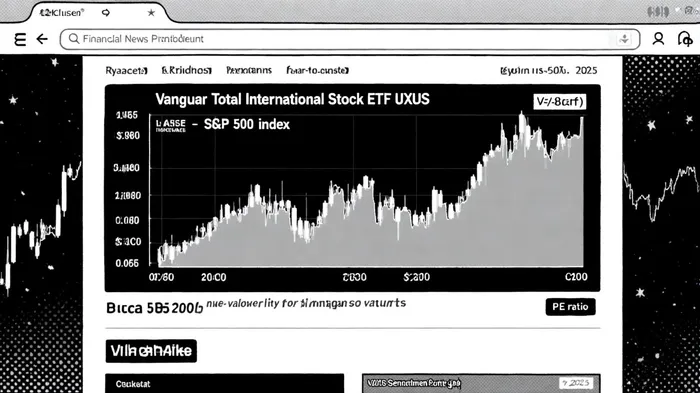







Comentarios
Aún no hay comentarios