
Intermap's $20.1M Bought Deal Offering: Strategic Capital Raise or Red Flag?
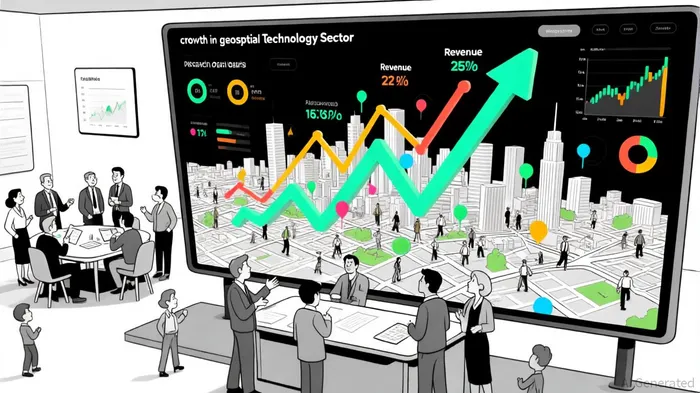
Intermap Technologies Corporation's recent $20.1 million bought deal offering has sparked debate among investors: Is this a calculated move to fuel growth in a booming geospatial technology market, or a sign of financial strain? To answer this, we must dissect the company's capital allocation strategy, its alignment with industry trends, and its competitive positioning in a sector projected to grow at a staggering 14.6% CAGR through 2030 [1].
Strategic Capital Allocation: Fueling High-Value Contracts
Intermap's $20.1 million raise, announced on September 22, 2025, follows a $12 million financing in February 2025, which was explicitly earmarked for working capital and government contract execution [3]. The latest offering—selling 6.7 million Class A shares at $3.00 apiece, with an over-allotment option—further strengthens liquidity. According to the company's Q1 2025 results, this capital will support the delivery of high-value contracts, including its role in Indonesia's $653 million World Bank-funded ILASP project and the U.S. National Geospatial-Intelligence Agency's Luno B IDIQ contract [1].
The timing is critical. Intermap reported a 153% year-over-year revenue increase in Q1 2025, driven by both government and commercial segments, and reaffirmed its full-year 2025 revenue guidance of $30–35 million with a 28% EBITDA margin [1]. This suggests the company is not merely raising capital to survive but to accelerate its pipeline of projects. For instance, its proprietary IFSAR technology—offering cost-effective, high-resolution 3D elevation data—positions it to capitalize on government contracts and commercial partnerships in insurance and space infrastructure [2].
Industry Tailwinds and Competitive Advantages
The geospatial technology market is undergoing a transformation. By 2030, the global geospatial solutions market is expected to reach $990.79 billion, driven by AI, machine learning, and 5G-enabled location services [1]. Intermap's focus on high-precision data aligns with these trends. Its partnerships with a European bank-insurance group and a global space infrastructure operator highlight its ability to monetize geospatial analytics for applications like risk modeling and radio frequency interference analysis [1].
Moreover, the company's recurring revenue model—via NEXTMap licensing—provides stability. Government contracts, such as the $2.5 million Indonesia project, further diversify its income streams [4]. This contrasts with smaller competitors reliant on volatile project-based revenue.
Red Flags? Currency Risks and Market Challenges
Despite these positives, risks persist. Intermap operates in 61 countries, exposing it to currency fluctuations and hedging costs [2]. While the World Bank's involvement in Indonesia mitigates some of these risks, the company's reliance on international contracts remains a vulnerability. Additionally, the geospatial industry faces hurdles such as high implementation costs and regulatory constraints around data privacy, which could slow adoption among small and medium enterprises [2].
However, these challenges are not unique to Intermap. The broader market's projected growth—particularly in managed analytics and consulting services—suggests demand for expertise that Intermap's IFSAR technology can fulfill [2].
Conclusion: A Calculated Bet on the Future
Intermap's $20.1 million capital raise appears to be a strategic move rather than a red flag. The funds align with its 2025 revenue guidance, support high-margin government contracts, and position the company to leverage industry tailwinds. While currency risks and market complexities exist, Intermap's proprietary technology, recurring revenue streams, and alignment with multi-billion-dollar projects provide a strong foundation for growth.







Comentarios
Aún no hay comentarios