
Interlink Electronics (LINK): A 2026 Turnaround Story in Smart Sensors and Food Safety Innovation
Financial Foundations: From Loss to Margin Expansion
Interlink's third-quarter 2025 results revealed a critical inflection point. Revenue rose 11% year-over-year to $3.0 million, driven by robust demand for force-sensing products and printed electronics from its Calman Technology subsidiary. More importantly, gross margins expanded to 41.8%, reflecting better product mix and cost discipline. While the company still reported a net loss of $336,000, this marked a 36% improvement compared to the same period in 2024.
The capital structure simplification-via the conversion of preferred stock and a 50% common stock dividend-has enhanced liquidity and shareholder alignment. As stated by management, the focus is now on leveraging these resources to scale high-margin offerings.
Strategic Leverage: SBIR Grants and AI-Driven Food Safety
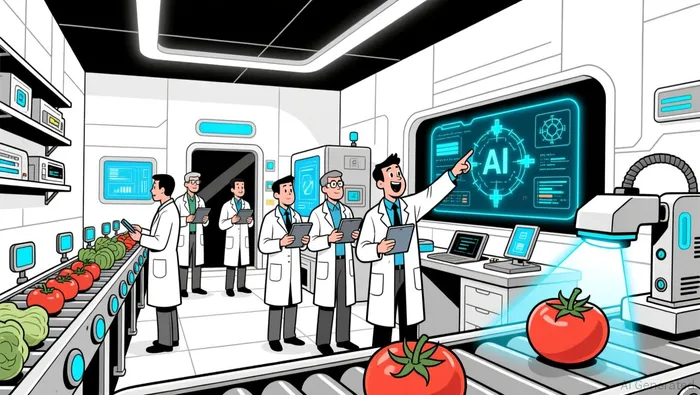
One of Interlink's most compelling initiatives is its USDA-funded SBIR grant to develop an AI-powered post-harvest food monitoring system. This system integrates electrochemical gas sensors with machine learning to detect spoilage risks in real time, addressing a $1.5 trillion global food waste problem. The Phase I grant of $175,000 is not just a cash infusion-it's a validation of the company's ability to commercialize cutting-edge solutions in a high-growth sector.
The potential for Phase II funding and subsequent commercialization is significant. If successful, this project could position Interlink as a key player in the $12.5 billion global food safety market, which is projected to grow at a 7.2% CAGR through 2030. Moreover, the gross margin of 45% reported in Q2 2025-driven by a favorable product mix-suggests that such innovations could further boost profitability.
M&A and Global Expansion: The U.K. Acquisition Play
Interlink's strategic playbook also includes a Letter of Intent for a U.K. acquisition, a move that underscores its ambition to scale beyond North America. While details remain undisclosed, the U.K. market offers access to advanced sensor manufacturing capabilities and a well-established food safety infrastructure. This acquisition, if executed, could accelerate revenue diversification and reduce reliance on volatile sectors.
The company's recent design win with a top-ten global OEM-expected to generate $1 million in FY2026-further reinforces its ability to penetrate high-margin markets. These wins, combined with the SBIR grants, create a flywheel effect: innovation attracts partnerships, which drive revenue and margins.
Risks and Realism
No turnaround story is without risks. Interlink's path to profitability hinges on the successful commercialization of its AI food safety system and the closure of the U.K. acquisition. Delays in R&D or regulatory hurdles could dampen momentum. Additionally, the company's current net loss and negative EBITDA highlight the need for continued cost management.
However, the improving financials and strategic clarity suggest that these risks are being actively mitigated. The 50% stock dividend has simplified the capital structure, and the SBIR grants reduce R&D costs while validating the company's technological edge.
Conclusion: A 2026 Catalyst Story
Interlink Electronics is no longer a speculative bet-it's a company with a clear roadmap to profitability. By combining operational improvements, government-backed innovation, and strategic M&A, LINK is positioning itself to capitalize on two of the most critical trends of the 2020s: smart sensor proliferation and AI-driven food security. For investors seeking value-driven growth in high-margin, high-demand sectors, Interlink's 2026 turnaround could be a compelling opportunity.





Comentarios
Aún no hay comentarios