
The Interconnected Risks of the AI Bubble and Cryptocurrency Volatility in 2026: Strategic Hedging in a Dual-Crisis Era
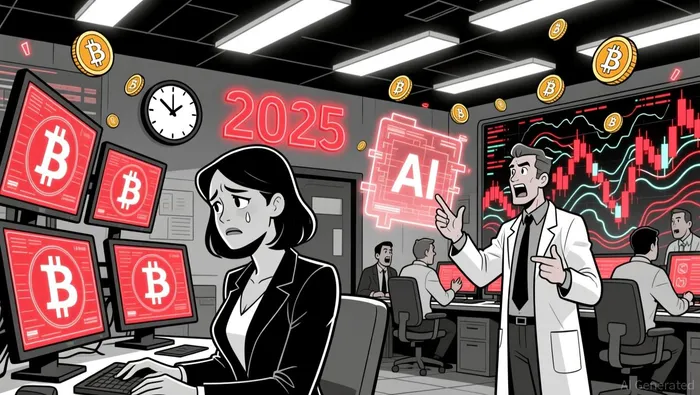
The year 2026 marks a pivotal inflection point in the convergence of artificial intelligence (AI) and cryptocurrency markets. As AI investment surges to unprecedented levels, it has created a gravitational pull on capital that has left crypto markets vulnerable to volatility and underperformance. This dynamic is not merely coincidental but structurally rooted in the bidirectional relationship between AI-driven innovation and crypto asset dynamics. For institutional investors, the challenge lies in navigating these interconnected risks while deploying sophisticated hedging strategies to preserve capital and generate alpha.
The AI-Crypto Nexus: A Tale of Two Bubbles
According to a 2025 study titled Unlocking the Investment Nexus Between Artificial Intelligence and Cryptocurrency, BitcoinBTC-- and AI markets exhibit a statistically significant co-movement across quantiles. Specifically, Bitcoin's price exerts a positive influence on AI investments in mid-to-high quantiles (0.30–0.80), while AI's growth in low-to-mid quantiles (0.15–0.60) amplifies Bitcoin's price in mid-to-upper quantiles (0.35–0.95). This interdependence reflects a feedback loop: as AI startups attract venture capital, they siphon liquidity from crypto markets, exacerbating Bitcoin's bearish trajectory. By 2025, nearly half of global venture funding had shifted to AI, leaving crypto firms starved of capital and amplifying price swings.
The rise of AI-driven trading tools further complicates this landscape. Platforms like Nansen and Elliptic Lens now integrate real-time on-chain data with predictive analytics, enabling institutions to detect market patterns and execute trades with precision. However, these tools also democratize access to sophisticated strategies, increasing systemic risk as retail and institutional players alike deploy AI to exploit inefficiencies. The result is a market where volatility is not just a byproduct of speculation but a feature of algorithmic competition.
Institutional Hedging: From Speculation to Structured Risk Management
Institutional investors are responding to these dual risks by adopting multi-strategy frameworks that blend AI-driven analytics with traditional hedging techniques. A 2026 report by highlights how large firms are leveraging quantitative models to detect cross-venue pricing inefficiencies and model on-chain behavior, enabling precise liquidity forecasts. For example, market-neutral arbitrage strategies-such as basis trading and funding rate arbitrage-allow institutions to profit from micro-level inefficiencies while insulating portfolios from broader market swings.
Regulatory clarity has also catalyzed institutional adoption. The U.S. GENIUS Act and the EU's Markets in Crypto-Assets (MiCA) framework have provided structured environments for crypto participation, reducing legal uncertainties. Stablecoins, now a core rail for cross-market fungibility, further enhance liquidity management. Institutions are also tokenizing real-world assets (RWAs), such as treasuries and real estate, to diversify portfolios and hedge against macroeconomic risks.
Case Studies in Risk Mitigation: ETFs, Derivatives, and Structured Products
The launch of U.S.-listed spot Bitcoin and EthereumETH-- ETFs in 2025 exemplifies institutional ingenuity. BlackRock's IBIT and Fidelity's FBTC attracted over $115 billion in combined assets, signaling a shift from speculative interest to strategic allocation. These ETFs provide regulated exposure to crypto, mitigating custody and compliance risks while aligning with traditional portfolio management practices.
Derivatives markets are equally transformative. Institutions now apply Bitcoin-like options strategies-such as covered calls and protective puts-to altcoins like XRPXRP-- and SolanaSOL--, generating yield and downside protection. For instance, Amplify's XRP 3% Monthly Premium Income ETF leverages covered call strategies to offer a 36% annualized yield, capitalizing on post-SEC regulatory clarity.
The Road Ahead: Balancing Growth and Diversification
While AI infrastructure spending is projected to reach $5–8 trillion by 2030, institutions must guard against overconcentration. Morgan Stanley's 2026 Hedge Fund Outlook emphasizes diversifying across strategies and regions to capture unique alpha while minimizing market beta. This approach is critical in an era where AI-driven valuations may face corrections, as seen in the 2023–2025 venture capital exodus to AI.
For crypto, the focus is shifting from speculative trading to structured integration. JPMorgan's Kinexys platform and SoFi's direct digital asset trading exemplify how institutions are embedding crypto into traditional infrastructure, enhancing operational efficiency. Meanwhile, tokenized private equity and real estate are enabling fractional ownership, broadening access to high-value assets.
Conclusion: Hedging in the Age of Convergence
The AI and crypto markets of 2026 are no longer siloed but deeply intertwined. For institutional investors, the key to resilience lies in embracing AI-driven analytics, regulatory frameworks, and structured products to hedge against volatility. As the lines between AI and crypto blurBLUR--, strategic diversification-across asset classes, geographies, and strategies-will define the winners in this dual-crisis era.





Comentarios
Aún no hay comentarios