
Interactive Brokers' Surging September DARTs Signal Broader Retail Trading Momentum
Interactive Brokers Group (IBKR) has reported a staggering 47% year-over-year increase in Daily Average Revenue Trades (DARTs) for September 2025, reaching 3.864 million trades. This surge, coupled with a 32% rise in client accounts to 4.127 million and a 39% jump in ending client margin loan balances to $77.3 billion, underscores a broader transformation in retail-driven market participation. The data reflects not just IBKR's success but also a systemic shift in how individual investors are reshaping equity markets.
The Retail Revolution: From Niche to Mainstream
Retail trading now accounts for approximately 20% of total U.S. equity volume, nearly double the level from a decade ago. This growth is fueled by accessible platforms, mobile apps, and a cultural shift toward "buy-the-dip" strategies during market corrections. For instance, during the April 2024 selloff-triggered by sweeping tariff announcements-retail investors injected $4.7 billion into equities in a single day, with half of that volume concentrated in individual stocks and ETFs. This behavior starkly contrasts with the panic selling observed during the 2020 pandemic crash, signaling a new era of retail resilience.
The rise of pre-market trading has further amplified this trend. In Q2 2024, pre-market volume hit 476 million shares, or 4% of total daily volume, as traders increasingly act on overnight news and social media trends. Platforms like Yahoo Finance, which default to price charts and sentiment-driven metrics, reinforce this focus on short-term speculation over fundamental analysis.
Implications for Brokerages: Volume vs. Profitability
Brokerages like IBKRIBKR-- face a dual challenge: capitalizing on surging trading volumes while navigating the erosion of traditional commission-based revenue. DARTs, once a proxy for commission income, now include trades that generate revenue through alternative means such as payment for order flow. For IBKR, this model has proven effective: despite the shift to commission-free trading, the firm reported a 27% year-over-year increase in commission revenue to $516 million in Q2 2025, driven by higher volumes and cost-efficient execution (1.8 basis points for U.S. Reg.-NMS stocks).
However, the profitability of each trade has declined. Subdollar securities, which accounted for 17.4% of total market volume in Q2 2024, often yield minimal margins. Brokerages must now prioritize scale and diversification-expanding product suites (e.g., IBKR's InvestMentor app and crypto offerings) and geographic reach (e.g., NISA accounts in Japan) to offset per-trade losses.
Retail-Driven Volatility: A New Market Dynamic
Retail activity has also decoupled traditional volatility metrics from market behavior. While the VIX Index (a gauge of investor fear) has trended lower in recent years, retail-driven volume spikes-such as the 4.2 billion-share surge during the 2021 meme stock frenzy-highlight a new volatility paradigm. This divergence suggests that social media sentiment and algorithmic trading tools now rival macroeconomic factors in shaping price movements.
For institutional investors, the challenge lies in adapting to this fragmented landscape. Money managers must now account for retail-driven trends in portfolio allocations, while regulators grapple with the risks of herd behavior and liquidity imbalances.
Conclusion: A Tipping Point for Retail Markets
Interactive Brokers' September DARTs surge is not an anomaly but a symptom of a deeper structural shift. As retail participation continues to rise, brokerages must innovate to balance volume growth with profitability, while markets brace for a future where individual investors wield outsized influence. For now, the data is clear: retail trading is no longer a side show-it's the main event.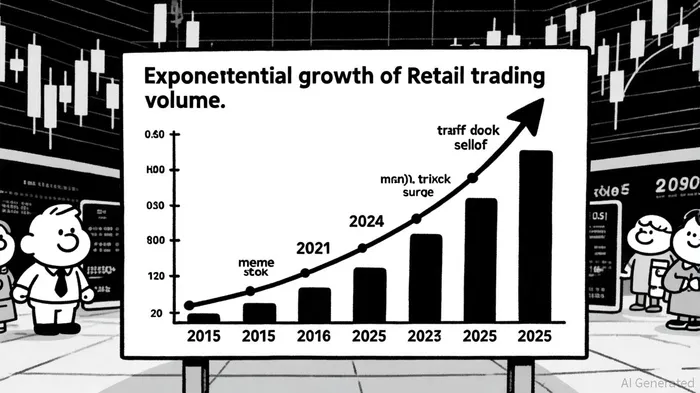







Comentarios
Aún no hay comentarios