
Interactive Brokers (IBKR): Volatility Beneficiary or Overvalued Risk?
In the ever-shifting landscape of financial markets, Interactive Brokers (IBKR) has emerged as a standout performer, leveraging rising trading volumes and geopolitical volatility to fuel record growth. But with its stock price near all-time highs and valuation metrics stretching beyond historical norms, investors must ask: Is IBKRIBKR-- a buy-the-dip opportunity or a cautionary tale of overvaluation? Let's dissect its latest results, valuation, and risks.
The Case for IBKR: Growth Machine or Geopolitical Darling?
Interactive Brokers' Q1 2025 results underscore its dominance in volatile markets. Daily Average Revenue Trades (DARTs) surged 50% year-over-year to 3.5 million, while client equity climbed 34% to $664.6 billion. These metrics are fueled by 32% annual growth in client accounts to 3.866 million, reflecting its global expansion and appeal to both retail and institutional traders.
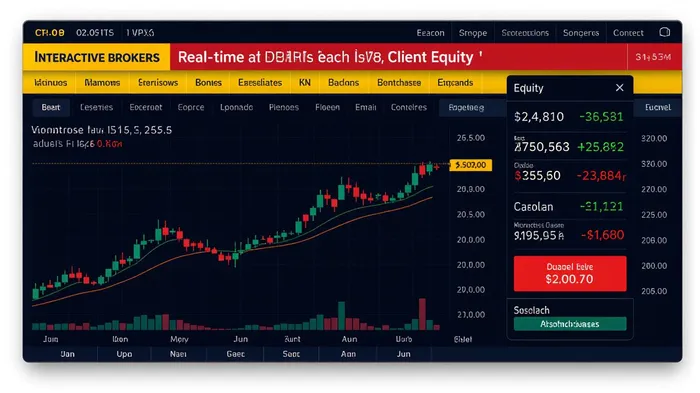
The company's commission revenue grew 36% to $514 million, driven by soaring stock and options trading volumes. Even net interest income—traditionally a stable cash cow—held steady at $770 million, despite lower benchmark rates. With adjusted pretax margins at 74%, IBKR's profitability remains industry-leading, even as it invests in new tools like its PEA Classique accounts and enhanced IBKR Desktop platform.
Valuation: Stretching Toward Overheated Territory?
IBKR's P/E ratio of 32.74 (as of Feb 2025) sits 36% above its 13-year median of 24.16, signaling investor optimism about future growth. While its forward P/E of 26.37 offers some comfort, the stock's valuation now rivals its 5-year high, even as revenue growth slows to 18.6% in Q1 2025 from prior torridCURV-- paces.
The Price-to-Book (P/B) ratio adds complexity. While the TTM P/B of 4.06x suggests premium pricing, conflicting reports of a 10.3956 P/B (likely due to differing calculation periods) highlight potential red flags. For context, the broader financial sector trades at an average P_
Growth Sustainability: Can the Rally Continue?
IBKR's growth hinges on two pillars: geopolitical volatility and international expansion. Rising interest in crypto and global equities has driven开户 growth, but here's the catch:
- Crypto Headwinds: Despite its crypto-friendly platform, trading volumes here have lagged expectations, a potential drag on future revenue.
- Margin Loan Declines: Client margin loans fell 12% in volatile markets, hinting at over-leverage risks if markets correct.
- Regulatory Uncertainty: New rules on trading fees and margin policies could compress margins, even as IBKR navigates cross-border regulations.
Risks: Overvalued or Overexposed?
- Valuation Squeeze: A P/E of 32.74 assumes EPS growth of 8.7% annually, but if geopolitical calm reduces trading activity, earnings could disappoint.
- Competitive Pressure: Rivals like Fidelity and E*TRADE are slashing fees, while fintech upstarts target millennials.
- Balance Sheet Risk: While client credit balances hit $143.7 billion, insured deposits (only $5.8 billion) leave much uninsured—a regulatory concern.
Investment Takeaway: Proceed with Caution
For aggressive traders, the stock's volatility-linked upside remains supported by historical performance. A backtest of a strategy that bought IBKR shares after positive quarterly earnings announcements with DARTs growth exceeding 30% year-over-year, and held them for 20 trading days, generated an impressive 168.23% return from 2020 to 2025, outperforming the benchmark with a 19.93% compound annual growth rate (CAGR). However, the strategy also faced a maximum drawdown of 25.99%, underscoring the need for disciplined risk management. This suggests that while the strategy can yield strong returns in favorable conditions, investors must remain vigilant to market corrections.
IBKR's $0.32 quarterly dividend and stock split signal confidence, but investors should weigh the risks. A neutral stance makes sense until growth reaccelerates or geopolitical tailwinds sustain trading frenzy.
Final Verdict: Hold for now. IBKR's fundamentals are strong, but its valuation demands flawless execution. Investors should set strict price targets and monitor DART trends closely. In choppy markets, this is a stock to own—but not to overown.
Disclosure: The analysis is based on publicly available data. Past performance does not guarantee future results.





Comentarios
Aún no hay comentarios