
NEAR Intents and the Future of Cross-Chain Composability
The Case for Chain Abstraction: Solving the Fragmentation Problem
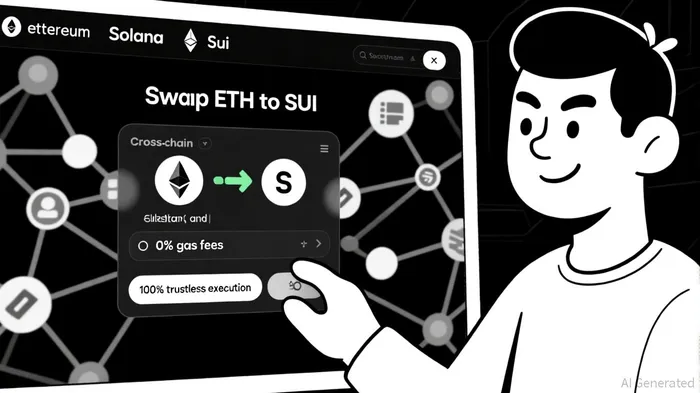
Chain abstraction simplifies cross-chain interactions by abstracting away the technical intricacies of blockchain infrastructure. Instead of requiring users to manually execute multi-step transactions across disparate chains, chain-abstraction platforms like NEAR Intents allow users to define intent-based outcomes-such as swapping tokens or transferring assets-while automated systems handle routing, execution, and settlement.
The market is already responding. Bridging volume hit $17.3 billion in May 2025, and projects like Particle Network have seen 110,900 Universal Account users in Q1 2025. NEAR's approach, however, goes further. Its three-stage model-Express, Solve, and Settle-enables users to sign a payload specifying their desired outcome, after which solvers (automated agents) compete to create the most efficient execution plan. Transactions are then co-signed by Chain Signatures validators and finalized in 2–3 seconds. This eliminates the need for bridges, wrapping tokens, or third-party intermediaries, reducing both time and cost.
NEAR's Competitive Edge: Technical Innovation and Ecosystem Growth
NEAR's dominance in chain abstraction is underpinned by its technical architecture and ecosystem momentum. Unlike Polkadot's parachain model (which requires costly slot auctions) or Cosmos' IBC protocol (which prioritizes chain independence), NEAR's Nightshade sharding and chain signatures enable high throughput (100,000+ TPS) and seamless cross-chain execution, as noted in the NEAR Protocol 2025 Review. By 2025, NEAR had achieved 314,556 daily active addresses and 4.6 million daily transactions, with NEAR Intents processing $1.3 billion in volume and 3 million swaps, according to Nansen's NEAR Quarterly Report.
The platform's gas abstraction and account aggregation features further enhance usability. Users can manage assets across chains with a single address, pay gas fees in USDCUSDC--, and interact with DeFi protocols without switching networks, as detailed in a Reflexivity report. This is a stark contrast to the current status quo, where 50% of the top 10 chains are incompatible, according to the Web3 Fragmentation Report. NEAR's partnerships with EigenlayerEIGEN--, Binance Labs, and SuiSUI--, as reported by The Block, also validate its ecosystem appeal, while its integration of Zero-Knowledge (ZK) proofs and zkWASM bolsters security and privacy.
Long-Term Value Capture: Tokenomics and Institutional Confidence
NEAR's tokenomics are designed to incentivize long-term value capture. The protocol has halved its annual inflation rate from 5% to 2.5%, with gas-fee burns and revenue from product integrations (e.g., NEAR Intents) creating a deflationary path, as argued in a Medium analysis. Staking rewards of 10.57% APY, per a staking guide, attract institutional and retail investors, while governance proposals like HSP-002 and HSP-003 align validator and community incentives.
Institutional confidence is growing. Grayscale's inclusion of NEAR in its Decentralized AI Fund, according to a Yahoo Finance piece, and Binance Labs' investments in chain-abstraction projects signal broader adoption. Analysts project NEAR's price could reach $10.82 (a 315% upside) if its chain-abstraction model scales, while conservative estimates suggest $5 by year-end and $20 by 2026.
Real-World Applications: From DeFi to AI-Native Protocols
NEAR's chain-abstraction capabilities are already driving real-world impact. DapDap streamlines onboarding across Web3, while Allstake enables restaking on all chains using chain signatures. In DeFi, NEAR's cross-chain swaps allow users to access liquidity pools on Sui, Ethereum, and SolanaSOL-- via direct cross-chain swaps. AI-native applications are also emerging: PublicAI's data marketplace and RHEA Finance's DeFi solutions leverage NEAR Intents to abstract away blockchain complexity.
Conclusion: A Disruptive Force in Crypto
Chain abstraction is not just a buzzword-it's a necessity for mainstream adoption. NEAR Protocol's NEAR Intents platform addresses the core pain points of cross-chain interactions, offering a scalable, user-friendly solution. With 52 million monthly active addresses, a deflationary token model, and institutional backing, NEAR is poised to capture long-term value as the blockchain ecosystem evolves. For investors, the question is no longer if chain abstraction will matter, but how much NEAR will dominate the space.






Comentarios
Aún no hay comentarios