
Intel's Strategic Turnaround: Can Panther Lake and the Nvidia Partnership Drive Sustained Growth?
Intel's recent strategic moves-centered on the launch of its Panther Lake processor and a landmark partnership with Nvidia-have reignited investor optimism about the chipmaker's long-term trajectory. After years of financial turbulence and manufacturing delays, the company appears to be pivoting toward a future defined by AI-driven innovation and collaborative ecosystem-building. This analysis evaluates whether these catalysts can translate into durable value creation for shareholders.
Panther Lake: A Technological Leap with Market Implications
Intel's Panther Lake (Core Ultra Series 3) represents a significant step forward in the company's roadmap. Built on the 18A node with gate-all-around (GAA) transistors and PowerVia power delivery, the architecture promises a 50% boost in multi-threaded performance and 10% improvement in single-threaded performance compared to Lunar Lake, all while maintaining similar power efficiency. The integration of up to 12 Xe3 GPU cores and XeSS 3 upscaling technology positions Panther Lake as a direct competitor to AMD's Ryzen AI and Intel's own previous-gen offerings in the high-performance laptop segment.
Critically, Panther Lake's AI capabilities-50 TOPS of NPU performance and a combined CPU/GPU AI throughput of 170 TOPS- align with the growing demand for on-device AI in consumer and enterprise applications. As stated by IntelINTC-- in its press release, this architecture is designed to "redefine the boundaries of what's possible" in thin-and-light form factors. With systems launching in late January 2026, the timing coincides with a key holiday shopping window, potentially accelerating adoption.
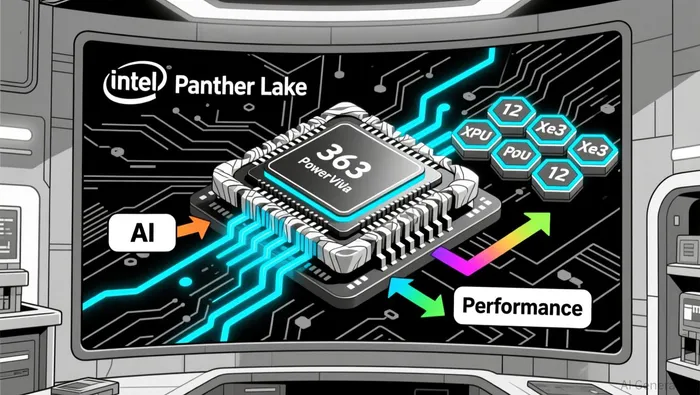
However, success hinges on execution. While Intel claims Panther Lake will deliver "76% faster gaming performance" than prior generations, real-world benchmarks and OEM partnerships will determine whether this translates to market share gains. The company's ability to scale 18A production without the delays that plagued its 7A node will be a critical test of its manufacturing revival.
The Nvidia Partnership: Strategic Synergy or Short-Term Fix?
Intel's $5 billion collaboration with Nvidia-marked by a $5 billion equity investment and co-development of custom x86 CPUs with NVLink interconnects-signals a shift toward ecosystem-driven growth. By integrating Nvidia's RTX GPU chiplets into x86 SoCs, Intel aims to create a new class of high-performance PCs that combine its CPU expertise with Nvidia's AI and graphics leadership. This partnership also extends to data centers, where Intel's CPUs will power Nvidia's AI platforms, leveraging NVLink to reduce latency and improve workload efficiency.
The financial terms alone are noteworthy. Nvidia's investment at $23.28 per share (valuing Intel at ~$150 billion) suggests confidence in the company's long-term potential, particularly as AI infrastructure demand surges. For Intel, the partnership mitigates risks associated with standalone R&D in AI accelerators, while also securing a steady revenue stream from data center contracts. Analysts at Omdia note this could "reshape the competitive landscape," challenging AMD's Zen 5 AI chips and Apple's M4 MacBooks.
Yet, the partnership's success depends on execution. Intel must ensure its 18A node can reliably produce the custom SoCs, while Nvidia's RTX chiplets must deliver performance that justifies the added complexity. Additionally, the collaboration could face regulatory scrutiny, particularly in markets where antitrust concerns are already heightened by Intel's government-backed funding deals.
Financial Resilience and Analyst Sentiment
Intel's third-quarter 2025 results ($13.7 billion revenue, up 3% YoY) underscore its improving financial health, driven by asset sales (Altera, Mobileye) and cost discipline. The $5 billion NvidiaNVDA-- investment, coupled with $8.9 billion in U.S. government funding and a $2 billion SoftBank stake, has strengthened its balance sheet, enabling reinvestment in R&D and manufacturing.
Analysts are cautiously optimistic. Following the Panther Lake and Nvidia announcements, several firms raised Intel's price targets, with Yahoo Finance reporting that "renewed confidence in AI execution" has repositioned Intel as a growth story. However, fourth-quarter revenue guidance ($12.8–$13.8 billion) reflects a modest growth rate, highlighting the need for Panther Lake to exceed expectations to justify elevated valuations.
Long-Term Value Creation: Catalysts and Risks
The combined impact of Panther Lake and the Nvidia partnership could catalyze Intel's reentry into growth markets. By 2026, the company aims to capture a larger share of the AI PC and data center segments, leveraging its 18A node and strategic alliances. However, risks remain:- Competition: AMD's Ryzen AI 300 series and Apple's M4 MacBooks could erode Intel's consumer market share.- Execution Gaps: Delays in 18A production or subpar Panther Lake performance could stall momentum.- Market Saturation: The AI PC market may face oversupply risks if demand growth slows.
Nonetheless, Intel's dual focus on cutting-edge silicon and ecosystem partnerships-particularly with Nvidia-positions it to capitalize on the AI-first computing era. For investors, the key question is whether these moves can sustainably outpace AMD's Zen 5 roadmap and Apple's Arm-based dominance.
Conclusion
Intel's Panther Lake and Nvidia collaboration represent a pivotal inflection point. The former addresses the company's historical weakness in performance-per-watt, while the latter secures access to Nvidia's AI ecosystem-a critical asset in the post-PC era. While challenges persist, the alignment of technological innovation, financial strength, and strategic partnerships suggests that Intel is laying the groundwork for a durable turnaround. For long-term investors, the coming months will test whether this strategy can translate into sustained value creation.





Comentarios
Aún no hay comentarios