
Intel's Strategic Missteps and Competitive Erosion: A Foundry and AI Market Analysis
In the high-stakes arena of semiconductor manufacturing and AI hardware, Intel's recent performance underscores a painful reality: strategic misalignment and competitive erosion are eroding its market position. Despite aggressive pivots under CEO Lip-Bu Tan, the company's foundry and AI initiatives remain mired in operational and financial challenges, raising questions about its ability to reclaim relevance in a rapidly evolving industry.
Foundry Ambitions: A Tale of Promises and Pitfalls
Intel's foundry business, once envisioned as a cornerstone of its "IDM 2.0" strategy, has struggled to gain traction. While Q2 2025 revenue reached $4.4 billion-a 3% year-over-year increase-this growth masked a staggering $3.17 billion operating loss and a $441 million adjusted net loss, according to Intel's Q2 2025 financial report. The company's market share in the semiconductor industry stands at 14.62%, trailing TSMC's 64.9% and Samsung's 9.3%, according to a MarketMinute article. Intel's 18A process node, touted as a breakthrough in advanced manufacturing, is now delayed to late 2025, while its 14A roadmap hinges on securing external customers-a goal that remains unmet, as noted in an AI Business analysis.
The disconnect between Intel's ambitions and market realities is stark. The company has canceled foundry projects in Germany and Poland, consolidated operations in Vietnam and Malaysia, and slowed construction of its Ohio facility, according to a GM Insights report. These moves reflect a shift from speculative capacity expansion to demand-driven production, but they also highlight a lack of confidence in its ability to attract major clients. As one analyst notes in a MarketBeat analysis, "Intel's foundry strategy has been a case of overbuilding without underpinning demand."
AI Market: A Late and Fragmented Entry
In the AI sector, Intel's challenges are equally pronounced. While its Gaudi 3 accelerator aims to undercut Nvidia's H100 by 50%, the company lags in revenue and ecosystem maturity. According to a report by Forbes, Intel's AI revenue remains a fraction of Nvidia's, which dominates both training and inference markets. The partnership with Nvidia to adopt NVLINK protocols-a move signaling a strategic retreat from direct competition-further illustrates Intel's recalibration toward edge computing and x86 integration.
Compounding these issues is Intel's fragmented product portfolio. The delayed Panther Lake 18A processor and reliance on older IntelINTC-- 7 processes have ceded ground to rivals like AMD, whose Instinct MI325X and CDNA 4 architecture promise 35x AI inference performance improvements. Meanwhile, Intel's full-stack AI strategy-encompassing hardware, software, and secure enclaves-remains unproven, with internal teams admitting a lack of cohesion.
Competitive Erosion: A Global Race for Dominance
The foundry and AI markets are witnessing a seismic shift, with TSMCTSM--, Samsung, and emerging players like Japan's Rapidus intensifying their investments. TSMC's 2nm node and 67.6% market share in Q1 2025 underscore its unassailable lead, while Rapidus' government-backed 2nm trial production in 2025 threatens to disrupt the status quo. Intel's response-prioritizing 18A for internal use and pivoting to high-margin services like design tooling-positions it as a niche player rather than a challenger.
Geopolitical factors further complicate Intel's trajectory. U.S.-China trade tensions and the rise of "chip sovereignty" initiatives in Europe and Asia are reshaping supply chains, yet Intel's capital expenditures have been scaled back. This hesitancy contrasts with South Korea's $20 trillion "Korean TSMC" initiative, which aims to capture 300 trillion won in economic output by 2045.
Strategic Misalignment: The Cost of Hesitation
Intel's struggles stem from a fundamental misalignment between its strategic priorities and market demands. The company's $75,000 workforce reduction and $3 billion in operating losses reflect a desperate attempt to streamline operations, but these measures risk stifling innovation. For instance, the cancellation of 14A projects without confirmed customer commitments signals a lack of confidence in its roadmap.
Moreover, Intel's focus on AI inference-a market projected to grow at 35% CAGR through 2030-arrives late to a space already dominated by Nvidia's Rubin platform (launching in 2026) and AMD's aggressive pricing. While Intel's SGX v4 attestation and platform model offer differentiation in regulated industries, these advantages are insufficient to offset its broader execution risks.
Conclusion: A Path Forward?
For Intel, the path to recovery hinges on three critical factors: securing external foundry customers for its 14A and 18A nodes, accelerating AI inference adoption, and aligning its cost structure with market realities. The company's recent partnerships with Microsoft and SK hynix provide glimmers of hope, but these relationships must translate into tangible revenue.
Investors should remain cautious. While Intel's foundry and AI strategies align with long-term trends like edge computing and chip sovereignty, the company's operational delays, financial drag, and competitive pressures suggest a prolonged turnaround. As one industry observer aptly put it, "Intel's story is one of potential, but execution remains its greatest enemy."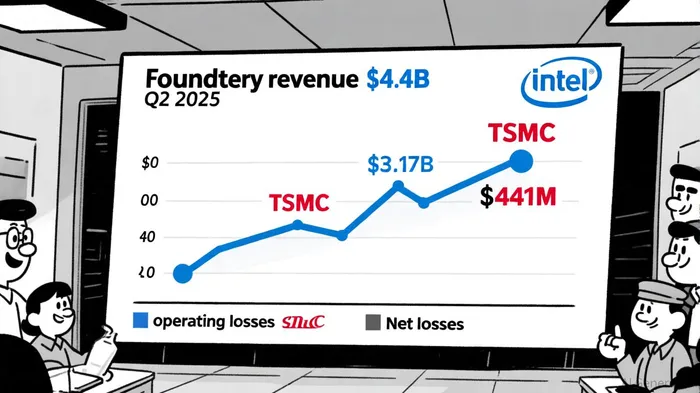





Comentarios
Aún no hay comentarios